
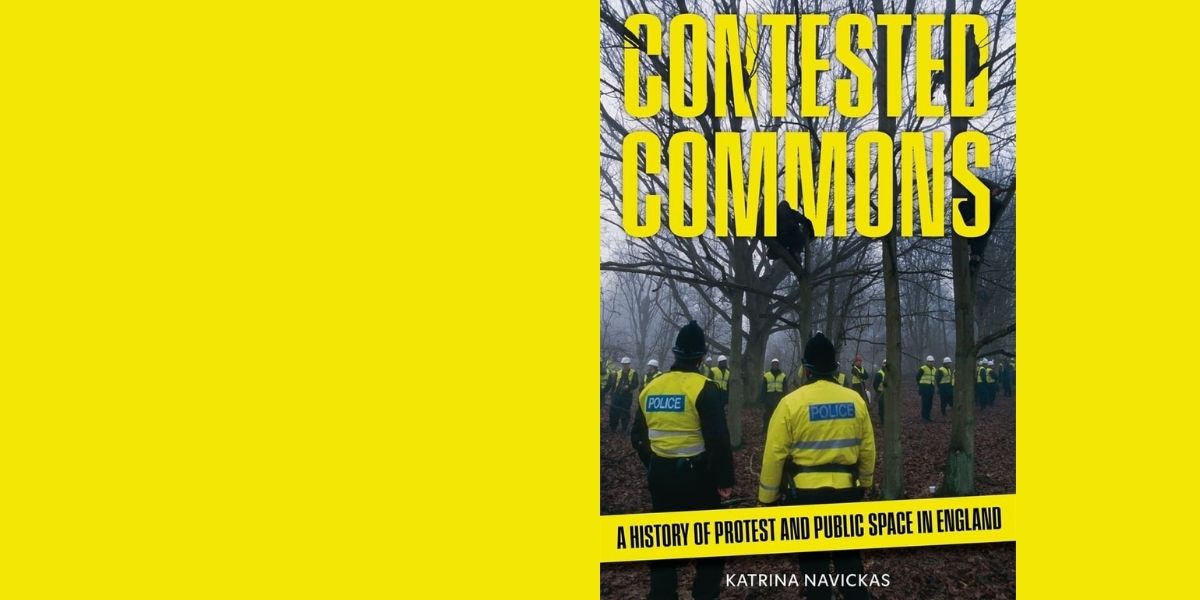
Title: Contested Commons: A History of Protest and Public Space in England
Author: Katrina Navickas
Publisher: Reaktion Books
Year: 2026
Amid ever more repressive restrictions on public protest in the UK, Contested Commons makes it clear how much ground we have lost. The book begins in the shadow of the pandemic and lockdown, a moment that starkly exposed inequalities in access to private space and the restrictions on the use of public space for those without it.
Exploring competing claims and struggles over the use and occupation of public space and land in England – a story in which mass popular protest plays a decisive part – historian Katrina Navickas brings a breadth of specialist knowledge, coupled with deep archival research, to bear on still-relevant issues.
History and locality
Early chapters cover the 19thcentury acceleration of the enclosure schemes that accompanied and fuelled the Industrial Revolution, first in rural then in urban England. Begun as early as the 1400s with the purchase of lands from the Crown by wealthy landowners, enclosure is a broad and ongoing process. Navickas notes its persistence even today in the guise of gentrification and the rise of pseudo-public spaces controlled by private developers.
While the enforcement of enclosed spaces is encountered materially via policing, fences and keep-out signs, it begins with legislation, from the 1723 ‘Black Act’ which applied the death penalty to poaching on common land, through the multitude of private bills bought by Victorian landowners to enclose land for private enrichment, to the restrictions on public gatherings of the 1994 Criminal Justice Act. In opposition, Navickas makes clear that enclosure has been consistently challenged and countered by ‘commoning’ – the process of claiming public land ‘for the people’, asserting an alternative ideal or mythos that challenges private ownership.
Contested Commons shows how the ideal of ‘the commons’ was fashioned from a chaos of customary rights to manorial wastes, quasi-legal uses of common land, and local rights to ‘air and recreation’ on village greens or to political assemblies in Victorian ‘people’s parks’. The claim to use of the commons was then embodied in the form of marches, occupations, mass trespasses and sit-ins, as well as smaller acts of defiance.
Navickas traces this process from the Land Plans of Thomas Spence and the Chartists, through the Hunger Marches of the 1930s and the 1990s’ anti-roads protests and free festivals, to the era of the resonantly named Occupy movement. Although much of this is well-trodden ground for historians, Contested Commons brings the past to life by linking it to present struggles.
The book’s style is clear and persuasive, explaining without simplifying the often complex legislative or bureaucratic tangles it unravels. Its thematic threads are connected to a more expansive network, as the history of enclosure is tied to private property and wealth accumulation, industrial capitalism and colonial exploitation.

A monthly dose of our best articles direct to your inbox
Within these sweeping themes, the book is attentive to local and small-scale contestations, often spontaneous one-offs but sometimes persistently pursued and organised over years or decades. These are shown to be as significant as better-known cases like the mass demonstrations for democratic reform of the early 19th century or the ‘mass trespass’ on Kinder Scout in 1932.
Navickas adopts Doreen Massey’s concept of such local protests as place-based but not place-bound, to argue for their usefulness for wider solidarity which connects the local, national and global. Place and locality is a strength of the book, and although its scope is limited to England its case studies could inspire local research and stories far beyond.
Contested publics
As the book shows, attempts to uphold the right to public space can stem from abstract principles, but are often based in practical demands: the right to glean or poach for sustenance; to hold political meetings or rallies; to exist free from police hostility or from provocation and threats by the far right. The concept of ‘public space’, like that of ‘the public’ itself, is constrained by class, race and gender; marginalised and minoritised communities have had to fight for their visibility and inclusion in both.
Historical examples of restrictive regulations often imagined other ‘respectable’ publics, apparently at risk of disruption from the noise or actions of protesters or simply the presence of working-class or Black youth. More recent policing and legislation like the Criminal Justice Act – spurred on by 1990s moral panics – lumped together all those regarded as ‘out of place’ in public spaces, whether ravers, Travellers or environmental protesters.
Against this, Navickas explores the examples of suffrage campaigners whose marches and rallies claimed space for women as citizens in a masculine public realm; protests against ‘colour bars’ in pubs and other spaces in the 1950s; and the carnivals instituted by Commonwealth migrant communities in response to racism and far-right agitation.
The history of enclosure is tied to private property and wealth accumulation, industrial capitalism and colonial exploitation
The far right’s growing public presence today, from ‘Unite the Kingdom’ marches to anti-migrant riots, reminds us that the right to public space can be utilised by reactionary as well as progressive and radical forces, something Contested Commons doesn’t ignore. Its discussion of Britain’s lineage of fascist assemblies notes the importance of public counter-demonstrations, disruption and obstruction by anti-fascists, examining the Battle of Cable Street as an intensified ‘defence of territory and the urban commons’ in London’s East End in which Jewish communities and leftwing protesters continued to assert their own right to the public arena.
Ironically notable in this discussion is the government’s resultant debates on public order legislation, which often show a higher concern with balancing greater police powers with the protection of civil liberties than is the case today.
Sobering conclusions
The book’s narrative is sometimes sobering. The recency of an established right to assembly is perhaps surprising – passed only in 1998 as part of Westminster’s acceptance of the Human Rights Act – and there is still no general right to roam in English law. Progress has been piecemeal, with small and specific victories often the result of individual or group tenacity, gradually establishing rights which are nonetheless continually threatened and undermined.
As Navickas notes in her conclusion, the step forward of the Human Rights Act was followed by a rapid clampdown on public protest, which is still ongoing. We might also reflect on how online space is now being colonised, privatised and policed, and even the occupation of cultural space questioned for certain ideas.
There is an urgent need to reclaim this ground and Contested Commons, a history strongly rooted in the present, both asserts this and provides examples from our past of how it might be done.
