
Siobhán McGuirk
Can you give us a temperature check from inside the movement for migrant justice?
Zrinka Bralo
As far-right marches have increased, there’s been a visible shift in the sense of urgency for people to start organising and thinking about what might happen next. Shabana Mahmood’s policy announcements were really scary, because that was the government’s response. Put those two things together and there is a lot of fear among organisers, who are also dealing with the daily reality of deportations, raids and violent shows of immigration control.
It’s no coincidence that they’re called ICE [Immigration and Customs Enforcement] here as well. We can see where it’s all going. We’re on a three-year clock. We’ll see what happens in the local elections, but if the far right wins and becomes stronger, institutions will fold – they’re already being gutted from the inside – then grassroots organisations will disappear. Let’s say a catastrophe happens. The last line of resistance will be mutual aid-based, organised communities – people who trust each other. It’s not going to be online, that can be easily shut down. Best-case scenario: some progressive force wins. That’s great. We have a party, then we sleep with one eye open to keep it accountable. The reality? We need to get our act together and work hard to stop catastrophe from happening.
SM
It seems like this urgency has taken people by surprise, why do you think that is?
ZB
I saw my country, Yugoslavia, dismantle itself in a very short period of time, through fear and ideologues, because a lot of smart people were disconnected. We didn’t have social media, but we were very individualised, looking towards Europe, thinking: ‘The Berlin Wall came down; the Czech Republic and Slovakia separated peacefully; the Soviet Union came to an end. We’ll be fine.’ If you don’t have your ear to the ground, you really don’t know what’s going on.
The right start, operate and end with feelings of fear and anger. Their agenda
is hit-and-run, whereas we want to do the work of transforming our communities
In the UK, there was a feeling that racism had been dealt with in the 90s, which was co-opted by New Labour. It’s daunting now because people have lost the muscle for organising, even though they know what needs to happen. It’s been partly destroyed by focusing online or on mobilisations. So there’s a march, we rent the bus and come to London, but what happens the next day? Don’t get me wrong, demos are really important, but they can also end up small, depressing and unsafe.
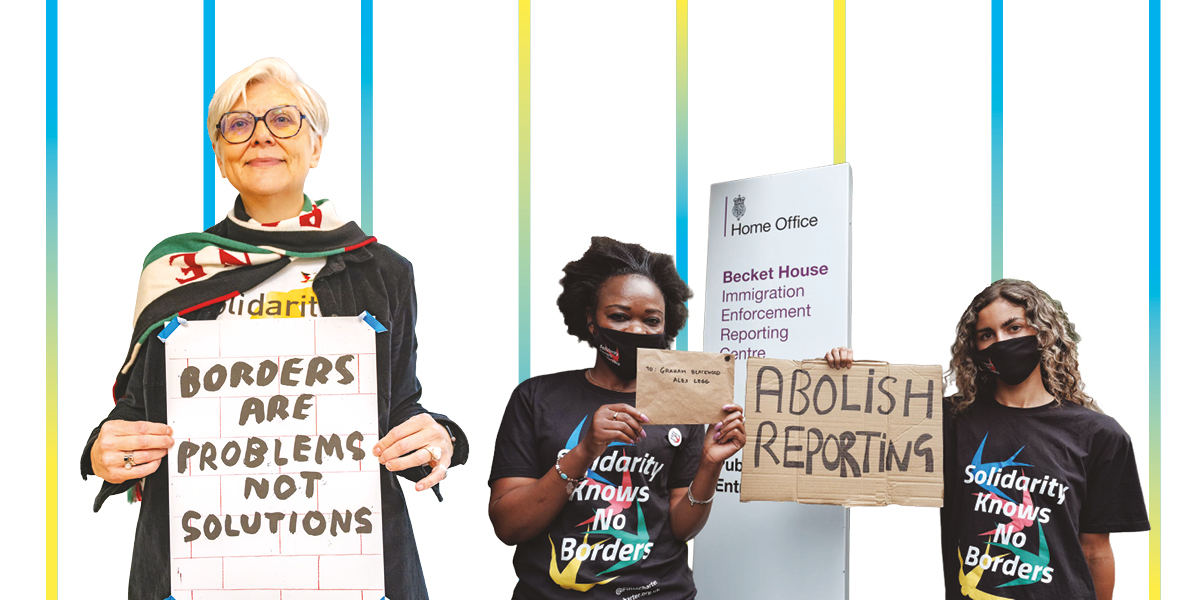
We need physical spaces where communities can come together. Our Solidarity Knows No Borders community (SKNB) has that, because we’ve been working at it for ten years. Recently I attended an anti-racist movement coalition meeting with over 80 people from around the country. That’s exciting, but there’s still lots of work to do. It’s a forever fight.
SM
How does Migrants Organise / SKNB approach this work?
ZB
We provide direct support, run campaigns, do research and fundraising, but our guiding principle is always organising, asking: How do I build power today? We’re flexible. Whatever works for people who want to address needs in their community – and are thinking about why those needs exist – whatever stage they’re at. We might be here today with ten people cooking lunch, learning English, but what’s going to happen in three years, ten years? What do we need to do now to get there together?
Our work is political work. We recognise that organisations are set up in a way designed structurally to strip us of any political framing, understanding, analysis and power. We know that what is happening to us is happening because we have no power. So the first step is to build power by being in intentional relationships of trust. We ask: who’s missing around the table; what infrastructure and platform do they need? We don’t do ‘lived experience advisory groups’ – people at the sharp end of the system do not just advise, they design and take action. We start digging, mapping, asking: who has the power to make change? Who do we know? How do we get to them? We start where people are at, and they grow their power at their own pace. That’s how you build power.
Not everyone is up for organising and that’s fine. We calculate that ten per cent of people might want to organise with us, but that cascades. We ask people to bring someone new to our next meeting. They have to prepare them – have a one-to- one so their person knows what we do, what the meeting is about. That can be taxing, but that’s how transformational organising and distributive leadership work.
SM
SKNB Summits are always invigorating and informed, supporting so many local, grassroots-led campaigns through mutual aid. Why don’t more migrants’ rights groups – whether liberal or radical – embrace a similar approach?
ZB
The challenge is that work doesn’t look like it’s addressing urgent needs. It’s very process-driven and takes time. You can’t build trust just like that – listening takes a long time. It’s a perpetual conversation and analysis while looking for opportunities to do things. It can feel quite nebulous, but then suddenly you’re ready to act, because you’ve been building that muscle.
The charity world framing is: ‘Britain has a long tradition of welcoming refugees. We just need to raise awareness. People are kind.’ While true for some, when our people show up in those spaces – people who are not allowed to work, who live in destitution, but are standing up and fighting for their communities – their experience is completely erased. Unless structural and systemic realities are recognised, and efforts made to bring our people in as the guiding lights, we’re not going to find solutions. A consistent failure is groups thinking, ‘We’ll deliver training and have a planning session’, and that’s it. Organising is for life. It is transformational. It’s what keeps my sanity: these are my people, and that’s what makes me feel safe.
That’s not to say we don’t need allies. We do. There is a new awareness among colleagues – in think tanks, academia, community and voluntary organisations – that there is space for everyone. Space for mobilising, for direct support, for cooking together. The struggle is having the capacity to move into organising; it’s not a lack of understanding the issues or need for it. The far right has that capacity. The shift that has happened in the last couple of years is the money being pumped into their movement and infrastructure.
SM
The far-right ‘investment’ in local organising seems painfully underestimated. Lots of debate on the left has focused on ‘matching’ or opposing far-right voices online, overlooking the offline work done in pubs, churches, cafes…
ZB
Absolutely. They’ve adopted the choreography of community organising, bringing people together – at least that’s what it looks like to the uninformed person who is angry, or had to live through austerity and can’t pay the Christmas gas bill. They’re not going to research why asylum seekers are in hotels and all the private profit-making behind it.
The right start, operate and end with feelings of fear and anger. Their agenda is hit-and-run, whereas we want to do the work of transforming our communities. Our entire theory of change is different. If I want to work with you and build trust, Twitter is of no use to me, because you are not the kind of person who’s going to be on Twitter. You’re at your local food bank, church, mosque. Ten good connections with people who are up for doing something together is more valuable than a thousand ‘likes’.
SM
Is there a tension between that slower work of building power and responding to the urgency of the moment? Anti-raids call-outs can be so powerful – as we famously saw in Scotland – but also lead well-meaning people to rush in…
ZB
You need to have somebody inside a hotel, organising and talking to people, otherwise a group of people shouting outside look and sound like the far right. That’s the relationship we have: residents come to our English class; we go to hotels. You have to show up in spaces like that. The hotels are an extension of the politics of dispersal, intentionally isolating people from community. The most radical thing you can do is to break that isolation. That’s your resistance. The system wants people to be isolated from society – not to work, volunteer, earn money; be in contained spaces. You break that by inviting people into community.
SM
Where are the trade unions in this fight?
ZB
We’ve had conversations with different trade unions about solidarity actions, but there is a lack of capacity on both sides. Conversations get drowned
out by the day-to-day. In some professions, 70 per cent of workers are migrants. They’re doing great
work organising, winning better conditions against employers, but it’s focused on workers’ rights because that’s their skill set and agenda. Workers
also need to feel safe in order to organise, but there is almost no immigration advice available, so the
union would need to pay for it, which can look like a ‘special’ service. Resentment can quickly creep in, because of the scarcity narrative. Our challenge is meeting migrant workers’ needs in order to organise.
The hostile environment already borders people in employment, and is just ramping it up. Spousal visas, how much you need to earn before you can bring your family, healthcare levies – that stuff is overwhelming in a general situation where wages are low and conditions are terrible. Another challenge is that each big trade union has a different relationship with the Labour Party – which wants to be ‘tough on immigration’. We’re not privy to those conversations.
SM
Language like ‘tough on immigration’ very effectively frames migrants as a problem, associated with crime, justifiably facing harsh treatment. How do we challenge these normalised terms, in the media and in organising?
ZB
It is a massive challenge. I used to be a radio journalist, where language is really important – how quickly you can sum things up clearly. It’s not just what you say, it’s what people hear. When I talk about abolitionism, for example, I go into ‘show don’t tell’ mode, because I never know what people’s understanding will be.
It’s the same with ‘no borders’. People immediately think, ‘Oh, you want complete chaos and lack of control?’ But you can talk about how borders function and for whom. You can say: ‘450 million people across the EU don’t have borders.’ The challenge is finding ways of communicating so that people hear you. That means trying to relate to their experiences, so you have to really listen first. That is hard for us in migrant justice spaces, because we’re exhausted. But if we use words for the sake of changing the language, or if we’re prescriptive about it, it’s not going to filter into day-to-day usage. It’s about building our language into relational narratives.
SM
A lot of people are anxious about the far right, racism, xenophobia in their communities. Some feel powerless. How can they help build power across movements for justice?
ZB
A Bosnian wisdom is ‘problem shared, problem halved’. It exists in every language. Seek out something local and small. If it doesn’t already exist, set it up. Find people in safe ways, among your friends, on your local estate, book club, gardening club, synagogue, wherever your people are. Start working alongside other people. Feeling overwhelmed is normal; what sustains us is our collective actions, not individual heroics. Nobody needs saving. People need others to be in the struggle with them. So find your people and stay together. That’s going to be transformational. Then there are bigger groups and places to go and plug into once you have an idea what’s happening.
SKNB is for grassroots migrant and refugee organisers with the only condition that you’re a group of people organising for migrant justice, whatever that might look like. We have 80 hubs around the country, where we think, organise and learn together. We listen to each other, which is the most important thing. Sometimes that’s difficult, but it helps our resilience, helps us know that there are people out there on our side in a very serious way. I have their names. I have their phone numbers.
In the second world war, my family fought in guerrilla partisan wars against the most powerful army in the world. As I grow older, I’m increasingly thinking: ‘How did they live in the forest for four years? Not even having camping gear, carrying out eight revolutionary offensives, fighting Nazis and setting up a socialist republic?’ We can learn from organised movements of people who believed in and fought for a world without oppression and fascism, not very long ago. We need to remember that this didn’t come out of nowhere.
Mariame Kaba says: ‘I’m on a 500-year clock. I’m here acting in the world today, but it took 500 years to make this situation this bad; how long is it going to take to undo it?’ So don’t give up, because everything we do today is important. There’ll be days when I’m in despair, but somebody else will come to fire me up, remind me of all the badass stuff that we did. The more you do, the more it becomes part of your experiential learning. Then you can fall on that experience, and that will get you through the bad days – that is resilience.

