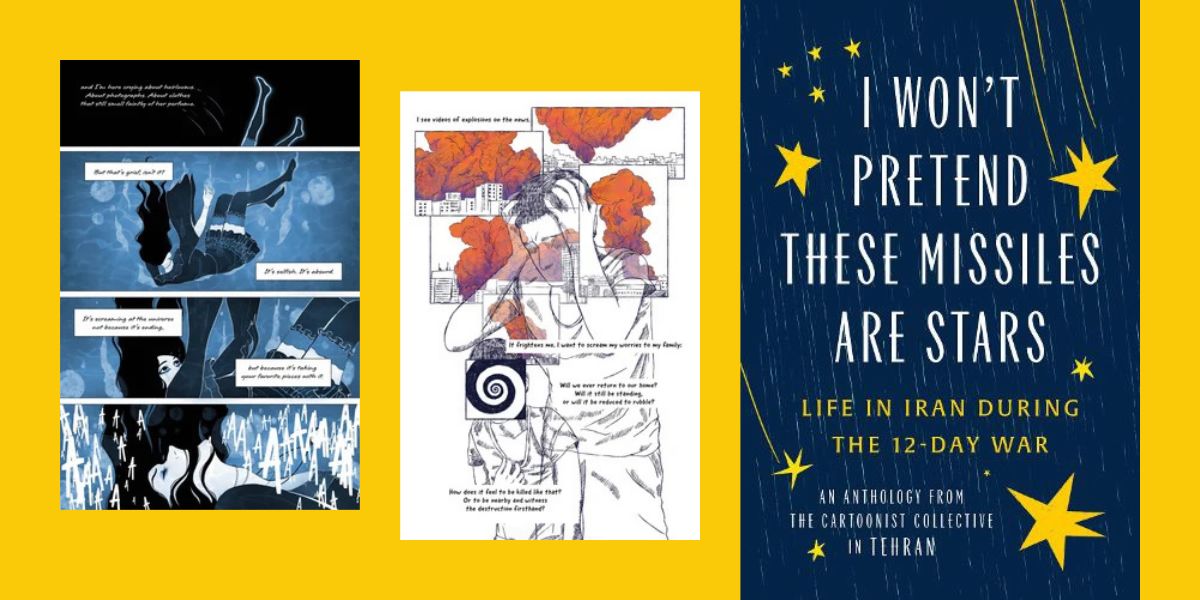
Title: I Won’t Pretend These Missiles Are Stars: Life in Iran During the 12-Day War
Author: The Cartoonist Collective
Publisher: Street Noise Books
Year: 2026
On 17 February 1998, Labour MP Tony Benn gave perhaps his most famous speech, opposing military action against Iraq. He condemned the bombing of Iraq on several fronts, including the likelihood that civilians would be killed during the campaign.
‘The military men are very clever’, he said, ‘They talk not about hydrogen bombs but about deterrence. They talk not about people but about collateral damage. They talk not about power stations and sewage plants but about assets’. Dehumanised strangers are easier to terrorise; easier to kill. This fact remains true whether one is talking about Iraq in 1998 or Iran in 2026.
The subjects of II Won’t Pretend These Missiles Are Stars: Life in Iran During the 12-Day War are not collateral damage and their communities are not assets. After reading their stories, they even cease to be strangers. They hope, dream, and worry just like anyone else.
One is reminded endlessly of the common humanity between Iranians and non-Iranians. This title from Street Noise – a collection of the reactions of fifteen Iranians to 2025’s bombing campaign – has been given an unfortunate timeliness and urgency by the more recent war waged by the United States and Israel against Iran.
This anthology by the Tehran Cartoonists Collective relates the autobiographical reactions of fifteen Iranians, mostly university students or recent graduates, to the 12-day aerial offensive launched by Israel (with US support) in June 2025. The strikes killed almost 1,200 people, including at least 436 civilians. These appalling numbers have since been dwarfed by the total killed in the ongoing war.
It quickly becomes apparent why the creators of these comics are anonymous. The contents would make poor propaganda for the Iranian government. The narrator of 12 Days proclaims: ‘I don’t want wars. I don’t want oppression. I don’t want dictatorship. I don’t want this life … I feel no sense of victory’. They write, ‘nothing has changed’.
In Nothing, the narrator remarks ‘our government couldn’t defend our sky’ because it was too focused on fining women who weren’t wearing the mandatory hijab. Opinions like these could lead to official reprisals from the Iranian leadership.
Much of the material, however, is not taken up with boldfaced political statements like these. More often, stories focus on attempts to survive; to carry out some semblance of a normal life while being bombed.
This is politics of a type, in so far as it gets beyond the dehumanising propaganda Western audiences often see about Iran; as solely populated with terrorists and religious fanatics. The same could be said about the work of the late Marjane Satrapi in Persepolis.
Creative language
The talented creators take differing approaches to telling their stories. Some choose realistic colours, some more fantastical, and others go for monochrome. Most use a subdued, melancholy palette, complementing the downbeat feel of the stories.
Many of the creators express a profound fatalism; they worry that conditions inside Iran will only continue to worsen. The artist responsible for Memento Mori – Latin for ‘remember you will die’ – puts on makeup and imagines how she will look at her own funeral, if she were killed in the bombing.
A powerful reminder of the essential humanity of the people on the receiving end of these attacks
The art styles are similarly varied, going from the cartoony to the abstract. All are engaging, despite the necessarily similar subject matter. The stories capture not just the feelings of confusion and hopelessness, but also determination and resilience. These are the stories of people who play no part in declaring war or in making peace. They can only face events as best they can.
Multiple creators who are able to evacuate Tehran, do so – sometimes with pets in tow. They wonder if the homes they leave behind will still be standing when they return. The lettering of Lappe Letters is a particular highlight. The ‘boom’ of bombs, the ‘khrrgh’ of torn paper, the ‘creak’ of a door and other examples give readers a sense of the sounds heard by the creator, despite the status of the comic as a silent medium. The family cat emits deafening meows on the way out of the city, shown by letters of immense size; a familiar noise to any cat owner who has tried to take their pet somewhere the feline does not want to go.
Dark humour
Some approach the material with an attitude of dark humour. Deadline With Letters explores the difficulties of making comics during the war. The power fails, the internet goes out, the narrator forgets a computer charger. She frets over completing her work under these conditions and on a time limit, but it all turns out to be for naught. Her editor stops responding and the comic fails to even meet its Kickstarter funding goal.
The narrator of Lappe Letters is concerned about the titular cat’s missing name tag and fashions a replacement out of paper. At the story’s end, she opens her bag to find the tag. She can only facepalm at her own forgetfulness.

A monthly dose of our best articles direct to your inbox
The media assumes a prime importance as people try to figure out what is happening. Stay Alive’s creator expresses doubts as to the ability of mass media to tell the truth. ‘People on various news networks both inside Iran and abroad,’ they write, ‘were giving opinions, but I didn’t believe them’. People try to keep in contact via social media, but that becomes difficult due to the unreliability of the internet and government censorship of the web.
Two of the most powerful sections, I’ll Tell You a Story if we Don’t Die and A Safe Place contain lines that anticipate the war in 2026. The former ends with this rhetorical question: ‘And now the war is over…or is it?’
Any observer of the back and forth between the US, Israel and Iran during the subsequent months – and the ceasefires during which fire has never ceased – will have asked themselves similar questions and received a similar lack of answers. The latter’s narrator expresses the sentiment that ‘We all know there’s a bigger war coming’. And so, it has – according to the United Nations, over 3,400 Iranian civilians have been killed in the ongoing war.
The first ever aerial bombardment took place in Tripoli, Libya, in 1922. Over a hundred years on, there is little sign the practice will end any time soon. Korea, Vietnam, Iraq, and now Iran, have been just a few sites for mass carnage. I Won’t Pretend These Missiles Are Stars is a powerful reminder of the essential humanity of those on the receiving end of these attacks, one that couldn’t be more relevant.
