A Right to Housing? Samuel Stein (Verso)
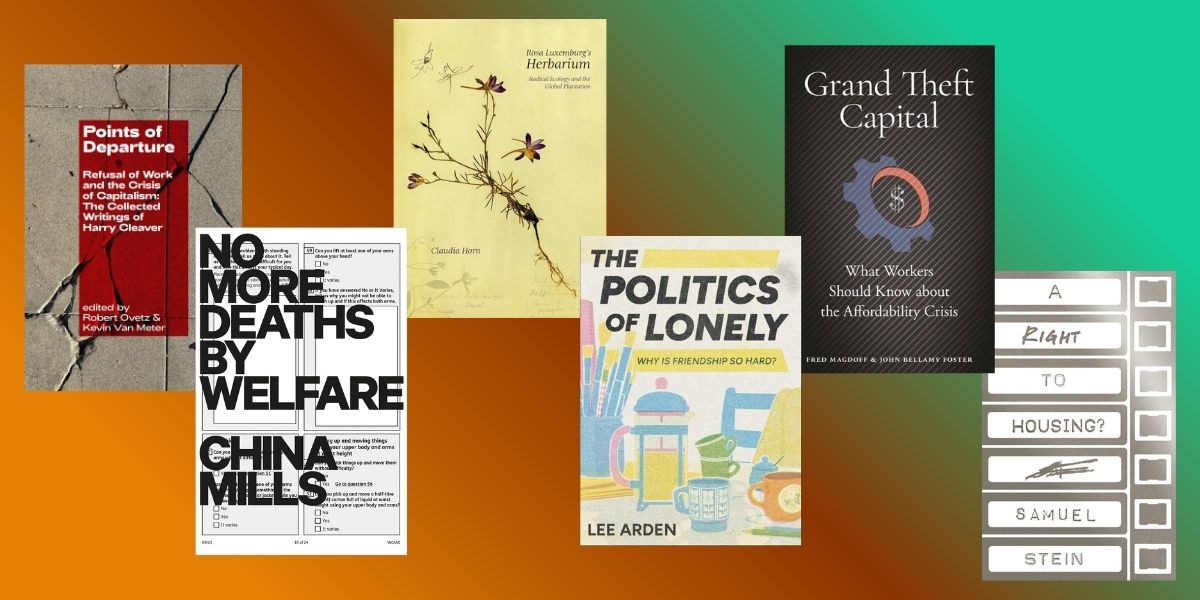
Landlords and developers consider it unprofitable to house the poor. Governments hide behind the excuse of it being too expensive, so as not to impose taxes on the most powerful to pay for it. Stein, however, challenges us to be bold: to enthusiastically embrace the ideal of decommodified housing, free from the market, and to actively fight for socialist housing for all. He answers his titular question with an emphatic ‘yes’, powerfully arguing that housing is a universal right.
Rosa Luxemburg’s Herbarium: Radical Ecology and the Global Plantation, Claudia Horn (OR Books)
As a revolutionary Marxist, Rosa Luxemburg is remembered for her uncompromising stance towards socialism. Her passion for botany remains largely unexplored – until now. Though overshadowed by her radicalism, Luxemburg’s love for nature was deeply intertwined with her politics. Anticipating modern concerns regarding environmental decline, Horn makes clear that over a century before contemporary anxieties about the state of the natural world came to prominence, Luxemburg was already fearful of how capitalism could sabotage nature as part of its insatiable drive for economic growth.
No More Deaths by Welfare, China Mills (Pluto)
The welfare state has long been celebrated as a progressive a space, free from the restraints and injustices of the market. Undeniably, it has provided advantages to the working class, but those opportunities have frequently been accompanied by attempts to regulate people’s lives. In this vital book, Mills highlights the extent to which the welfare system, and in particular social security, has become a source of punitive control over the most vulnerable people in society. By withholding benefits and forcing people into work, the welfare state, Mills asserts, is literally killing people.
The Politics of Lonely: Why is Friendship So Hard? Lee Arden (Fernwood Publishing)
The value of true friendship can bring us great joy, yet deep connections can be remarkably hard to come by. Moreover, loneliness is arguably one of the most debilitating public health issues of our time. Arden argues that, for many of us, loneliness and unsatisfactory friendships are an inevitable outcome of the lifestyles we must lead in order to survive in contemporary capitalist society. Nonetheless, Arden makes the clear case that, in a society built on solidarity and community, meaningful friendships can flourish.

A monthly dose of our best articles direct to your inbox
Grand Theft Capital: What Workers Should Know about the Affordability Crisis, Fred Magdoff and John Bellamy Foster (Monthly Review Press)
Capitalism has been stagnating for decades, characterized by sluggish growth. Yet the wealthy continue to grow richer while the rest of us face declining wages and eroding living standards. Focusing on the United States yet deeply relevant to Britain and other capitalist countries, Magdoff and Bellamy Foster make clear that in a climate of economic decline, big business has deliberately and strategically targeted workers as a primary source of wealth extraction. Their conclusion is a call for mass action, from below.
Points of Departure: Refusal of Work and the Crisis of Capitalism: The Collected Writings of Harry Cleaver, Edited by Robert Ovetz and Kevin Van Meter (Common Notions)
Rooted in the Marxist autonomist tradition – which places class struggle at the centre of social change – this welcome collection of Cleaver’s rare and unpublished writings puts the overthrow of capitalism firmly back in the hands of the working class. With themes exploring the nature of Marxist theory and the causes of capitalist instability, Cleaver’s defence of the ‘refusal of work’ is the heart of the collection. Rather than fighting to make work tolerable, Cleaver goes further, asserting that the class struggle must be a fight to liberate us from work altogether.

