
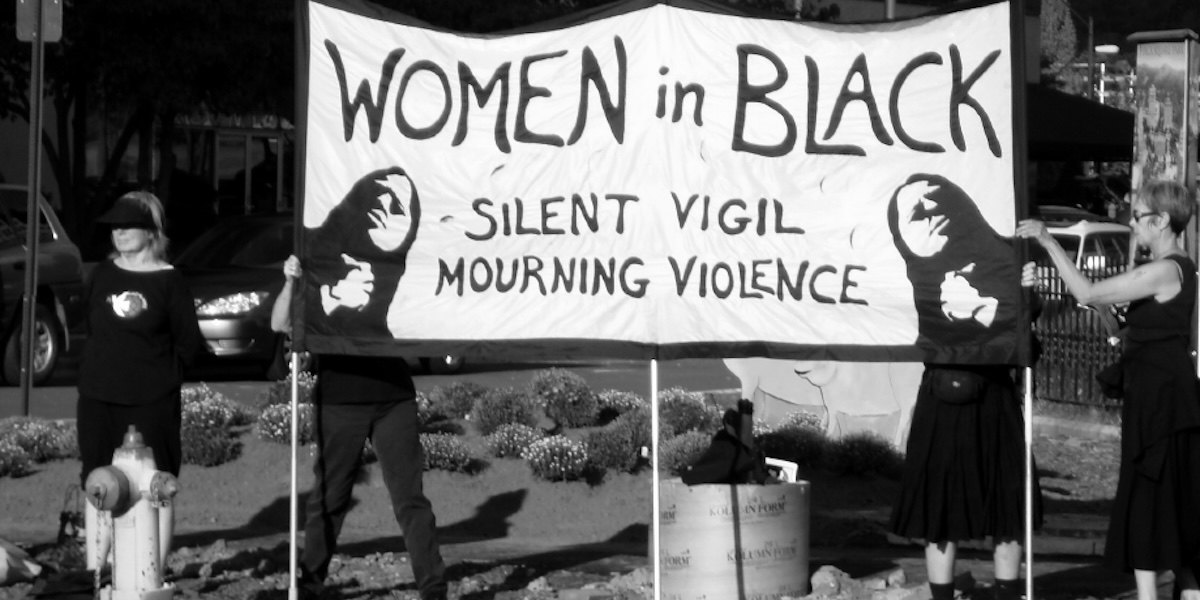
Women in Black (WiB) has become a worldwide network of women committed to peace with justice, and opposition to militarism, war and other forms of violence. Connected by shared theories, inspiration and actions, an international website and conferences, women hold silent non-violent vigils in public spaces, create imaginative street theatre, blockade US Airforce bases that store nuclear weapons across Europe and demonstrate for peace, dressed in black.
The network began in 1988 when Israeli and Palestinian women started weekly vigils in Jerusalem, prompted by the Palestinian intifada, holding placards demanding an End to the Occupation. They called themselves Women in Black, inspired by the Black Sash movement in South Africa that campaigned against Apartheid in 1955, and the Madres de la Plaza de Mayo in Argentina who had demonstrated against the disappearance and murder of thousands of children and adults by the military junta since 1977.
Working across borders
For a network held together by shared aims, passion and theories, Women in Black has reached surprisingly far and wide since then. Starting from Jerusalem, taken by Italian feminists to former Yugoslavia, it has spread to the UK, Spain, Belgium, India, Africa, North and South America, Australia, Austria, France, Germany, the Netherlands, Finland, Canada and beyond, across every continent.
The different WiB groups act against the continuum of violence that flows in both directions, from the rape and murder of women in war to the murder and rape of women in the home. Some, working within occupation or war zones, focus mainly on crossing borders to work together for peace with justice. Others focus more on violence against women and justice for women. Most do both and all are connected.

A monthly dose of our best articles direct to your inbox
Women in Black activists are motivated and informed by theories about the relationship between gender and violence in war and in peace time. Violence, militarism and war are gendered phenomena and to be effective peace activism must likewise be gender analytical. As feminist activist and author Cynthia Cockburn (1934-2019) demonstrated in Women in Black (2023):
‘Gender relations are lived in all societies to a greater and lesser degree as patriarchal. Men and masculinity are relatively dominant and relatively militarised. Rape is endemic in peacetime and a pronounced element of war strategies. Economic class structures and ethno-religious cultures intersect with these inequalities, to different effects in different places’.
A key theory of transversal politics in practice was taken further by Women in Black in Serbia and Bosnia-Herzegovina in the build-up to war in former Yugoslavia, as a way of working together across boundaries, refusing the arbitrary barriers placed between people, and seeking political grounds for practical solidarity across borders.
No peace without justice
In the UK, some of the women who later became Women in Black protested outside the London office of the Israeli airline El Al in solidarity with Israeli and Palestinian Women in Black in 1988. By 1991 they came together with the Greenham Common women’s peace movement that had successfully campaigned against American nuclear weapons based there, the Women’s International League for Peace and Freedom and Women’s Aid to Former Yugoslavia; inspired by the WIB movement to form their own group in London.
There are now at least 18 WiB groups in the UK – in Aberystwyth and Borth, Bradford, Brighton, Bristol, Cambridge, Chesham, Chester, Cullercoats, Dorset, Edinburgh, Faringdon and Ilminster, Glasgow, Leeds, Oxford, Portsmouth and two London groups.
In London, there are currently two vigils held weekly, one on Wednesdays from 6-7pm, a regular vigil since 1992 at the statue of Edith Cavell in St Martin’s Place, opposite the National Portrait Gallery. The group rotates themes focusing on military involvement and costs, the Trident nuclear submarines based at Faslane in Scotland, wars taking place around the world and the effects these have on women and children’s lives; including starvation, homelessness, becoming refugees, illness and lack of education.
Once a month, the focus is on Israel and Palestine where the main slogan is ‘There Can Be No Peace Without Justice’. Around 250-300 leaflets are handed out along with peace stickers. There is a regular group of 12 women and others who join whenever they can; individual women draft leaflets, and create placards, these are agreed online by the collective.
Gender equality is essential in peace negotiations … the chance of long-term success increases by 35 per cent when women are at the table
The second WiB group in London came together following 7 October 2023 and continues to meet outside Friends House on Euston Road every Saturday from 12-1pm. The focus is the ongoing Israeli war on Gaza, and in Lebanon and Iran. A regular group of around 25-40 hold placards and hand out leaflets and peace stickers to the public.
Women in Black develop theories and practice through international conferences, sharing ideas and actions. Each conference is hosted by a different country. This year’s conference was hosted by Colombia, where there are 350 Women in Black groups, working together with Ruta Pacifica. They spoke about the importance of women being at the table for the peace process there, and how they achieved this. Gender equality is essential in peace negotiations; it has been estimated that the chance of long-term success increases by 35 per cent when women are at the table – and Colombian women have proved it.

