
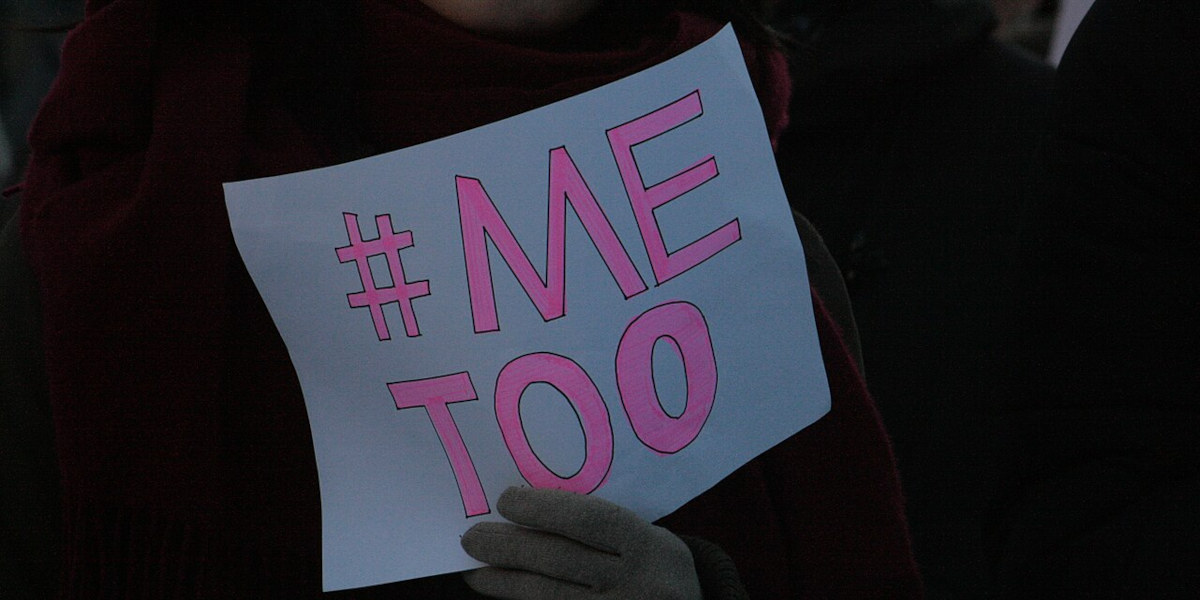
In the wake of #MeToo, society has been forced to acknowledge the ubiquity of sexual violence. We are in the process of confronting the fact that violence is not the state of exception, but rather it is the rule, and women’s lives are governed and punctuated by violence and the expectation of it. The statistics that feminists have reeled out for decades on the prevalence of sexual violence are now being felt as realities that are experienced collectively and that require resolution.
However, there is an uncomfortable reckoning that #MeToo has made necessary, even though the weight of this reckoning may be almost socially unbearable. The ubiquity of sexual violence is not just represented in the ubiquity of victims, but also in the ubiquity of perpetrators. They are not monsters from elsewhere, they are not all Weinsteins using their power to manipulate, coerce and silence for decades, they are men we know and men we trust. They are men who have maybe only assaulted someone once and never did it again, they are men who perhaps only harm women when very drunk, they are men who repeatedly cross women’s boundaries whilst not perceiving wrongdoing on their part.

A monthly dose of our best articles direct to your inbox
What becomes clear when we consider this vast constituency of perpetrators is that if sexual violence is not the state of exception, we must accept that perpetrators are not exceptional monsters, who we may permanently excise from society and therefore remove the problem. Rather, they are constituent parts of society itself, they are our friends, brothers, lovers.
Understood this way, we have two options as a society: either we live without men, or we believe that men can and will change their behaviour if given the cultural and social resources to do so. We can no longer be content with caricaturing perpetrators as a contaminant on our social body, but rather the social body itself. The way forward starts with the painful knowledge: We have all co-existed with, been complicit in, and perhaps even perpetrated violence. Insofar as we live in a society and move in social circles where patriarchal power structures legitimate, normalise and reward all kinds of harmful behaviour, as Elizabeth Bruenig writes ‘it doesn’t take a whole lot of intense, volitional evil to wind up doing a very bad thing’.
There’s a stereotype of abusers which is one where they are habitually & continuously harmful, who know what they are doing is wrong, who show no remorse, and either reject or manipulate attempts at rehabilitation. This type of person unquestionably exists, but it would be a mistake to assume that all, or perhaps even most, men who behave abusively fit a similar pattern. I am concerned here with those individuals who behave abusively/harmfully, but who who do not fit that popular image in part or in whole. There is a danger here in too sharply delineating ‘kinds’ of perpetrators – the curable and the irredeemable – but I am wary of writing beyond the limits of my own understanding. Yet this too, we must understand.
The people I am speaking about are those who have perpetrated non-consensual sexual acts, who have caused harm, but who don’t set out to violate consent in their encounters. Those who aren’t cackling cartoon villains, but who carry with them the unexamined behaviours bred into them by toxic male socialisation.
Mechanisms of accountability
A problem this comprehensive requires a comprehensive set of tools to tackle it. The exclusion and disavowal of abusers is certainly an important tool, and has proved invaluable in isolating dangerous people – and lately, in kickstarting a global conversation about sexual violence. But against the litany of unthought abuses, it’s a rather blunt instrument. We need to find more positive, constructive ways to hold people accountable – ways which allow men to examine their own behaviour and that of the men around them.
Any form of accountability is dependent on the perpetrator being willing to actively engage in reflection about what they have done and being ready to change how they behave in significant ways. They must attempt to understand the harm they have caused and work towards remedying it. The duty of repair, first and foremost, lies with them.
Remorsefulness does not absolve them of responsibility for their actions. Proceeding in the absence of consent is subordinating another person’s needs, desires and human vulnerability in favour of one’s own interests. When we frustratedly cry out ‘how could you possibly think this was ok?’, we are probing much deeper. We are asking: ‘Why did you behave as if I mattered less than you? Do you think that I matter less than you?’. To examine this question with the seriousness it deserves will likely be distressing and disturbing for the perpetrator. However without this examination taking place, moving forward from the act of harm is impossible.
The vast constituency of perpetrators of sexual violence are constituent parts of society itself, they are our friends, brothers, lovers
The question of responsibility is not around whether someone who has perpetrated violence is morally responsible, but rather on what form that responsibility takes. Any morally serious inquiry into dealing with the perpetrator must be an inquiry into dealing with our friends. If we are not able to construct accountability processes that we would readily apply to our closest, most trusted friends, we will simply return to a situation in which violence is perpetrated by the exceptional monster and we quietly endure the violence of our friends as they are not the monsters who processes were intended for. We are implicated in the moral frameworks of our friendship groups, and it is this that makes violence almost unbearable to confront and psychologically easier to repress.
The problem is reminiscent of Adrienne Rich’s discussion of trust in ‘Notes on Women and Honour’, she writes ‘When we discover that someone we trusted can be trusted no longer, it forces us to reexamine the universe, to question the whole instinct and concept of trust… we are brought close to formlessness’. Confronting violence that has taken place is an attempt to reconstruct a semblance of form, a semblance of a community that has moral obligations to care for each other. We cannot proceed unless we appreciate that this is difficult. When we ask of ourselves that we honestly re-examine the universe, we are confronting pain, distress, and discomfort that we barely have the language to articulate, let alone handle.
Ostracisation vs resolution
I do not believe that social disappearance, exile, or ostracisation are equivalent to justice. Indeed we must question and be wary of the power structures which give some the ability to ostracise, and others be subject to ostracisation. Denunciations and punishments are fundamentally exercises of social power and are not governed by the logic of who ‘deserves’ punishment, but rather who is incapable of evading punishment. Moreover, I cannot see ostracisation as a morally responsible course of action by a community (whilst I do not believe that there should be any expectation that a victim has to remain in close social contexts with someone who has harmed them).
Sarah Schulman succinctly elaborates the problem with this approach: ‘expelling a man who has committed a sexual assault from an elite private school simply unleashes him on the world of women who don’t go to elite private schools’. Similarly our communities cannot deal with problems of violence by simply shifting them out of sight, moving the perpetrators to an undefined elsewhere, where they may behave in whatever way they please. We are collectively responsible for protecting each other from doing wrong and changing the behaviours of those who have done wrong in order to prevent further harm taking place.
There are no promises or roadmaps here, only a collective endeavour to inch closer to doing right
Of course, to some extent, it is easy to state that disappearing human beings from our social perspective is not a long-term solution, as prison abolitionist feminists have been saying for decades. The question is then: what resolution do we seek within our communities? How do we support healing after an act of violence, whilst also attempting to change the behaviour of the perpetrator? On the level of practical existence: how do we keep both victim and perpetrator as part of our community when frequently the presence of one implicates the absence of the other? I do not claim to have ways forward in this that are not miserable, draining and intensely frustrating.
Moreover, it is reasonable to expect some form of social withdrawal from a perpetrator of violence, in order for a victim to re-affirm her place and build her trust in the spaces of her social milieu once more. But this withdrawal, in my view, should neither be indefinite nor should it be total. There should be members of the community which sustain friendships with a perpetrator of violence and friendship should not be seen as equivalent with sympathy for their harmful behaviour. Intimate friendships signify more than enjoying someone’s company when you see them, they are bonds that create the space for radical honesty. They are the space where someone can ask ‘Why did you do this?’ and expect an answer that seeks to illuminate.
In good friendships, we can learn difficult truths about ourselves that we’d otherwise not acknowledge. Simone Weil’s definition of a hurtful act is ‘the transference to others of the degradation which we bear in ourselves’. In this understanding, we may prevent this transference of hurt by reckoning with our own degradation, painfully and truthfully. This kind of reckoning is far too overwhelming and existentially threatening to be carried out in solitude. It requires the patience and persistent probing of friends.
Collective transformation
The question we are then faced with is: how do we ascertain that such a reckoning or transformation has taken place? We live in age, as Tithi Bhattacharya writes, where ‘we have lost a socio-moral language of pardon, forgiveness and, yes, grace’. We do not know how to reintegrate someone into a moral community following sincere repentance, we lack an understanding of what sincere repentance means in the face of harm wrought. And yet we must believe that people can change. And yet what solace is change to the scarred social body?
In the absence of being able to verify the wholesale deliverance of someone’s soul (after all, we live in the ‘soulless world’ of Marx that has alienated justice from spiritual redemption), we can only look to how they behave and what steps they have taken to change their behaviour. If they have only caused harm in a particular social context, a reasonable way forward is that they don’t enter such a social context again. If this type of social context comprises an overwhelming majority of the social events of the community or scene, it becomes our duty to hold a mirror to ourselves collectively: what kind of cultures and dynamics do we have that facilitate violence? I cannot say this is perfect or even that it is felt as remedy by the person harmed.
There are no promises or roadmaps here, only a collective endeavour to inch closer to doing right. I do not know what justice which aligns with restoration looks like, although I am unconvinced that a reassembly of the past is possible in instances of violence. But to forego reassembly should not mean settling for livable compromises but rather an active construction of a new social situation in which a victim of harm feels secure and valued. I am not writing here about institutions, workplaces, governments. We do not need to forgive or co-exist with the social relations and power structures that have enabled the widespread traumas we live with the weight of – we need to tear them down. The question still remains: how do we deal with human agents of harm in a way that restores the humanity of the community as a whole?

