



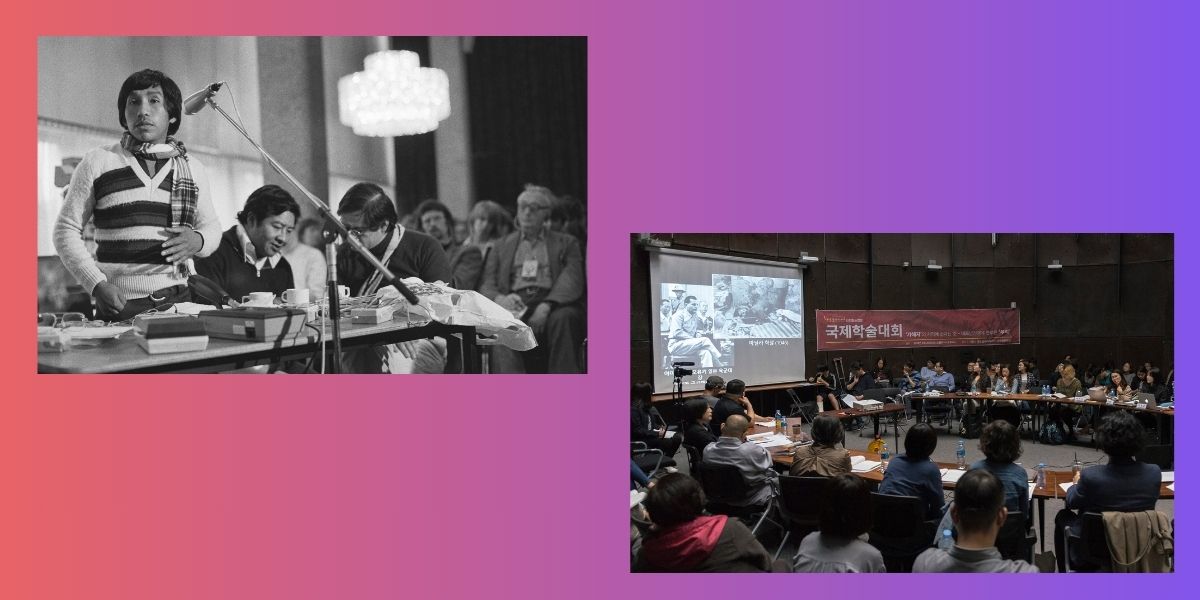
Peoples’ tribunals are grassroots initiatives. They use the conventions and format of the courtroom to publicly stage evidence hearings on rights abuses that formal institutions have failed to recognise or fully address, or where impunity persists.
The tradition stretches back to at least 1966, when philosopher and anti-war activist Bertrand Russell established an International War Crimes Tribunal. Together, lawyers, activists and thinkers investigated US war crimes and foreign policy in Vietnam. For Russell, its goal was to compile a comprehensive record of US conduct in the region that would ‘arouse passionate resistance’. The tribunal exposed the use of cluster bombs against civilians, a finding that helped shape emerging human rights frameworks.
The model of peoples’ tribunals has since been used in a variety of settings. The Russell Tribunal II on Repression in Brazil, Chile and Latin America (1974-1976) came about when Brazilian exiles approached Italian jurist Lelio Basso – a member of the Vietnam tribunal – to examine the role of US corporations and government in sustaining Latin American military dictatorships.
Basso went on to establish the Permanent Peoples’ Tribunal in Rome, grounded in the Universal Declaration of the Rights of Peoples (Algiers, 1976). A rare permanent base to support tribunals, it has since facilitated more than 50 sessions worldwide.
Evidence to action
Other examples include the Russell Tribunal on Palestine (2009-2014), which examined Israeli settlement policies and the occupation and blockade of Gaza. The International Monsanto Tribunal (2016) evaluated whether the corporation’s use of agrochemicals in Colombia amounted to violations of human rights and environmental law. It subsequently called for ecocide to be recognised as a crime in international law.
There have been several tribunals on violence against women, including the Women’s International War Crimes Tribunal (2000), which examined Japan’s system of military sexual slavery during the Second World War. In 2025, the People’s Tribunal for Women of Afghanistan heard testimonies about the Taliban’s violations of girl’s’ and women’s rights. The organisations who had requested the tribunal hoped the process would ‘bear witness, seek accountability, and challenge tyranny and its normalization’.
Peoples’ tribunals have also been used by trade unions. In 2024, the Ceylon Workers Red Flag Union (CWRFU) convened a tribunal in Colombo, on behalf of tea and rubber plantation workers. The findings called for a living wage, the restoration of collective bargaining agreements and new legislation to protect workers’ rights and dignity at work.
Overdue process
In replicating courtroom proceedings, peoples’ tribunals use a recognisable format to raise awareness of the failures of institutions and existing forms of redress. Law courts or wage boards, for instance, often presuppose a fairness and a level playing field that rarely exists.
Tribunals make legible the gaps between such ideals and reality, and refuse to allow injustices to become ordinary and acceptable. By treating workers and survivors as authoritative witnesses, peoples’ tribunals affirm collectively authorised knowledge as a necessary condition for social justice.
While findings have no legal status, peoples’ tribunals show what justice might look like if power was to be arranged differently. When states and formal legal systems fail the most vulnerable, tribunals show the power of organised civil society to create and enact its own standards of judgement.
Despite their differences, all tribunals concern prefigurative politics. Their political potential lies in how they convene collective solidarity and model and rehearse a justice that has yet to come. As a process of consciousness-raising for those who participate and for larger audiences, peoples’ tribunals show us how more just worlds might look and feel.
Further Reading
- Bertrand Russell, Jean Paul Sartre and Charles De Gaulle debate the 1966 Tribunal in World Outlook / Perspective Mondial Volume 5, Number 19 (1967)
- The Permanent People’s Tribunal website
- The Tricycle Theatre: Collected Tribunal Plays 1994 – 2012 (Concord Theatricals, 2014)
- A Collective Voice must be raised for Plantation Workers by Ceylon Workers Red Flag Union (2024)
- Inside The People’s Tribunal on Police Killings by James Whitfield, Red Pepper (2026)