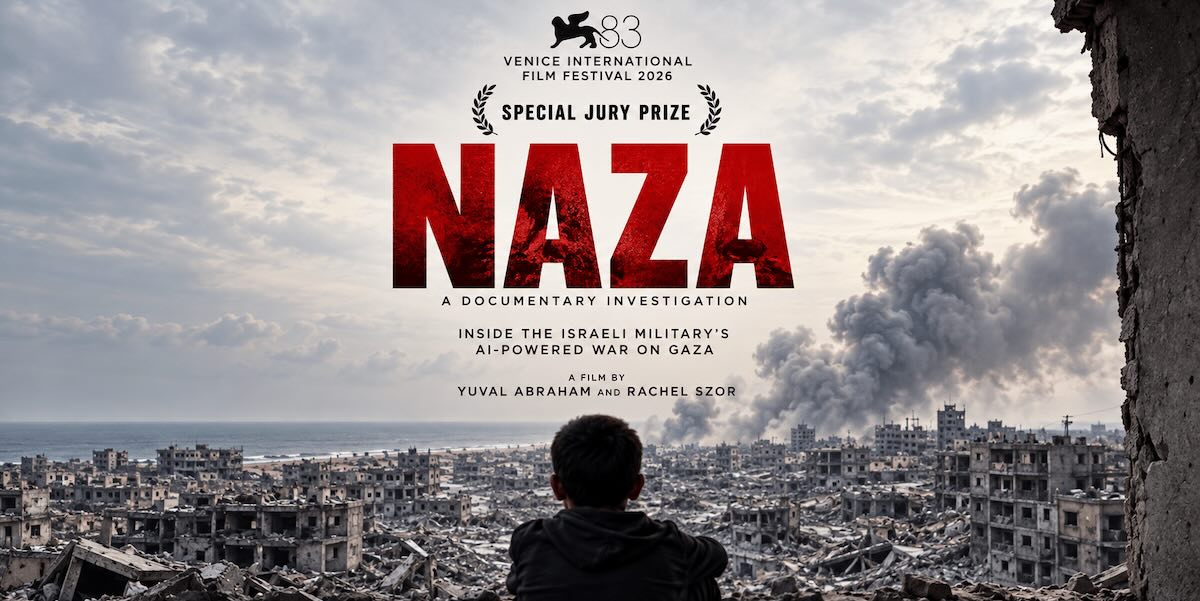
Title: NAZA
Directors: Yuval Abraham and Rachel Szor
Producers: The Guardian Documentaries / JW Films / mk2 films
Year: 2026
How do societies that pride themselves on their tolerance and liberal values come to accept genocide? How do well-educated and well-adjusted people become perpetrators of the most terrible crimes against humanity? Yuval Abraham and Rachel Szor’s startling documentary NAZA answers these questions in the context of Gaza – but it also tells us something about our own increasingly militarised and atomised societies.
The film is built around the anonymous testimony of 24 Israeli soldiers and intelligence personnel interviewed at night on rooftops in Tel Aviv. The effect is chilling, as the details of mass death and destruction are recounted against the backdrop of high-rise apartment blocks where the ritual of watching the nightly war news can be glimpsed behind half-drawn curtains.
What we’re seeing is something widely shared by Western audiences: the disconnect between the unimaginable violence of modern militaries and the affluent lifestyles of those they serve.
The NAZA Protocol
The term NAZA is an abbreviation of the Hebrew phrase nezek agavi meaning ‘collateral damage’. According to the interviewees, the acronym designates the acceptable level of civilian deaths expected from a specific targeted killing, a kind of tariff adjusted for the perceived importance of the target: a lower-level Hamas operative might be scored 15 or 20 NAZA whereas a military commander might carry an allowance of hundreds of civilian deaths.
The NAZA protocol is part of the process whereby the Israeli Defense Forces (IDF) target lethal strikes within the densely-populated urban landscape of Gaza. NAZA scores were particularly prominent in the initial stages of the assault because the IDF preferred to hit ‘military operatives’ at home where they are more easily locatable – and where they would be surrounded by their families.

A monthly dose of our best articles direct to your inbox
The actual work of targeting is largely conducted by AI-based systems which rely on the vast haul of data generated by the mass electronic surveillance of the Palestinian population. According to the film, not only can each mobile phone in Gaza be tracked, but its functions can be accessed, stored and even remotely operated.
Calling patterns, text messages, and other phone data are used to profile individuals and designate them as ‘military operatives’, which in turn generates a NAZA score. But most chillingly, as reported by some of the film’s interviewees, intelligence analysts can confirm the target’s presence by activating a phone’s audio and listening in to a family’s evening routine – children playing, family members sharing a meal, laughing, praying – before the strike gets the go ahead.
An enabling mindset
What’s particularly horrifying about NAZA is its cold and clinical calculation of civilian deaths, yet this is not the central charge made by the film – it’s not the smoking gun or silver bullet to convict Israel of genocide, as both sympathetic reviewers and the IDF’s own rebuttal, seems to suggest.
In fact, the film moves on to other mechanisms for the mass slaughter of civilians. Most notably, it shows the pulverising of whole city blocks following a grid system that aims to turn the patches on the map from purple (more densely populated) to white (zero population), as well as the deliberate murder of civilians stepping out of line in a food queue.
Here there is no targeting of ‘military operatives’ and so, strictly speaking, no NAZA: it is just indiscriminate murder, killing civilians and combatants, young and old, parent and child, alike. And yet the NAZA protocol is active here in another sense, as an enabling fiction that plays a much larger role in the genocide in Gaza. As co-director Yuval Abraham explains, the rhetoric of NAZA ‘produce[s] an endless stream of apparent military justifications, creating a veneer of legality for a policy of mass murder’.
Distance and disconnect
In wars in Afghanistan and Iraq, Western powers prioritised protecting their own forces through a shift to airpower and remote weaponry. In turn, they developed quasi-legal justifications for the resulting civilian casualties by weaponising the juridical concept of proportionality – the requirement that civilian casualties should be ‘in proportion’ to the anticipated military gain. Together, these developments led to what Martin Shaw has called ‘risk-transfer militarism’, a paradigm that helps contextualise NAZA.
In 2012, epidemiologist John Tirman estimated that well over six million people had been killed due to US wars since 1945, but observes how civilian deaths are largely absent from mainstream politics and culture. While millions marched against the invasions of Afghanistan and Iraq in New York and London, the fate of civilians receded from public consciousness as the wars rumbled on. As Sheila M Bird noted in 2006: ‘neither the UK nor US Governments properly counted, or even seriously sought to count, civilian casualties in Iraq’.
The projection of lethal force at distance removes Western combatants from harm’s way, but at the same time increases the risk of civilian casualties – euphemistically termed ‘collateral damage’. For Bird, such an outcome was ‘not only known and understood by Western military planners’, but was ‘a completely predictable consequence’. Yet because it is framed in terms of targeting and proportionality, the ‘risk transfer’ from military to civilian becomes invisible, lending a semblance of legitimacy to Western violence.
The mindset generated functions as a rationalising gateway for ordinary people to become perpetrators
Redeploying a paradigm ostensibly designed for the battlefield, to the private homes and apartments of families, internalises the psychological work of legitimising violence. As Abraham argues, the legalistic language of NAZA provides a ‘mission-oriented framing’ that focuses on the perceived military gain to the exclusion of all else, so that ‘each act of violence’ is separated ‘as a discrete task’ from its human consequences.
For those building the software, designing the algorithms, or remotely directing the strikes – the social elite of Israeli society – their actions are insulated from ethical responsibility. Instead of thinking about the repercussions of their activities, they can instead concentrate on the job in hand. As Abraham writes, NAZA has ‘a crucial role in enabling ordinary Israelis to participate in genocide – perhaps more than obedience alone, which is usually assumed to be the primary motivator’.
Beyond NAZA
The IDF seeks to deflect criticism by focusing on the NAZA protocol and claiming that it proves compliance with international law. The fact that by the IDF’s own count 83 per cent of the dead are likely civilians, alongside the huge number of entire families wiped out, belies such arguments. As does, of course, the targeting of families at home where no military activity is occurring, in contravention to international humanitarian law.
But at another level, a simplistic focus on NAZA as the primary mechanism of massacre is a distraction and misses a larger point. As Sebastian Ben Daniel puts it: ‘If the discussion can be reduced to whether the number of civilians killed in a particular strike is exact, people can avoid confronting… a system built to generate and process killing at enormous scale’.
The targeted killings that gave rise to the terminology of NAZA may to an extent have been displaced by other means, but the mindset it generates continues to function as an enabling fiction, a rationalising gateway for ordinary people to become perpetrators. And if the roots of NAZA lie in ‘risk-transfer militarism’ and the blindness to the suffering of others which it fosters, then the film might also provide insights into the Western polities that call for peace while supplying weaponry for genocide.
NAZA will be available to stream online, for free, from early December via The Guardian
