
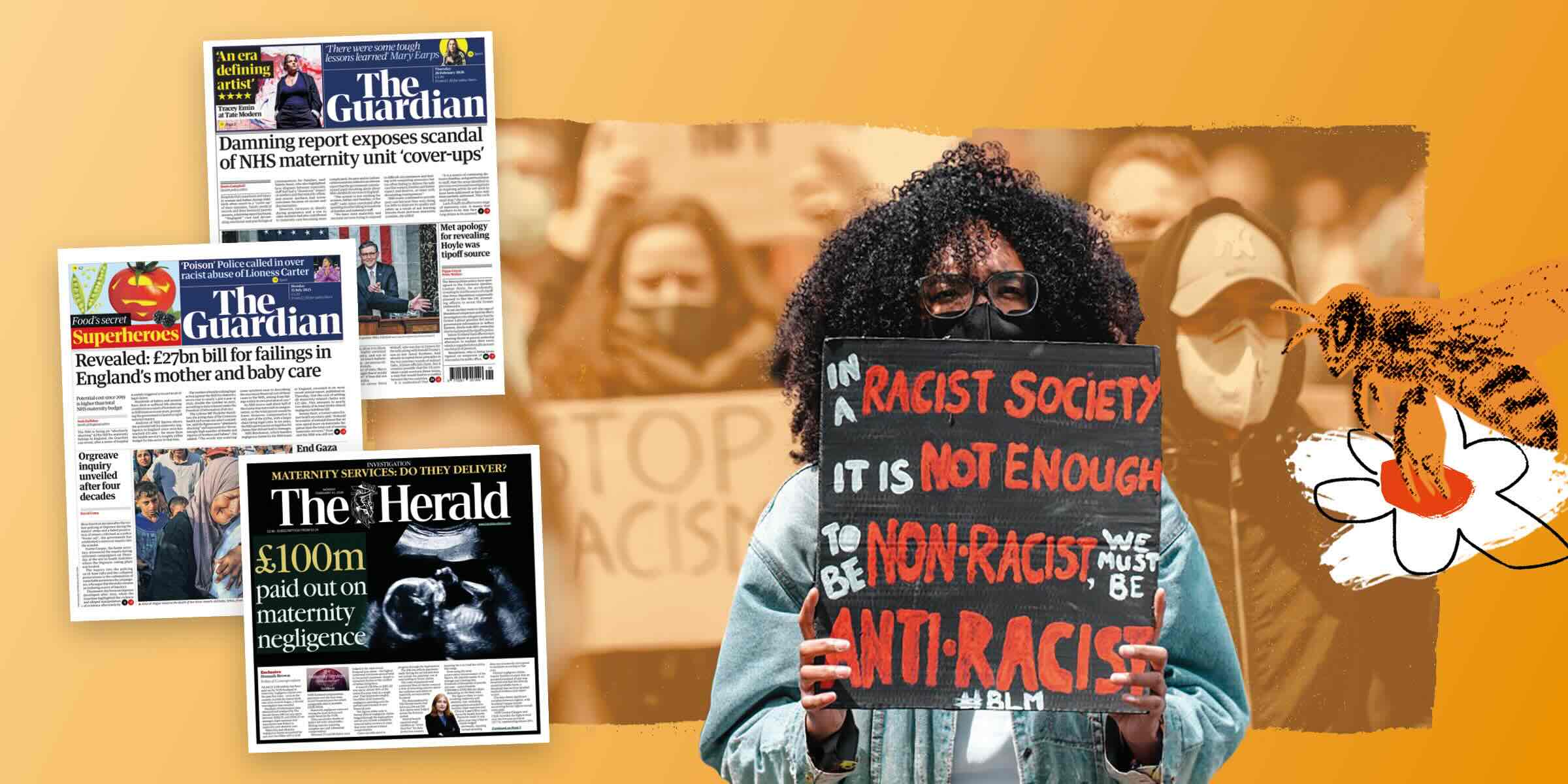
I am not questioning the existence and impact of racism. That needs to be said up front. My suggestion that we rethink how to undertake our anti-racist politics, and to what end, is not a suggestion that racism is not real or somehow less important than other political priorities. But in the face of emboldened organised racist groups and the persistence of violence and systematic neglect, we must reflect on our established habits of anti-racist organising. None of us are in this to be ineffectual.
Too often we are presented with anti-racism as a method of addressing ‘racism’ as a standalone entity. This is racism stripped of context or process, that seems like only wrong-headed ideas. The implication of targeting and undoing racism without context is that there exists a fair, just and equal world there for the taking – and only the mistake of racist ideas stops it from happening.
We would be better to understand that racism is one powerful and pernicious mode of normalising inequality and injustice in our society. That is the job of racism: to make inequality into business as usual. To address the impacts of racism, we need to shift our focus from what people think and believe towards what racism does and enables.
Importantly, these horrors can be enabled even if no particular person holds the racist belief.
The ongoing scandal of medical racism is instructive here: there might not be a single member of staff in a hospital who believes that Black women experience less pain than other women, yet the practices that deny pain relief to Black women, particularly during birth, may continue.
Anti-racism is like jujitsu: tracking the workings of racism to find points of weakness
Our anti-racist politics must understand how racism makes injustice possible and can make injustice feel inevitable and unstoppable. This attention demands we spend less time trying to find out who the racist is and more time tracking what and how and where racism makes things happen.
This is partly because, over decades of attempted policy intervention, finding the racists and trying to address their beliefs has had little impact on unequal outcomes. But I also say this because racism allows injustice for everyone. That also is its job: to make injustice the inescapable flavour of all human life, so all we can hope for is that injustice does not land on us or our loved ones.
Myths of race
Racism teaches us that some people are born to be unable to have nice things. It teaches us that violence against those inherently lesser people is justified, even if it is a matter of regret, because they are a threat to human achievement and social order. Instead of trying to persuade people who believe such things to believe something better, I suggest we work on tracking processes of exclusion, neglect, discrimination and injustice, identifying in each step what racism allows to happen.
We might, for example, try to understand how racism allows inadequate antenatal support. How, by disrupting access to healthcare, racism inserts a logic of rationing and differential entitlement to essential healthcare. How racism ensures that not everyone can contact healthcare providers at the point of need, leading to more acute, complicated and damaging health outcomes.
Each of these realities reflects more than ideas; they are sets of practices enabled by the fictions of racial categorisation and impacts of racism across society. Race is a myth about how we are inevitably, naturally and irrevocably different and divided from each other. The idea of race makes us believe, so implicitly that it is all but indiscernible, that humans cannot be equal because nature decrees injustice.

A monthly dose of our best articles direct to your inbox
Every faked study or misleading analysis of allegedly trans-historical racial categories – deemed to arise from biology not culture – is a tall tale. These stories are designed to persuade us that race has already allocated a status to each of us and that no human endeavour can change this hierarchy. This set of fictions drip, drip, drips away in our conceptualisation of the world, slyly inserting the belief that politics must have its limits – and the limit is that humans cannot be liberated because we are not born for liberation.
Nature, coded as race, tells us so. Instead of seeking to address racism as a thing in itself, we might do better to address the systemic role of racism in, for example, undoing the possibility of health justice, with an impact on all. Distressing revelations from the 2026 final report of the independent National Maternity and Neonatal Investigation reveal this dynamic.
The distressing and overt forms of racism it documents include the still-shocking dehumanisation of patients by healthcare workers, with horrific impacts including the deaths of mothers and of babies. It reveals a terrible circuit of racism: Black and brown communities being stereotyped by some healthcare workers in ways that prevented attentive and effective care, leading to patterns of poor outcomes that were then characterised as more likely for Black and brown mothers and babies.
At the same time, that cycle worked to obscure wider systemic failures in maternal and neonatal healthcare. The repeated implication that some ethnic groups are more at risk because of some imagined racialised trait delayed investigation into failures that also led to the avoidable deaths of ‘white’ mothers and babies.
Racism normalises failures of care. More than this, racism surreptitiously suggests that there can be no universal healthcare because some people cannot be assisted by care – while making possible the erosion of an equitable and effective service for all mothers and babies, not only those who are Black and brown.
Identifying weaknesses
When we learn how racism works, we are learning how powerful people can take things from us and make our lives painful and constrained. We must understand what they are doing, not because we want to persuade our enemies to be less racist, but so we can disrupt their project of dehumanisation and inequality. Anti-racism is more like jujitsu than debate club. We are tracking the workings of racism to see the points of intervention and weakness; to see how power is used against us to our detriment.
Instead of starting with an identification of our target as the ‘racist’ or the ‘racism’, let us learn to map the processes that enable located injustice. I am imagining political training where we together look at a site of injustice and try to distil how racism works as a central technique of the powerful in that setting.
How does racism shape a policy landscape that, say, enables poor rental housing? How does grasping racism illuminate our understanding of who is a landlord, and how landlords are (and are not) regulated? How does racism disrupt mobilisations of renters in a building or neighbourhood? How does racism fragment the community we wish to work with in material ways, such as immigration status? What new political skills, organising approaches and activities might we develop to address racism as we understand it as a tactic of power deployed to disrupt our capacities for collective action?
This approach may not work for all issues, but it could help build a generation of formidable organisers for justice. If our responsibility is to become more terrifying to our enemies, this work is part of what must be done.
