In 2012, a new generation of free to-air UK TV channels launched. The stations were intended for local news, information and culture, yet their public profile remained minimal. Most viewers have likely never tuned into their local TV franchise. Filmmaker Mike Bennion-Rowe puts it succinctly: ‘There was a dream. And it’s not appeared.’ Instead, a potentially radical platform for local journalism, marginal voices and grassroots culture has slid into consolidation.
Latest TV in Brighton is a rare success story and one of only two remaining independent local channels. I chatted with Bill Smith, the irrepressible owner, and Angi Mariani, newsreader and programme-maker, who jokes that the team is forever trying to keep up with Smith’s ideas. Their explanation for why it works? ‘Because we are filmmakers, and musicians, principally,’ Mariani replies. ‘We’re obsessed with the city!’ Smith had long urged big broadcasters to base something in Brighton: ‘Eventually I thought maybe I can do it myself.’

A monthly dose of our best articles direct to your inbox
Meanwhile in Belfast, David Hyndman built on decades of filmmaking experience at Northern Visions, to create NVTV. ‘I always felt that video and television was a really important medium that wasn’t being used by ordinary people.’ Northern Visions’ original TV foothold was via Channel 4’s Workshops, which funded politically-engaged groups to make challenging issue led films. Via the Workshops, ‘You were able to make the programmes you felt were important.’
The plan and the reality
Local TV is now remembered as a Jeremy Hunt project, because he was culture secretary at the time, though those involved recall a longer gestation. Hyndman recalls the agenda-setting Shott report, written for the secretary of state for culture, Olympics, media and sport in 2010: ‘I’ve always said we did better in the [Tory] era than the Labour era. [Nicholas] Shott was very good at this sort of radicalism, to make people, politicians accountable – he could see the benefits of a local voice, in terms of democracy. It’s that sort of libertarianism, I think, that they saw.’
Such DCMS planning documents were full of civic ambition but assumed the market would do the rest – a miscalculation for a sector in which the market had already failed to sustain previous independent local channels.
The franchise auction received dozens of applications; by 2015, 17 stations were broadcasting. Early funding ran through a convoluted scheme, whereby channels supplied regular news content to the BBC, which paid a flat fee whether or not a report was used. Some stations churned out copious news stories of variable quality. Anticipated local and national advertising money never materialised. Even measuring audiences well enough to sell ads was impossible. Ultimately, the business model never stacked up.
Truly local
The Latest TV approach includes platforming the best of Brighton culture and sport; partnering with international stations to serve the city’s Ukrainian and Chinese communities; and approaching independent filmmakers for themed festivals like the internationally renowned Film Pride.
Bill Smith recalls offering to film Brighton Pride for the BBC: ‘They were doing Glastonbury and I said, “More people come to Pride in Brighton than go to Glastonbury, why don’t you put it on?” The response was, “They might like that in Brighton, Bill, but they won’t like it in Tunbridge Wells.”’
Smith and Mariani know the city through dozens of overlapping communities – faith groups, culture, nightlife, unions, public services. ‘That’s how 12 people can cover the whole city,’ Mariani says. Their verve is an exception. Tom Chivers of the Media Reform Coalition has tracked local TV’s decline. ‘It’s a fantastic invitation to civic and cultural expression. But the infrastructure and support isn’t there. Those barriers to entry are just too high.’
David Hyndman agrees: ‘A lot of stations were very ambitious initially and that led to their downfall – how much it cost and how difficult it was to produce programmes. They didn’t have a business plan. We were hand to mouth, relying on goodwill.’
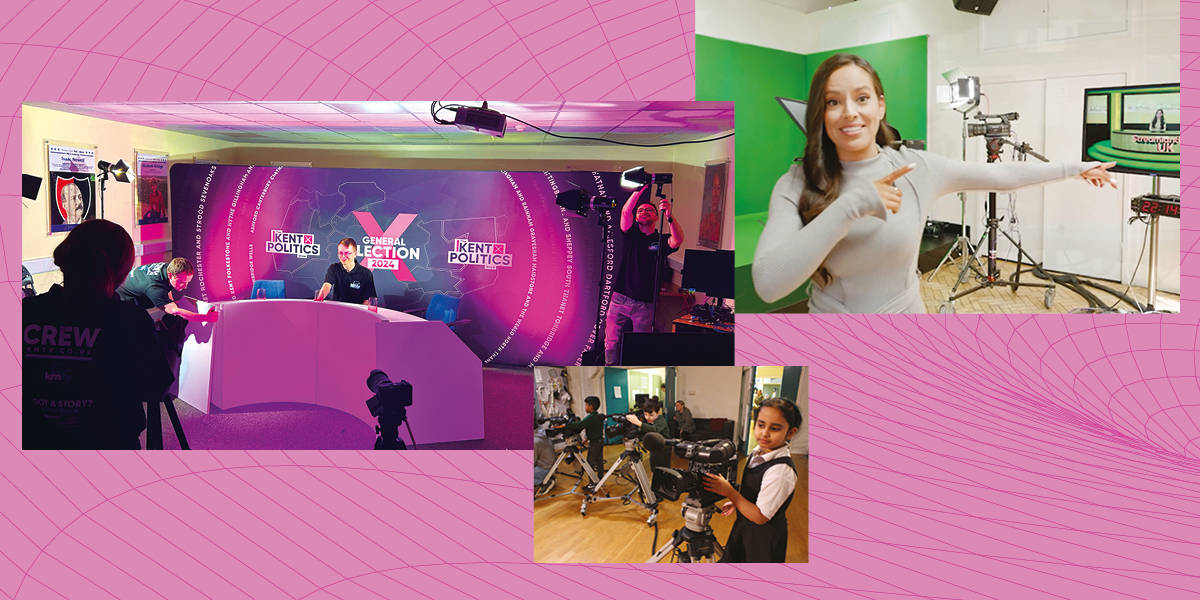
A decade on, almost all the franchises have been swallowed up by two companies, That’s TV and Local TV Ltd. Their schedules are light on local output and heavy on vintage repeats. That’s TV has been repeatedly castigated for working practices involving fire and rehire, ‘Bright Sparks’: NVTV work shops for eight-year-olds Some of the current KMTV team of professional journalists and staff poor conditions, overworking and minimal training.
Tom Chivers echoes the consensus that regulator Ofcom is culpable: ‘Ofcom just left the model to wilt and die.’ Quotas have been repeatedly weakened instead of enforced. Even then, Chivers argues, Ofcom let stations satisfy the letter of quotas without delivering public value, meaning channels with ‘very limited appeal to their local communities’.
From marginalised to mainstream
Some of the most successful stations were university backed, offering students hands-on experience. Notts TV ran 24/7 from Nottingham Trent University for 11 years; KMTV continues from the University of Kent in Maidstone. Its business model utilises training income, production grants and research funding. This has helped it make programmes that travel beyond the licence area, including children’s series Generation Genome, acquired by ITVX, and an RTS-shortlisted international documentary commission.
KMTV director Andy Richards describes ‘a professional newsroom supported by students’ and former staff have moved into roles at ITV and the BBC. Latest TV partners with the DWP, similarly training people on the job. The team introduced me to Viktorija Faith, a young filmmaker who teaches visual storytelling. She describes their trainees as ‘creative, free-spirited, ambitious and wanting to make a difference’. Angi Mariani notes the benefit gained from working with neurodivergent people in particular: ‘We employ a lot of people who would find it difficult to get employment in other fields, but they’re artistic geniuses.’
We are covering stories and communities that the public service broadcasters often do not
Latest TV sees itself as a vital stepping stone into the industry. Many prominent presenters learned their trade there. ‘We’re like a non-league football club,’ says Mariani. People start with us. Learn everything. Become multi skilled. And we’re proud of that.’
Local TV also appeals to independent filmmakers. Mike Bennion-Rowe, a Manchester based producer at TornBox, presents Chewing the Cud, a cheeky, weekly LGBTQ+ chat show syndicated across several franchises. It began as a self-funded passion project, distributed for free, though some stations were reluctant, ‘because the licence was a local licence. We were seen as national content.’ So TornBox blurred its own geography. ‘We stopped mentioning we were in Manchester,’ Bennion-Rowe tells me. ‘We started to pretend we were everywhere and nowhere.’ He’s proudest not of reach, but access: ‘Giving a voice to local people, and people that wouldn’t have had a voice otherwise.’
TornBox has also become an informal training ground. In a sector that can feel closed-off, he describes TornBox as a low barrier entry point for new crew and presenters. Its upcoming interview series, The Paris Show with Paris Monroe, will again be placed in local TV first. ‘It’s a trans-led show, something that’s not currently existing in the UK market.’ Latest TV has already said yes.
Concentration, renewal and legacy
The decline of traditional linear TV in an app-driven world of on-demand content has inevitably hurt the local stations. Rather than step in, Ofcom simply renewed the remaining franchises until 2035 with minimal scrutiny.
The run-up to renewal prompted most remaining independents to sell up. Notts TV shut down altogether. London Live, owned by Evgeny Lebedev, ran mounting losses throughout its lifespan. Sold to Local TV Ltd, it now follows the standard stripped-down, repeat-heavy formula. NVTV was left with little choice but to sell the Belfast licence to That’s TV, with a hard-won concession to continue supplying an hour of programmes a night. ‘That wiggle room became less and less. Really, it was an economic decision,’ says David Hyndman.
NVTV boasts over 5,000 programmes on Vimeo – an archive of social history. ‘We were always at the forefront of the women’s movement, the gay rights movement. You can see the progression to where things become mainstream. Also, it is an archive of people who have contributed to all these movements and are no longer with us.’ Despite NVTV’s withdrawal from Freeview, Hyndman plans an NVTV app – and an all-Ireland network, with studios in Dublin and Cork. ‘Local TV was a fantastic focus for us. You need that outlet, because that’s why people make programmes. They don’t make them to sit on the shelf.’
Latest TV’s future is via apps and Freeview’s online successor, Freely. Bill Smith explains: ‘I want to provide a great television service for Brighton that lasts for another 50 years, a good legacy, and I want a lot of young people to run it. And I want it to be sustainable and give them all nice jobs.’
The licence model may be fading, but the intended functions of local TV are still needed: independent scrutiny of local issues, training, creative outlet. KMTV shows what local TV can be when not surviving off advertising alone. Andy Richards says it’s kept daily first-run news and current affairs central to its output, with a ten-strong newsroom and senior journalism apprenticeships. ‘We are covering stories and communities that the public service broadcasters often do not, and we believe this role is crucial to the future of local news.’
The next generation may not need an Ofcom licence: low-cost internet channels, co-ops and community radio-style ‘social gain’ organisations can host local video, especially if funding and distribution are treated as civic infrastructure rather than a market bet. Whether via Freeview or an app, local video only survives if we treat it as a public good and build structures that keep it local.

