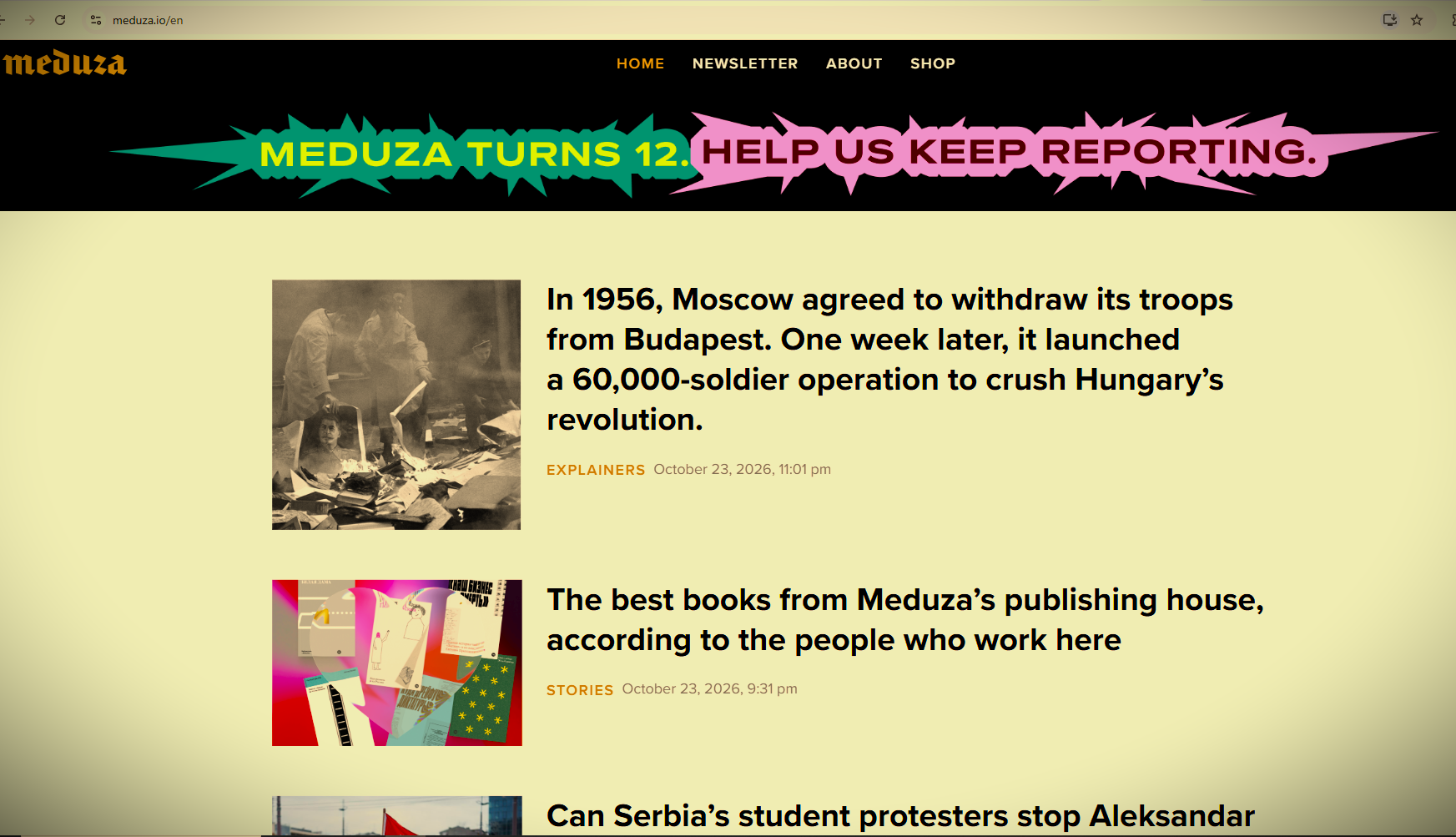
Founded in 2014 in Latvia by a small group of Russian journalists escaping repression from their home country, Meduza has become the leading independent Russian media outlet. Banned within Russia, it survives on the donations of its international readers. Both the Russian and English versions of the site operate under the slogan: ‘Make the Kremlin sad’.
Anne Schumacher: What was your vision for Meduza at the time the website was founded and how has that evolved under your leadership?
Ivan Kolpakov: We started because we wanted to keep doing journalism. Even then, it was obvious that journalism — especially political and social journalism — was no longer a smart or safe profession in Russia. Before Meduza, I worked at Lenta.ru, the largest news website in Russia. It was effectively destroyed a few weeks before the annexation of Crimea. The circumstances were sad, but we were young, optimistic and full of energy. Our main motivation was simply the will to keep going.
We saw Meduza as a kind of refuge for ourselves — we called it a ‘small pirate ship’. It was tiny at first, only about 15 people and we started it in Latvia. For us, it was already clear where the political situation was heading.
Recently, I found an early presentation we had made for potential investors. It predicted almost everything that later happened: that journalism would become a forbidden profession, that we would be blocked and prosecuted, forced to work from abroad and need technical solutions to bypass censorship. The only thing we didn’t foresee was Meduza becoming the biggest independent media outlet. We assumed it would be small and niche — but necessary. We didn’t expect the scale we eventually reached.
AS: Meduza has built a large following. What are your current estimates for readership and what trends are you observing?
IK: It is above ten million. Before the war, it was enormous — possibly the biggest news website in Russian history, especially in the months before the full-scale invasion, when the demand for independent information was huge. After the war, the numbers dropped for various reasons, but we still have around ten to twelve million unique monthly readers, which is huge.
The main trend now is the rapid degradation of the Russian internet. When we started in 2014, the Russian authorities were incompetent in internet regulation. But Russians learn fast, especially in engineering. Today Russia has one of the most sophisticated censorship systems in the world. They can block anything — large platforms, foreign services and even VPNs.
Since last winter, Russia has significantly slowed down YouTube, which had long been the last remaining channel for relatively free information inside the country. Voice calls on WhatsApp and Telegram are now blocked and regional mobile-internet shutdowns have also been introduced. During such shutdowns, users are restricted to a small ‘white list’ of allowed websites. Everything else is blocked and even our anti-blocking solutions cannot circumvent these restrictions.
Furthermore, Russia has introduced a law criminalizing the search for ‘extremist’ content. Anything related to Meduza is prohibited — donating, working for us, commenting, or posting our links — though reading our content is still allowed, for now. The situation has become completely dystopian and perhaps the most frightening aspect is how quickly people begin to accept it as normal.
AS: Given that Meduza journalists and readers are targeted by Russian authorities, how do you assess the risks that readers and collaborators still face inside Russia?
IK: Currently, readers in Russia can legally access Meduza, but publicly admitting that they do so can be dangerous and we advise against it. To help readers stay safe, our mobile app automatically switches between multiple technologies to maintain access without a VPN. Users can also camouflage the app icon so that Meduza is not visible on their phones, and we will soon release a new unbranded ‘safe mode’ app.
On the editorial side, we follow extremely strict protocols with sources, comments, and publication content, prioritizing the safety of people inside Russia. Since 2022, we have no staff journalists in the country, as collaborating with us can carry prison sentences of up to six years, and in some cases, journalists have been charged with state treason, carrying penalties of 20 years or more. Instead, we work with incredibly brave freelancers under unique safety protocols built from scratch. Thankfully, no one has been imprisoned so far. Our co-founder and publisher, Galina Timchenko, has been criminally charged in Russia and is wanted there, illustrating the serious risks involved.
AS: Could you talk more about Meduza’s ongoing collaborations with journalists and media organizations in other countries?
IK: We were fortunate to start in 2014, during a pivotal time in journalism and became pioneers in explanatory journalism, podcasting, YouTube videos and native advertising. We always sought to learn from the best media organizations worldwide. However, over time, Western experiences were no longer entirely relevant for us as the realities of authoritarianism made normal journalistic approaches insufficient. We had to relearn how to produce quality journalism under these constraints.
Eventually, we realized that we could learn from other media organizations facing similar circumstances. The world of media in exile was growing rapidly, with new regions becoming dangerous for journalists.
In 2022, shortly after the full-scale invasion of Ukraine, we helped found NEMO, the Network of Media Outlets in Exile, together with teams from Nicaragua, Azerbaijan, Iran and other countries. NEMO became the first global network representing media in exile. It allows us to share experiences, resistance strategies, censorship-bypassing technologies and safety protocols. This solidarity between media outlets worldwide has become increasingly important as the challenges for journalists under authoritarian regimes continue to expand.
AS: How do you view the prospects for peace in Ukraine and what would a lasting peace mean in the current situation?
IK: My feeling is that we are all desperately waiting for peace and demanding it as urgently as possible. First and foremost, peace is needed to stop the war and the killings of innocent people.
At the same time, I believe that Putin remains a global threat, with or without peace — perhaps even more so if peace is achieved. Unfortunately, I am quite pessimistic. The regime is strong and the economy is more resilient than many assume. Russia still has substantial resources, including from domestic and international sources and its trade and economic influence allow it to continue functioning as a threat and a significant player in the global economy.
Regarding Putin’s objectives, it seems that some of the goals he might have sought — such as retaining control over certain territories like Crimea and preventing Ukraine from joining NATO — have largely been addressed.
While some might argue that prolonging the war could lead to a ‘better peace,’ I do not share that view. I firmly believe the war must be stopped as soon as possible.
