
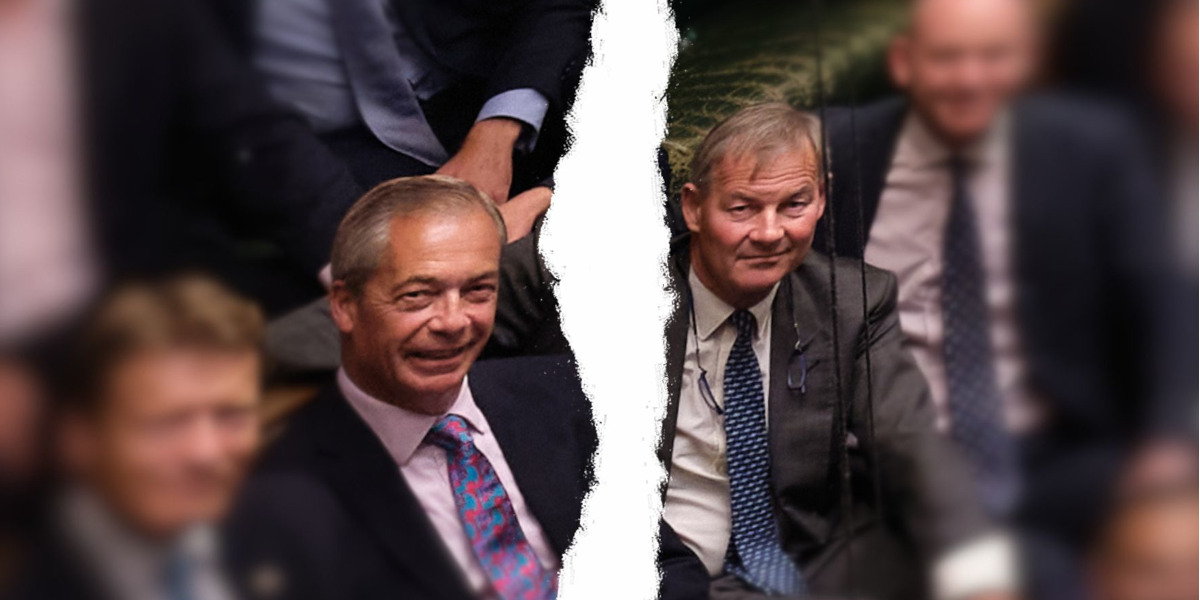
On Tuesday 7 July, Nigel Farage resigned from his parliamentary seat in Clacton, triggering a byelection for the Clacton constituency; a byelection that Farage has declared he will stand in. The leader of Reform UK said he wanted to ‘stick two fingers up to the entire establishment’. Ironically, his attempt to further cement his position as a legitimate representative for the people of Clacton has backfired.
While no Westminster parties have stood a candidate to run against Farage, 34 fringe and independent candidates have already been confirmed, including a surreal string of joke candidates – the most prominent being Count Binface.
Besides the more obviously satirical candidates, Farage is also facing a challenge from a former ally on the political right. Laurence Fox, the leader of the Reclaim Party, offered Farage his support prior to the 2024 General Election, claiming that Farage was ‘the only one … really taking the fight back to this sort of uniparty blob uselessness’.
Yet, when Farage announced that he was going to resign and re-stand, Fox posted on X that ‘Clacton is my backyard. I will be standing against Nigel Farage in this constituency.’ This new schism on the political right was described as a ‘farce made in Clacton’ in one Telegraph article.
Not so long ago, Reform UK was being trumpeted by its leader as the de facto ‘main opposition party’ to this government. Certainly, it would be difficult to deny that Reform has heavily benefited from the increasing fragmentation of the traditional two-party structure, gaining 1,454 councillors in the 2026 local elections.

A monthly dose of our best articles direct to your inbox
Reform’s growth has been enabled by the rapid decline of the Conservative party as a viable mainstream institution; a fact not lost on the Conservative party membership, resulting in a whole slew of defections to Reform UK. However, a potential rival for Farage’s nascent party has emerged, and it isn’t Laurence Fox’s Reclaim Party. Rupert Lowe, the former Business and Agriculture Spokesman for Reform UK, has established an alternative party for the rightwing voting bloc: Restore Britain.
The rivalry between the two party leaders is as personal as it is political. Nigel Farage has described his former subordinate as ‘a very vengeful man’. Lowe, in a recent interview with the Spectator, characterised Farage and his political movement as ‘managed opposition’.
It would be a mistake for the left to derive too much joy from this farcical power squabble. The true tragedy at the heart of this divide is that it may result in a more radical shift to the right in British politics.
Defections
Restore Britain’s launch has been the recipient of huge amounts of praise among the far-right commentariat, and Lowe’s crude but memorable slogan ‘millions must go’ has been echoed by many of his supporters. This surge of enthusiasm for Lowe’s alternative has already translated into numerous defections to Restore from Reform.
Two councillors from Warwickshire justified their defection by claiming that Reform has lost its way, becoming more ‘centrist’, hoping to win the popularity vote. These defections, coupled with the explosion of online support for Restore, expose a growing divide within the radical right.
In an attempt to walk the precarious line between ideology and pragmatism, Farage has flip-flopped on policies previously considered to be his strongest talking points; such as taxation and deportations. He has also been mealy-mouthed when confronted over comments made by his party members.
Matt Goodwin, whose candidacy in the Gorton and Denton byelection was supported by the far-right activist Tommy Robinson, had already faced criticism for claiming that ‘it takes more than a piece of paper to make somebody British’.
When asked about Robinson’s endorsement, or Goodwin’s comments, Farage failed to respond to the question directly, merely saying that Robinson ‘can do what he wants to do, away from us, as long as he stays away from the law, which he doesn’t always do. It’s none of our business.’
Restore vs Reform
Farage’s response exposes a fundamental vulnerability for Reform. As its leader attempts to drag the party into the political mainstream, he wants the support of the far right, but fears damage that such figures may bring to his party’s optics. Lowe appears far less constrained than Farage in this respect and has openly praised Robinson as ‘a man who loves his country’.
The radical right, who might previously have been forced to hold their noses and vote Reform, now have an alternative party to rally behind. The growing enthusiasm around Restore creates a significant problem for the so-called ‘centrist’ Reform UK.
Like their predecessors in UKIP, Restore Britain may fail to translate their grassroots and online support into enough votes to secure more than a handful of seats, but their ability to out-flank Farage from the right could have long-term consequences for the future of British politics.
The tragedy at the heart of this divide is that it may result in a more radical shift to the right in British politics
The seeds of this conflict go back to the 2026 local elections, during which Great Yarmouth First, Rupert Lowe’s previously established party – which now functions as the ‘local arm’ of Restore Britain – managed to secure all ten of the seats that they contested within the area. This small victory thwarted Reform’s attempts to establish a majority in the Norfolk County Council, with the party only obtaining 40 of the 43 seats they needed.
Prior to the election, Farage dismissed Great Yarmouth First as a ‘little local difficulty’ claiming ‘it’ll blow over’. Without a majority on the council, however, Reform’s councillors may be forced to rely on the support of other parties – and Lowe’s organisation currently holds the second largest rightwing share of seats on the council.
The early success of Lowe’s candidates in Norfolk could indicate that his new party may provide the radical right with a platform to exercise a protest vote against what they perceive as the ‘uniparty’ – which includes Reform. A poll conducted by YouGov just three months after Restore was officially registered as a party predicted that it would receive three per cent of the national vote share in a General Election.
This early surge of grassroots support shows signs of continuing. In the following Makerfield byelection, Restore achieved the third largest percentage of the vote share, not only outperforming the Conservatives, but also defeating more established parties including the Greens and the Liberal Democrats.
Moreover, Lowe has been platformed by rightwing commentators such as Joe Rogan, and has long-standing support from Elon Musk. More recently he has been endorsed by Ben Habib, chairman of the hard-right ‘Great British PAC’, and received financial support from wealthy backers such as the Cromwell Club. All this suggests that Restore has strong appeal both within the far right as a voting bloc, as well as their leading cultural figureheads.
If Restore Britain becomes the modern vehicle of the rightwing ‘protest vote’, Reform UK will be compelled to adopt evermore extreme far-right policies to appease Lowe’s supporters in the rightwing commentariat. In that case, we may live to see the emergence of a mainstream far-right party that explicitly panders to the most radical elements of the rightwing voting base.

