
This article is part of our exclusive Breaking the Sword in Occupied Palestine series – focusing on occupation and resistance in the West Bank – in partnership with The International Solidarity Movement (ISM)
‘Settlers call us “Arab invaders” then spit on my children. When the soldiers arrived…they said we were going to be burned alive. They want our land’.
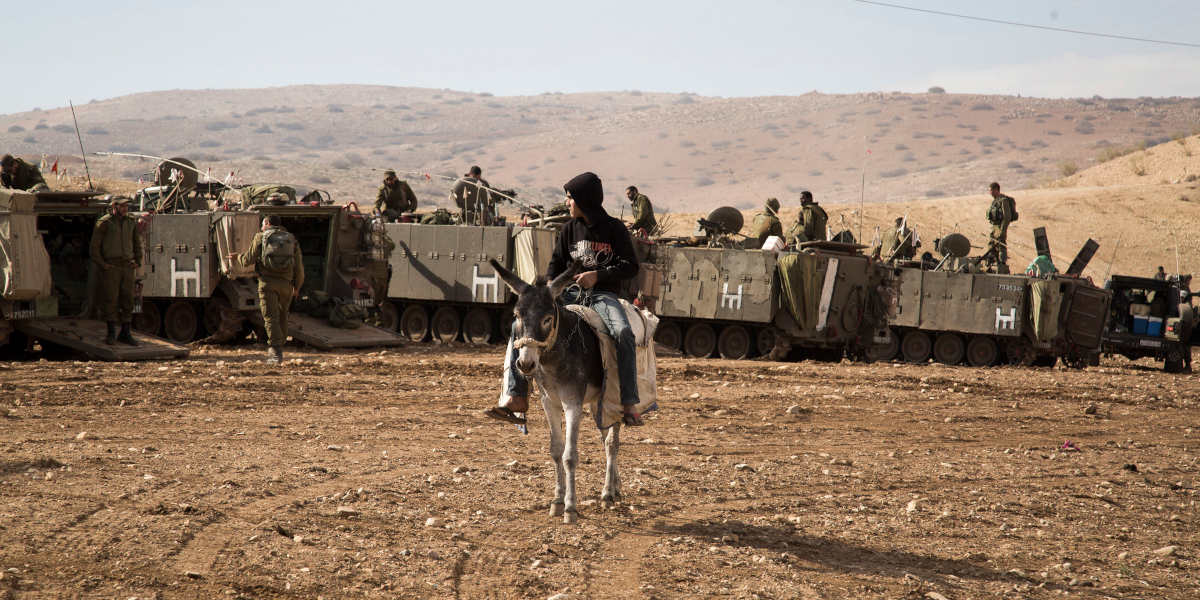
This was testimony we heard in one of our first debriefs after a night raid in the Jordan Valley from Hamden, a Palestinian shepherd whose family has lived off the land for generations. Days prior, Zionist settlers erected a rudimentary ‘outpost’ only meters away.
Hamden’s experience captures the pernicious forms of dehumanisation and dispossession that Palestinians experience under a structure of settler colonialism. He also sheds critical light on what daily life is like amid Israel’s illegal occupation and militarised apartheid regime.
There are thousands of stories like Hamden’s. Violence at the hands of Israeli settlers and Israeli Occupation Forces (IOF) soldiers is neither new nor random. Collective intimidation, coordinated attacks and war crimes under international law have been occurring for over a century and remain systemic.
In his 1967 essay, Resistance is the Essence, Ghassan Kanafani delivers a line about the crimes of Zionism that resonates to this day: ‘Namely, that what happened on the level of the land, happened to the human being. The Palestinian land was violated — and the Palestinian was also violated’.
Kanafani draws a parallel between the theft and abuse of Palestinian lands and the erosion and elimination of Palestinians as political subjects. For countless Palestinians, being on the land is inextricably linked to being fully human. To be connected to emotional and social relations, ecologies, and cosmologies that emerge from the land constitute what it means to be fully Palestinian.
Israeli terror hubs
Since 7 October 2023, settler pogroms and Israeli land grabs have increased in frequency and ferocity. As ethnic cleansing intensifies across the West Bank, settlers have made the establishment of ‘shepherding outposts’ their weapon of choice.
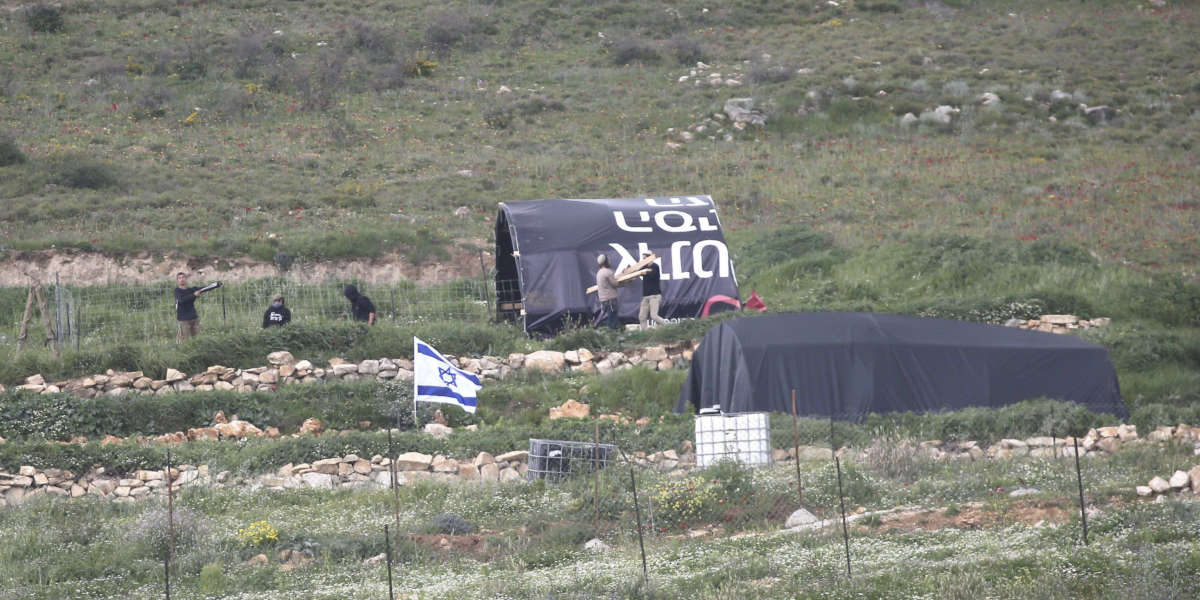
Zionists install a shepherding outpost and Israeli flags as they seize Palestinian land outside Nablus
CREDIT: SOPA IMAGES
Between 1967 and 2022, Israeli settlers stole roughly seven per cent of all the land in the West Bank. From 2022 to 2024, they doubled that to 14 per cent, stealing as much land in two years as over the previous 55. Activists on the ground estimate the number has likely tripled by 2026.
Most theft occurs via shepherding outposts, which cover more stolen land than all the illegal Jewish-only settlements in the West Bank combined. With a tent and water tank, settlers have developed an effective and dirt-cheap method of seizing Palestinian land.
For comparison, building an illegal settlement requires months of planning and hundreds of thousands of pounds for roads, housing, water, electricity, and cell service. Conversely, with shepherding outposts, Israeli settlers can steal hundreds of dunums of land at little to no cost – in a few hours – ostensibly for grazing.
Settlers use their proximity to Palestinian farms to intimidate, harass and attack local residents
One of the most effective tools for trespassing on indigenous lands and forcibly displacing Palestinian families is the grazing of unassuming animals. What is sold by settlers as a pastoral life in the rural idyll is actually a calculated programme of encroachment, enclosure and confiscation.
Ramshackle outposts are operating bases from which settler pogroms are carried out against Palestinian communities, many of whom are, in cruel irony, the land’s original stewards and shepherds. The Zionist movement has long greenwashed its settler colonial erasure of Palestine as ‘cultivation’ and ‘conservation’.
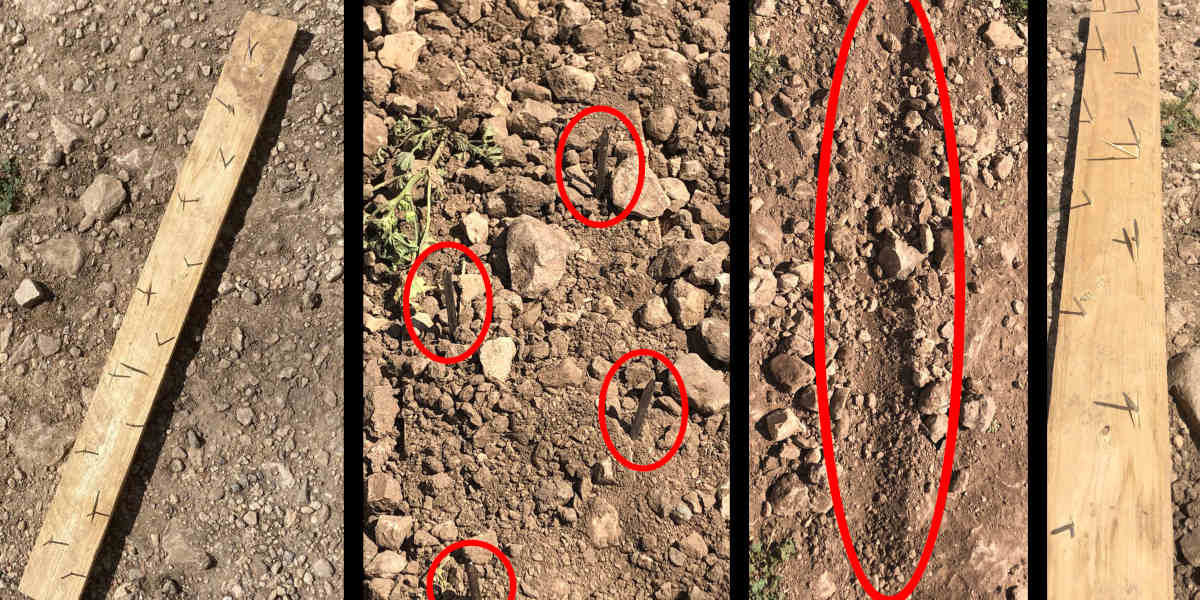
Settlers use their proximity to Palestinian farms to intimidate, harass and attack local residents. They cut water pipes, steal donkeys, massacre sheep, assault shepherds, drive ATVs through panicked herds, set fire to fields and sabotage roads using nails and spikes.
Zionist lynch mobs also raid homes to physically beat, sexually assault and even murder Palestinians before retreating to outposts to claim innocence. As Kian, a Palestinian university student and anti-prison activist put it to us: ‘The outpost is an Israeli terror hub’.
Nail-spiked boards buried in roads sabotage Palestinian farming, herding and livelihoods
CREDIT: JORDAN VALLEY SOLIDARITY
Imposing Jewish supremacy via ‘state land’
As outposts are assembled, they are adorned with Israeli flags, iron menorahs and the Star of David to send a Jewish supremacist message. The area upon which Palestinian shepherds can safely graze sheep gradually diminishes.
Families can no longer switch between seasonal grazing grounds because land left unattended will be taken by settlers. Shepherds are forced to buy feed to compensate, which forces many into crushing debt.
‘They [settlers] hate us and want to make life unbearable,’ Nabila, a Palestinian shepherd and mother of four told us. A way of life built on cyclical movement and deep ecological knowledge is suffocating under Zionism’s ever-tightening grip.
When settlers call on the IOF to restrict the movement of Palestinian herds, settlers claim the area by presenting the IOF with a ‘contract’. But how can Zionist settlers coming from outposts that are illegal under both international and Israeli law possess a legal deed? Terror on the ground works hand-in-hand with administrative procedure and colonial frontier mentality.
In a deliberately convoluted strategy, Israel allocates land to settlers through legal manipulations that rely on bad-faith interpretations of 1858 Ottoman-era law. The code, which was meant to encourage agricultural production and increase tax revenue, stipulated that land unused for three years would revert to ‘state land’.
For countless Palestinians, being on the land is inextricably linked to being fully human
In its original context, the law belonged to an entirely different political order and served an entirely different administrative purpose. Under Zionism, it has been instrumentalised for dispossession. A centuries-old statute tied to farming and taxation became a pretext for conquest.
More fundamentally, it is irrational for a settler colonial entity engaged in an illegal and hostile military occupation to cast itself as the legitimate authority to which Palestinian land would somehow revert. Nevertheless, for decades, the Israeli government has undertaken an extensive programme of (re)mapping and (re)categorising ‘state land’ for the sole purpose of Jewish-only settlement.
Colonial maps and ‘facts on the ground’
Israel has long manufactured ‘facts on the ground’. This includes designating areas as ‘closed military zones’, leading to violent evictions and criminalisation. After Palestinian expulsion, the government classifies it as ‘state land’ by arguing that it is ‘unused’.
From there, newly labelled state lands are transferred to Zionist organisations that fund and further coordinate annexation. These include the World Zionist Organization (WZO) and Jewish National Fund (JNF), who manage the stolen (now ‘state’) land.
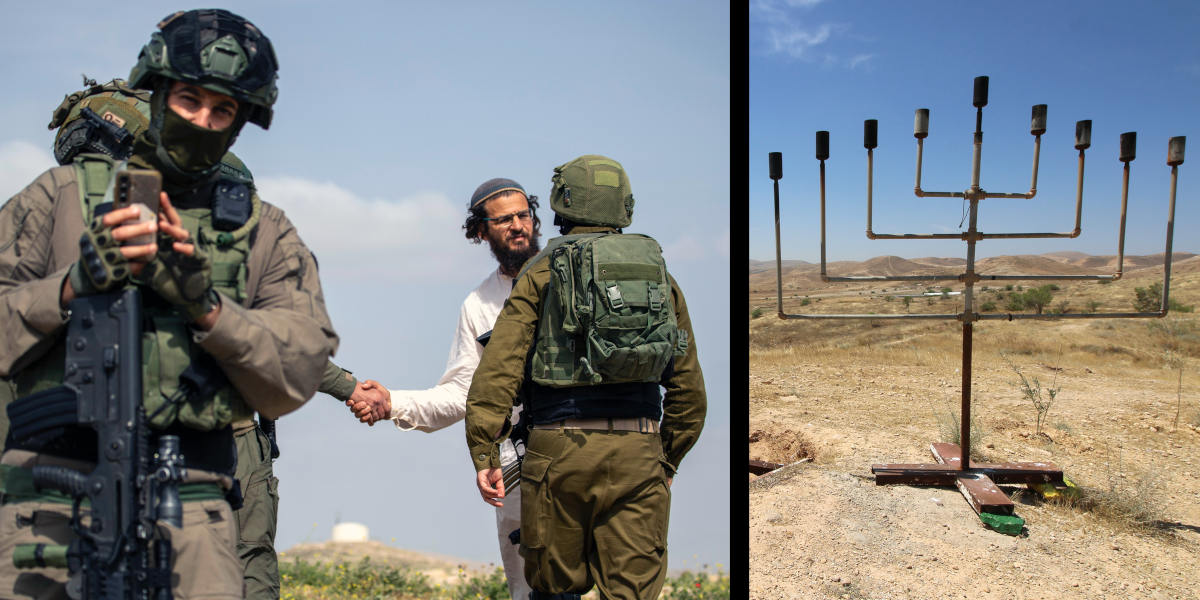
Israeli settlers and soldiers use Jewish symbols to assert religious supremacy and steal Palestinian lands
CREDIT: ACTIVESKILLS
This arrangement allows the WZO and JNF, as non-governmental organisations, to give land to settlers illegally occupying the West Bank for agricultural ‘development’. Conveniently, Israeli administrators are shielded from official involvement and the state is afforded plausible deniability.
One example from the WZO is the allocation of grazing contracts to settlers who build outposts. The contracts are expansive, vague and structured to facilitate land grabs. Maps are purposefully inaccurate and include differences between the number of dunums specified in the contracts versus areas marked for settler grazing.
Inaccuracies also involve maps that overlap with private Palestinian lands, closed military zones, protected nature reserves and areas held under Palestinian civil control (Area B). These discrepancies turn ambiguous, error-riddled maps into cunning if not absurd instruments of dispossession by allowing settlers (often escorted by the IOF) to invoke the ‘legitimacy’ of the colonial contract and map.
For Palestinians and anyone in solidarity with Palestinian liberation, sham contracts and cynical ‘facts on the ground’ are irrelevant because there is no ‘legal’ or moral way to (re)allocate stolen Palestinian lands.
Studying mechanisms of dispossession like shepherding outposts, grazing contracts and colonial maps thereby clarifies why complicit Zionist institutions such as the WZO and JNF must remain key targets of resistance.
The names of interviewees have been changed to protect their identities

