
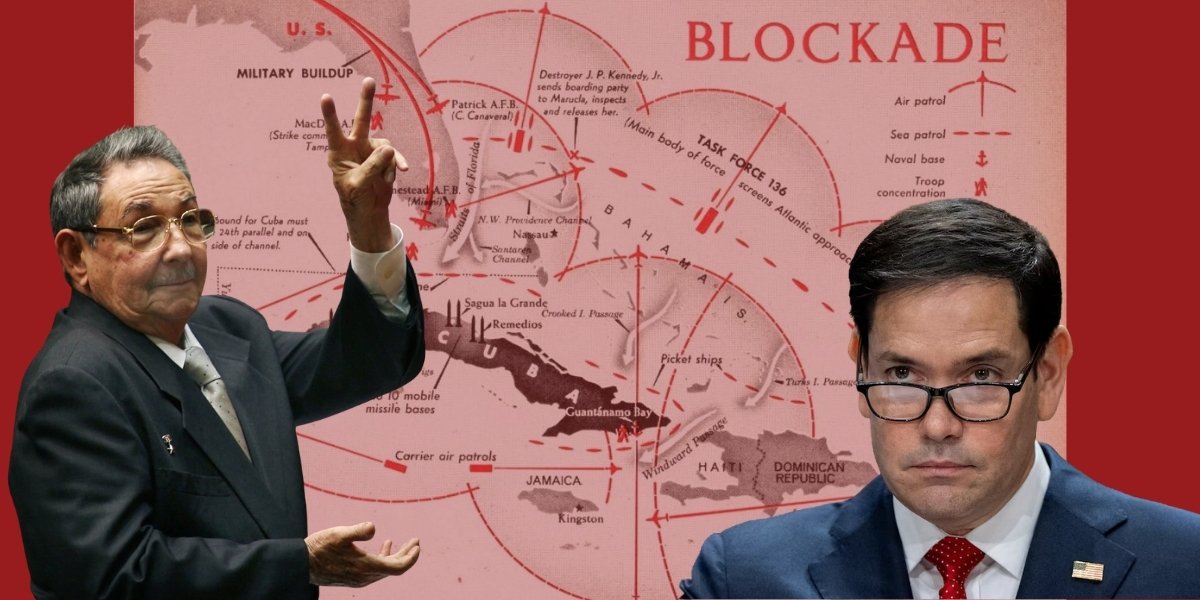
On 18 May 2026, Cuba’s representative to the UN’s World Health Assembly, Dr Tania Margarita Cruz Hernández, denounced the threat of US military aggression, stating that ‘nothing could justify such a brutal and uncivilised act on the part of the superpower’. Cuba, she said, calls on all peace-loving nations to mobilise to prevent such aggression, adding that ‘the Cuban people will defend their sovereignty and independence’. Her statement comes as US government warmongering reaches a fever pitch unseen since the 1962 Cuban Missile Crisis when some officials urged President Kennedy to invade or ‘nuke’ the island.
Even before the threat of nuclear conflagration, the US was waging economic warfare against revolutionary Cuba. It is the foundation of US policy, set out in a 1960 secret memorandum by US diplomat Lester Mallory which acknowledged the government’s popular support and proposed economic warfare ‘to bring about hunger, desperation and overthrow of government’. Backed by a powerful hard right exile lobby, US President Donald Trump and Secretary of State Marco Rubio are pushing this strategy to its extreme.
Trump’s first administration adopted a ‘maximum pressure’ policy, introducing over 240 new sanctions and coercive measures to cut Cuba off from global trade, investment and the international financial system. This coincided with the COVID-19 pandemic and hit Cuba hard: electricity blackouts returned, goods and medicines became scarce, inflation and emigration soared, and international reserves were drained.
Cubans were struggling before Trump returned to office, with a Secretary of State whose career was built on hard-line opposition to Cuban socialism. Trump and Rubio are set on regime change in Cuba by year’s end.
On 29 January, Trump signed an executive order claiming that Cuba constitutes ‘an unusual and extraordinary threat’ to US national security and foreign policy and authorising tariffs on goods from countries selling or providing oil to Cuba. This followed the December 2025 seizure of tankers carrying Venezuelan oil and the violent abduction of Venezuelan president Nicolás Maduro and his wife, Cilia Flores, on 3 January. The US took control of Venezuelan oil. Mexico and other countries abandoned oil shipments to Cuba.
A genocidal policy
The US oil siege has had immediate and devastating effects on every sector in Cuba: hospitals, schools and universities, industry, transport, the cold-chain, food production and distribution, water pumping and gas supplies, rubbish collection, and so on. It is a genocidal policy, generating universal suffering but particularly hitting vulnerable Cubans: children, the elderly and infirm, pregnant women forced to give birth by phone light, and premature babies in incubators.
The attack on Iran on 28 February 2026 has not stopped US threats against Cuba. Rubio declared on 27 March that ‘Cuba’s economy needs to change, and their economy can’t change unless the system of government changes’. Previously Trump boasted that he would have ‘the honour of taking Cuba’ adding, ‘think I could do anything I want with it’ (16 March). He nonchalantly suggested that the US military could stop by Cuba on return from Iran. This is psychological warfare, an integral component of US aggression.
Cuba’s alternative model of development places human welfare and environmental concerns at its core
Cuban leaders have responded by affirming their commitment to peace and dialogue, while warning that any attack would be met with fierce resistance, resulting in heavy casualties on both sides. Nearly five months into the oil blockade, Cuba has not collapsed and neither has the population revolted. In the last ten days of April, over 6.2 million Cubans, from a population of under 10 million, signed a petition repudiating the US blockade, the oil siege and threat of military attack and asserting the country’s right to peace and sovereignty. On 1st May, half a million Cubans marked international workers day with a march past the US embassy in Havana; millions more marched around the country.
As punishment, Trump issued a second executive order on 1st May, reiterating that Cuba threatens the US, and announcing sweeping extraterritorial sanctions to punish entities from anywhere in the world engaging with Cuba. Further sanctions followed on 7th May – so harsh and sweeping they compelled Canadian mining company Sherritt International to immediately end operations in Cuba after thirty years. Other companies followed suit, including shipping companies on which Cuba relies for most of its shipping traffic.
On 8 May, Rubio claimed the Cuban government turned down the US offer of $100 million in humanitarian aid. Not true, replied the Cubans. Regardless, the offer is absurd given that Cuba’s humanitarian crisis is the intended result of US policies. The ‘offer’ amounts to $10 per Cuban, while Cuban losses due to the US blockade were $7.5 billion just between March 2024 and February 2025; nearly $639,000 a month.
By 2025, the cumulative cost was over $170 billion since 1962. If the US were serious about alleviating the humanitarian crisis, it would end the US blockade and remove Cuba from its spurious State Sponsors of Terrorism designation, which locks the country out of the international financial system and obstructs transactions, trade and investment.
Psychological warfare
Lies and leaks are integral to this psychological warfare, including recurring speculation about secret talks with ‘the Castros.’ Cuban leaders acknowledge exploratory discussions have taken place about the scope of any future dialogue, but insist that neither Cuba’s political and economic system, nor its leadership, are up for negotiation. Speculation intensified after the CIA director John Ratcliffe met Cuban officials in Havana on 14 May at Washington’s request. The visit itself undermines US claims that Cuba is a ‘failed state’. Washington would not send its top intelligence chief to a state in collapse.
Now the US is scrambling to manufacture evidence that Cuba poses a threat. On 17 May, a report citing classified sources and anonymous (and therefore unaccountable) US officials claimed Cuba had acquired 300 drones and noted that this intel could be used by Washington as a pretext for military action. After a week of speculation, on 20 May, a US federal criminal indictment was issued for Cuba’s former president, 94-year-old Raúl Castro. This was over the 1996 shootdown of two planes operated by the right-wing exile group Brothers to the Rescue, which had violated Cuban airspace 25 times, even dropping leaflets over Havana.
Having infiltrated the group, the Cubans were aware of its terrorist plans and, after issuing multiple warnings to US and international authorities, downed the planes, killing four people. The incident prompted President Clinton to sign the Helms Burton Act later that year, dramatically expanding the extraterritorial reach of the US blockade to deter third parties from trade and investment with Cuba. In Venezuela, an indictment against Maduro enabled Trump to frame the military attack as a law enforcement issue, not war, sidestepping Congress and the War Powers Resolution.
This is all designed to manufacture consent for a military attack. We are to forget that the US has carried out extrajudicial killings of nearly 200 people in boats in the Caribbean and eastern Pacific, to forget the Iranian school bombed on day one of the US attack, killing over 170 children and teachers and accept that Cuba is the threat.
What form a US attack might take is hard to predict. The so-called ‘Venezuelan model’ of removing the head of state would not work against Cuba’s government which operates on consensus, placing a premium on unity. Meanwhile, US war with Iran shows that overwhelming military superiority does not guarantee a quick or easy victory.
Cuba’s alternative
Cuba has had the audacity to survive over six decades of US hostility, including overt and covert military actions, sabotage and terrorism, economic warfare, political ostracization, the promotion of dangerous emigration, the obstruction of remittances, family visits, and visas; and lucrative funding for regime-change programmes. Cuba continues to defy expectations and flout the rules.
However, its best form of resistance has been not just the assertion of national sovereignty, but the creation of an alternative model of development that places human welfare and environmental concerns at its core. This poor, blockaded island has achieved world-leading human development indicators and the highest ratio of doctors per person. It has mobilised the world’s largest international humanitarian assistance, with more than 600,000 Cuban healthcare professionals saving and improving lives in over 180 countries. It has contributed to global innovations in medical science, including the world’s first meningitis B vaccine, a lung-cancer immunotherapy, COVID-19 vaccines, and a treatment that heals diabetic foot ulcers. Even now they are trialling a promising new treatment for Alzheimer’s. Cuba’s contributions in sport, music, culture and the arts are admired throughout the world.
Cuba’s only threat to the United States is as a good example. As Fidel Castro warned before the Bay of Pigs invasion, Cuba would not be forgiven for carrying out ‘a socialist revolution right under the nose of the United States!’ We are left to ask, what could the revolutionary people of Cuba achieve if they were left in peace – if they were finally given the chance to prosper, and not just survive.

