
Brazil lives in the shadow of a military dictatorship, which lasted between 1964 and 1985. This ongoing legacy is reflected in two of the most successful Brazilian films of recent years – I’m Still Here and The Secret Agent.
For São Paulo-based playwright Filipe Pereira, the transitional process into a renewed democratic government wasn’t straightforward; ‘Rather than a clear-cut overthrow of the military regime, amnesty was offered to both the resistance and the military generals. At the same time, even after its fall, nostalgia for the military dictatorship has remained a feature of Brazilian life. There is a sentiment among many Brazilians that the military regime was a time of law and order, during which only communists and criminals were persecuted. The Red Scare was, and remains, very present in Brazil’.
At the same time, Pereira notes how this has helped foster a healthy spirit of cultural resistance in São Paulo, and further afield. He acknowledges the companies that took part in a movement known as Arte Contra a Barbárie (Arts Against Barbarism), paving the way for the Lei Municipal de Fomento ao Teatro (the Municipal Act on the Promotion of Theatre) in São Paulo. This movement included companies like Grupo Folias d’Arte, Companhia do Latão and Teatro Popular União e Olho Vivo, which fused activism with collaborative creative practice.
Lula, Bolsonaro and the arts
This culture of flourishing cultural activity was fostered by President Luiz Inácio Lula da Silva, following his landmark election in 2002. Shortly afterwards, legendary musician Gilberto Gil’s tenure as Minister of Culture, between 2003 and 2008, transformed cultural policy – increasing the department’s expenditure by over fifty per cent.
This was not to last. That nostalgia that Pereira talks of was soon, among other causes, to enable the election of Jair Bolsonaro in 2018.
Under this new right-wing government, Pereira recalls, ‘artists were consistently vilified and subject to right-wing smears. Bolsonaro also took measures to cut cultural funding, including abolishing the Ministry of Culture days into his presidency’.
Fortunately, in São Paulo, some jurisdiction over arts funding remained, via the Lei Municipal de Fomento ao Teatro, allowing companies like Pereira’s to continue to operate.
At the same time, Bolsonaro’s tenure created an urgent need for theatre makers to address burgeoning social issues. Pereira explains how, in 2019, ‘the Bolsonaro government deregulated labour laws in favour of business owners, encouraging individuals to shift their status from employee to employer. Work is generally considered a virtue in Brazil, and being a workaholic is often a source of pride.’
He talks of the ensuing ‘Uberization’ of Brazilian society, in which more people were forced to turn to precarious forms of self-employment – framed as an emancipatory move.
‘Pick your poison’
This, together with the pandemic, was the context within which Pereira’s company, Companhia no F!M (Company at the End), started making work together in 2021.
He recalls of the time: ‘There was a disease, a terrible government, rising fascist sentiment, and we had no idea what was going to happen. It was a case of pick your poison, which gave us plenty of material’.
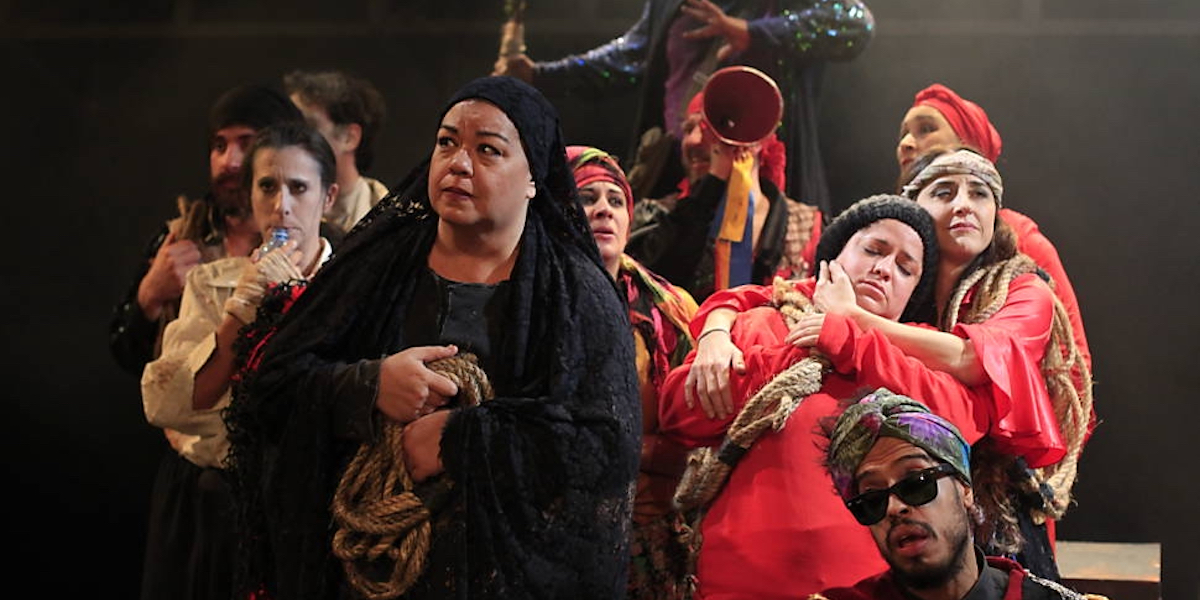
Pereira’s play The Last Remaining Video Store is Still in Business, presented at the Out-of-the-Wings Festival in 2025, reflects this context. It depicts three employees in a video store who refuse to stop working despite an ongoing apocalypse.
Bolsonaro’s tenure created an urgent need for theatre makers to address burgeoning social issues
Pereira’s politically-driven practice corresponds to wider trends in contemporary Brazilian theatre. He draws attention to theatre companies ‘making work in the suburbs, in defiance of the cultural hegemony of the city. These companies often take their work into public and unconventional spaces – not only into the streets or town squares, but into the true peripheries and even onto public transport’.
As examples of this wider movement, he singles out Brava Companhia, Grupo Clariô de Teatro, Companhia de Teatro Heliópolis, Pombas Urbanas, Grupo Pandora de Teatro, Zózima Trupe, and Coletivo Estopo Balaio.
Lula’s return
Pereira says ‘the reelection of Lula in 2022 was attributable to another kind of nostalgia’, this time for the poverty reduction wrought by Lula’s previous two terms (2003-2010). ‘Lula’s election ushered in a renewed sense of hope of greater investment in public services and the arts’. Yet, at the same time, the precarisation of Brazil that Pereira’s theatre making homes in on has not been resolved.
As Pereira sees it, ‘the corruption charges that led to Lula’s 2018 arrest – though ultimately nullified – were weaponised by the right, driving Lula to adopt a more conciliatory approach in his third term, limiting the scope of his policy changes. The problems Brazilians faced under Bolsonaro have not disappeared’.
Pereira’s latest play, Work While They Sleep, can be read as a response to these ongoing challenges. The play, through a sci-fi lens, reflects on the pressures placed on Brazilians to maximise their productivity in a volatile economy, while women still disproportionately carry the burden of unpaid domestic labour.
A continuing rollercoaster
Does Pereira see reasons for hope in Brazil? As our conversation turns to the 2026 elections, he describes the situation as ‘a rollercoaster. Although Lula’s approval ratings steadily increased into late 2025, recent US interference in Latin America has made the future uncertain’.
‘Democratic intervention limited to electoral participation is not enough to bring about meaningful change, while culture can play a key role in enabling a collective realisation of this’.
While he admits that he does not feel particularly hopeful, he says he tries to maintain a sense of pragmatic optimism; ‘We have to complain, we have to cry, but it’s over when we’re dead’.
Work While They Sleep plays at the Camden People’s Theatre 13-16 May 2026, then will tour to Salford’s Working Class Movement Library and Bradford’s 1 in 12 Club as part of the UK/Brazil Season of Culture

