
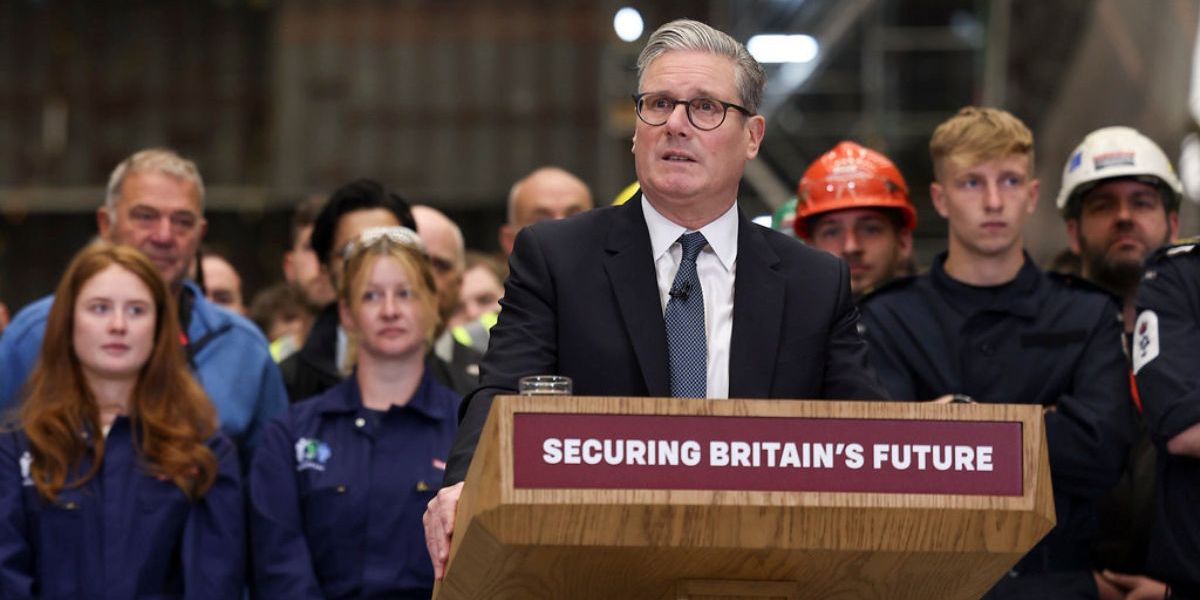
While the UK Government has so far played a limited role in the war on Iran, the broader trajectory of UK defence policy remains one of increasing military expenditure and preparedness. Keir Starmer has committed the UK to an assertive international military role, co-leading the so-called ‘Coalition of the Willing,’ and committing to establishing a ‘Multinational Force Ukraine’, or MFU.
The government claims increased defence spending will increase homeland security and create new economic opportunities and jobs. The Alternative Defence Review (ADR) – a systematic civil society response launched in May 2025 and co-authored by trade unionists, academics, and campaigners – argues that these claims are unfounded.
The deterrence myth
In terms of UK homeland security, military build-up does not deter attack. As outlined in the ADR, greater defence spending tends to increase the likelihood of conflict. Far from making us safer, more weapons procurement can increase our vulnerability to attack by escalating arms races and fuelling international tensions. Current attacks on Iran illustrate this dynamic, with escalating military action intensifying insecurity and heightening the risk of wider conflict.
The UK government’s decision to cut aid in order to increase defence spending will roll back gender equality and education programmes, both considered essential to peace and security. Such reductions risk deepening instability abroad, ultimately undermining security at home.
Increased defence spending will neither improve opportunities for working people and their communities in the UK. It will come at enormous cost, largely benefitting the US and globalarms industries, as with the recent order for F-35A jets, capable of carrying nuclear bombs.
The evidence suggests that Military Keynesianism does not work. While full employment and a boost to the economy can be achieved by almost any kind of government expenditure, defence spending is among the least effective. For each job subsidised in defence, there will likely be several lost in the public sector, leading to a net loss overall.
While the UK spends more on defence than almost any other country, thousands of children live in Dickensian levels of poverty
Ploughing vast public funds into defence comes at a wider cost to other state provision: while the UK government is already spending more on defence than almost any other country worldwide, public services are being squeezed and thousands of children live in ‘Dickensian levels’ of poverty.
As well as resulting in death, injury and psychological trauma, defence production has a significant environmental cost in terms of greenhouse gasses, pollution and depleted non-renewable resources. The UK’s military-industrial sector already emits more carbon than 60 nation states.
The proposed fossil fuel alternatives – biofuels, critical minerals, nuclear – will only increase other forms of ecological harm. In contrast, transitioning defence sector employment into green energy and infrastructure jobs would progress the transition to sustainability, rather than set it back.
Mobilising workers
In 2025, the Trade Union Congress passed the motion ‘Welfare Not Warfare’. It called for a shift in government priorities away from escalating military expenditure and towards investment in public services, decent jobs and social security. The motion reflected growing concern within the trade union movement that security should be defined by strong public services and economic justice, not simply by higher military spending.
In 2022, I carried out research on defence diversification, interviewing current and former defence workers on their views regarding Just Transition. Understanding the views and gaining the backing of those already employed in the sector are essential for accomplishing a green transition of defence.
Many expressed an interest in arms conversion. A woman working in US defence manufacturing told me she didn’t want to ‘support making machines of war’ and would feel better about her life in another job. A man working in UK government defence administration similarly said he’d ‘certainly do a greener job’ in an area where he could use his expertise or skills, if the money was right.
Initiatives like the 1970s Lucas Plan show what’s possible when workers organise to propose socially useful alternatives. Then, aerospace workers developed detailed proposals to shift production towards medical equipment, renewable energy technologies and public transport systems – demonstrating both the technical feasibility and the social value of conversion.
Today, a comparable approach could involve defence workers leading the transition into offshore wind manufacturing, low-carbon transport, housing retrofit programmes, and climate adaptation infrastructure – all sectors where their existing skills are directly transferable and urgently needed.
Rethinking ‘security’
The UK government’s and NATO’s new military spending target of five per cent GDP represent a failure to engage with what security means to most people in the 21st century. National security is not defined by the size or sophistication of our weapons systems. It can only be achieved through the interlinked approaches of human security and common security.
Human security includes protecting people from poverty, pollution, exclusion, and extreme climate events. It requires a reallocation of resources towards the services and infrastructures that truly keep us safe: healthcare, education, housing, environmental protection and secure employment.
Common security implies that no nation can be secure while others suffer. It means developing cooperation, solidarity, conflict prevention, and climate action – not competition over arms stockpiles.
National security can only be achieved through the interlinked approaches of human security and common security
Informed analyses, like those presented in the ADR, present clear, evidence-based visions for rethinking what truly keeps workers and communities safe. Reallocation of public resources toward the support, services, and infrastructure protect lives in real and lasting ways. Rather than fuelling arms races or subsidising corporate profit, the government must invest in the common good.
In practice, the alternative demands investment in public services and green jobs, while working with unions such as Unite, GMB, Prospect and PCS to develop credible transition pathways for the workers currently employed across the UK defence sector and its supply chains.
This could include sector-wide agreements on retraining, redeployment and job guarantees, alongside public investment targeted at regions most dependent on defence contracts. On a global scale, it means prioritising diplomacy, arms control and conflict prevention over escalation.
Realising these shifts will require coordinated action, from the government setting industrial strategy, from unions organising within workplaces and from civil society sustaining pressure for change. If current and recent conflicts tell us anything, it is that more weapons do not bring us closer to security. They move us further from it.

