



On the face of it, Scotland’s political class has been supportive of people’s right to protest in solidarity with Palestinians. The Scottish Parliament has passed several motions calling on the UK government to recognise the Palestinian state and in September 2025, it voted to impose boycott, divestment and sanctions measures including banning government funding of arms companies supplying the Israeli Defence Force. Former First Minister Humza Yousaf was particularly vocal about Palestine, calling for then-Home Secretary Suella Braverman to resign in November 2023 after she referred to Palestine demonstrations as ‘hate marches’.
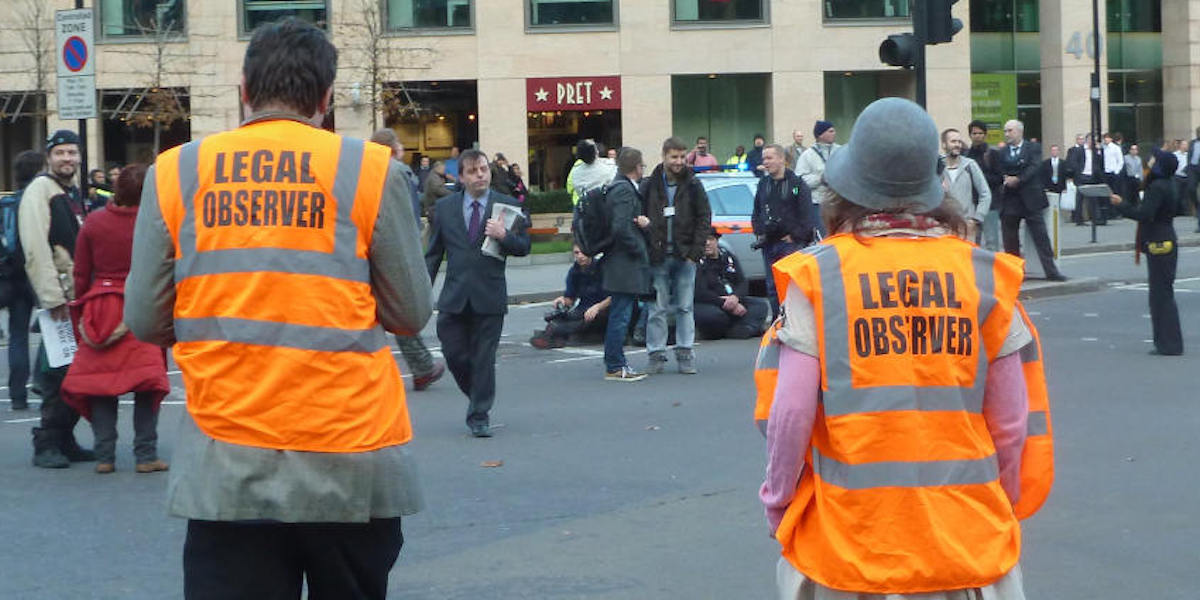
But these interventions are only part of the story. Grassroots legal rights and police monitoring organisations, Scottish Community Activist Legal Project (SCALP) and The Network for Police Monitoring (Netpol), are exposing the extent of repression Palestine solidarity movements face in Scotland. Responding to the increasingly authoritarian nature of protest policing, monitoring groups draw on a range of established strategies, including legal observing at protests, ‘know your rights’ education and supporting arrestees after release from custody. This is both a radical alternative to pursuing accountability through official complaints mechanisms and an opportunity to connect and learn from a longer history of the use of police monitoring by racialised communities in resisting their own criminalisation.
In doing so, SCALP challenges Police Scotland’s carefully cultivated image that aims to distinguish it from the rest of the UK by emphasising consensus and ‘facilitative policing’.
Familiar tactics of repression
A SCALP and Netpol report, From Scotland to Gaza, is based on data gathered through interviews and written testimony from protestors and legal observers, their court support database, and over 100 Freedom of Information (FOI) requests to Police Scotland and other official bodies. Covering October 2023-October 2024, the report is a snapshot within a broader picture of escalating repression of Palestine solidarity action across the UK, complementing Netpol’s 2024 report, In Our Millions, which focused on the policing of the movement in England and Wales under the Sunak government.
From Scotland to Gaza reveals a spectrum of repressive police tactics to subdue and deter protestors, from overt force to surveillance. It documents the alarming force used in July 2024, against a picket of a factory in Govan, Glasgow, operated by French defence giant, Thales, targeted due to its significant role in supplying components to Israeli arms companies.
Having left the Thales site, a group of protestors were followed by police to a nearby Subway station and subjected to an unprovoked violent assault. Protestors were thrown to the concrete, and incapacitant spray and baton strikes were used indiscriminately; one woman needed staples for a head wound. An officer was captured on video shouting ‘run for your lives’. Protestors reported suffering serious mental health impacts. Yet, no disciplinary proceedings were brought against the officers involved.
Documenting injustice
The extremity of the force used in Govan attracted some media coverage, but monitoring revealed other highly troubling issues that might have otherwise slipped under the radar. Testimonies demonstrate targeting of young racialised people; at one Glasgow protest, police told a group of young Muslim men that they could not march, arresting some of them when they tried to join. In another account, a racialised protestor was harassed and assaulted by a group of men during a protest but was ignored when they reported this incident to police.
Independent monitoring also reveals more subtle forms of repression. Extensive police surveillance of protestors has long been criticised for its infringement of civil liberties. Monitoring in Scotland found that pro-Palestine activists were frequently filmed, including by drones, despite Police Scotland denying this. Journalists were also prevented from documenting and reporting on protests, sometimes under threat of arrest.
FOI data obtained by SCALP saw a fourfold increase in the number of people arrested and charged with organising ‘illegal’ demonstrations, between 2023 and 2024; sometimes accompanied by bail conditions posing extreme restrictions on their movements. Police Scotland appear to have adopted an insidious tactic of initiating a process of ‘dialogue’ with protest organisers, but then threaten those people with arrest if they do not continue to ‘liaise’; a coercive use of ‘facilitative’ policing previously observed with movements such as anti-fracking protest. Documenting these subtler forms of repression is important in helping activist groups become more prepared for tactics aiming to intimidate, exhaust or manipulate them.
However, there has been a dramatic escalation in overt tactics of repression since the UK government proscribed Palestine Action in July 2025, including thousands arrested for supporting the organisation. In early 2026, over 20 people arrested in Scotland were still waiting to hear if their terrorism charges would proceed, pending a judicial review.
Disturbingly, three ‘Shut Down Leonardo’ activists, explicitly not associated with Palestine Action but with a group challenging another arms company implicated in the genocide, were arrested and charged under terrorism legislation after targeting an Edinburgh-based arms company shortly after the ban. These are further indications of the increasingly authoritarian repression of solidarity activism; criminalisation is being used to curb protest and delegitimise dissent.
Countering repression through accountability
This work has revealed a mismatch between the Scottish political elites’ apparent endorsement of the Palestine solidarity movement and the reality on the ground. This disconnect feels all too familiar. There is a widespread assumption of Scottish exceptionalism, a smug complacency that it is ‘more civilised’ here. This belief persists despite high profile incidents that challenge Police Scotland’s cuddly image, such as the deaths at the hands of police of Sheku Bayoh in 2015 and Badreddin Abdalla Adam Bosh in 2024.
At a time of extreme repression of protest, grassroots monitoring of police abuses of power is crucial. A 2020 Netpol report concluded that the policing of BLM protests was institutionally racist due to excessive force and the targeting of Black protestors. We cannot allow the state to control the narrative about its own use of force. Instead, as veteran copwatcher Kevin Blowe of Netpol insists, we must monitor an ‘institution that constantly monitors us’. The SCALP report amply demonstrates how a methodology of legal observation, supplemented by investigative tools such as FOI enquiries, can equip us with a powerful counternarrative. Despite being resource intensive, it is deeply empowering for movements to undertake this painstaking work.
In early November 2025, several imprisoned Palestine organisers went on hunger strike in English prisons and risked life-changing health consequences and even death, while ministers refused to engage. However, this may yet be seen as a significant moment in further galvanising support, given the reported surge in numbers of people committing to taking action in solidarity. The horrifying indifference of the authorities to the rights and welfare of both solidarity protestors and Palestinians themselves has been sickening to witness. But it also places urgent questions before those of us who stand against this indifference. What kinds of tactics of repression can we expect? And how can we support and sustain our work? The solidarity that is evidenced through local police monitoring projects gives us some valuable and practical answers.