
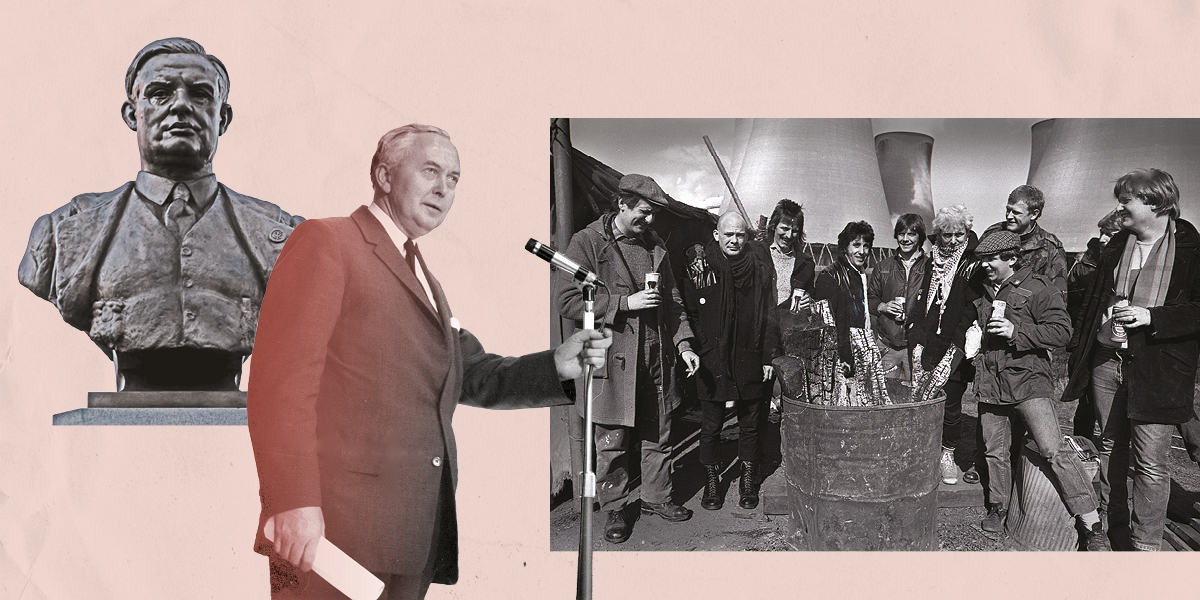
‘Do you remember 1926? The Great Dream and the Swift Disaster?’ Idris Davies, once a miner in the Rhymney, posed the question in his narrative poem, ‘The Angry Summer’. But remembering poses problems. In 1926, while the nine-day general strike was a swift disaster, the agonising months of the miners’ lockout were anything but.
The nine-day stoppage involved three million workers, with the contrast between union leaderships and members often stark. At the local level, those days were often notable for the creativity and solidarity of the strikers, especially on the railways. In rural areas and many small towns, the absence of trains was the sole evidence of the national mobilisation. In this rule-governed industry almost everyone in the traffic grades stopped work. When the hasty ending of the stoppage indicated that the railway companies would victimise some strikers, railwaymen continued the strike and secured a more favourable outcome.
The TUC shambles
In contrast, the general strike at national level was a shambles. Trade union leaders called the strike reluctantly and without any strategy for achieving a better settlement for the miners’ federation (MFGB), whose conditions had worsened. When the Baldwin government characterised the stoppage as ’unconstitutional’, trade union officials, as devout constitutionalists, had no answer. Their hasty abandonment of the strike confused their own members and incensed the MFGB, with Jimmy Thomas, the leader of the National Union of Railwaymen, becoming a hate figure in the coalfields for decades.

A monthly dose of our best articles direct to your inbox
Beatrice Webb, with characteristic condescension, dismissed the general strike as ‘a proletarian distemper’. Behind this dismissal lay a significant development. Trade union leaders and many union activists acknowledged that the achievement of many of their objectives necessitated political action and that meant working within and in partnership with the Labour Party. In its early years the party had acted as a parliamentary pressure group for organised labour. By the mid-1920s, the fact of one minority Labour government and the expectation of successors based on increasing working class support suggested a more ambitious agenda. The objective was a majority Labour government in partnership with the unions.
No inevitability
But there would be no inevitable forward march of Labour. The 1945 Attlee government marked the apogee of the strategy, but ideological differences and tensions between unions and Labour ministers ensured that subsequent Labour governments lacked its cohesion. Ultimately, the decline and in many cases the destruction of the party’s industrial base meant that the strategy developed in the aftermath of the general strike was no longer sustainable.
Ernest Bevin, leader of the recently formed Transport and General Workers Union, personified this agenda. His scepticism about career politicians meant a lack of deference towards Labour leaders, not least when they were ministers. In August 1931, he led the TUC opposition to the second Labour government’s proposals for economic cuts, most symbolically in unemployment benefit. The government fell. Five ministers, including Labour’s first prime minister Ramsey MacDonald and Jimmy Thomas, joined a National Government. But the party remained essentially united in resistance to an economic policy that the unions opposed but senior Labour politicians had reluctantly accepted.
This success for the post-1926 strategy came with a heavy cost. Post-1918, anti-Labour politicians sought an electoral arrangement that would confine Labour to opposition. In the 1920s the eccentricities of the first-past-the post electoral system produced two minority Labour governments on relatively small shares of the vote in what was in effect a three-party system. Whenever the Liberals polled credibly the Tories suffered. But in the 1931 crisis the National Government brought Tories and Liberals together in an alliance that endured through the 1930s. In contests offering a choice between Labour and a united anti-Labour front, Labour lost catastrophically in 1931 and very decisively in 1935. There was no reason to believe that the next election due by the end of 1940 would produce a different result.
The consequences of war
In May 1940, however, the tectonic plates shifted. The fall of Neville Chamberlain was followed by a coalition under Winston Churchill in which Labour politicians were leading figures. It could be characterised as a Labour coup. Military disaster, epitomised by the evacuation from Dunkirk, and the subsequent publication of the hugely influential Guilty Men denouncing 15 members of Chamberlain’s government as appeasers, condemned 1930s governments as incompetent and unpatriotic. The Attlee government, having broken decisively through the electoral ceiling, initiated what appeared to be a durable social democratic settlement in an adverse economic environment.
While the nine-day general strike was a swift disaster, the agonising months of the miners’ lockout were anything but
After 1945, the pre-war depression seemed a subject for museums; the National Health Service was celebrated; children grew up in decent social housing. The realisation of the vision mattered for millions. Co-operation between the unions and the government remained close even when this involved limitations on wages. This harmony was facilitated by the cold war. Critics of the government within the unions were often Communists and could be marginalised. In opposition and especially after the Communist Party’s crisis over Stalin’s crimes and the Hungarian uprising, this tactic would become less effective. Many Communist trade unionists left the party, a shift that would strengthen the credibility of the left within it.
What next after 1945?
After Labour’s loss of office in October 1951, the party faced a challenge. The post-war settlement of an apparently reformed capitalism had delivered much of what the labour movement had wanted. But the outcome was emphatically not a socialist society. This issue lay at the heart of the party’s identity and purpose. Inevitably it proved divisive. Trade union backing for the party leadership became less predictable, most notably in the party conference support for unilateral nuclear disarmament in 1960. Many within the party celebrated the party’s narrow election victory in 1964 and the substantial victory 18 months later as a second 1945. They were spectacularly mistaken.
Looking back now, across the debris that is the legacy of Thatcherism and its subsequent followers, the Attlee and Wilson administrations can seem like social democratic interludes in a bleak history. In fact, these two governments were very different. The Wilson years were profoundly disillusioning for many on the left. A rhetoric of modernity that destroyed many jobs, not least in the coalfields, went along with an incomes policy that was used as a means of restraining wages. The Wilson administration experienced defeat in supposedly safe seats as its working-class vote collapsed. Trade unions became more critical.
Union-party relations in crisis
This deteriorating relationship between the unions and a Labour government contrasted with the Attlee years. The discord was not restricted to exchanges between ministers and union officials. The 1968 party conference at Blackpool opened, perhaps appropriately given the government’s unpopularity at the time, on a wet October Monday morning. The proceedings began with an address from the chair; the speaker, Jennie Lee, was the daughter of a Fife miner. Her speech was interrupted – an unprecedented intervention – by a group of miners demanding a halt to the pit closures that were having such a devastating effect on coalfields in Scotland, the North East and South Wales. The National Union of Mineworkers had been largely acquiescent, but now some miners rejected the fatalism that had characterised their union’s response to a closure programme carried out by a Labour government.
The following year the mining industry saw a wave of unofficial stoppages, beginning in Yorkshire over surface workers’ hours with flying pickets spreading the strike. A relatively small issue had become the symbol for a much wider discontent. The denouement came when the TUC general council opposed the government’s proposal for new laws on strikes – ironically entitled In Place of Strife. When these were withdrawn by a chastened government, some saw parallels with the August 1931 crisis when the MacDonald government was destroyed.
No return to 1926
These mobilisations were auguries of the role that the NUM would play under the Heath government in 1970-74. With Labour divided over many issues, the two successful miners’ strikes in 1972 and 1974, the second leading to a general election in which Heath lost power, suggested that industrial action, rather than parliamentary politics, was the way to defeat a reactionary government. The NUM became characterised as a radical union that had first humiliated a government and then ejected it from office. When the 50th anniversary of the general strike was commemorated in 1976, the recent achievements of the NUM suggested that the spirit of 1926 was not dead.
Such sentiments owed much to illusion. The NUM’s success in 1972 depended on the government’s lack of awareness that electricity supplies were dependent on the mining and movement of coal, and that, as in 1926, the rail unions backed the miners. In 1974, the government responded by calling an election. The question ‘Who governs?’ echoed Baldwin’s position in 1926. The electorate’s answer was ‘Not you’. Heath lost office and Wilson settled the strike.
There would be no inevitable forward march of labour
But the margin was tight. In one respect it was a case of back to the 1920s. A surge in the Liberal vote and the quirks of the electoral system meant that Labour led by four seats, despite polling fewer votes than the Tories. The idea that the miners had overthrown a government was a myth.
The miners’ solidarity in 1972 and 1974 was based on a national system of wage determination. This was unpopular in the more productive coalfields and after the 1974 strike the National Coal Board, with the support of the recently elected Labour government, introduced a payment system based on area productivity schemes. The consequential divisions between areas meant that a national strike based on a wage demand was impossible.
Thatcher and after
As the events of 1984-85 would reveal, solidarity based on a campaign against pit closures was also problematic. Any idea that trade union solidarity could offer an alternative to an alliance between Labour politicians and the unions was an illusion. But one legacy of Thatcherism was to transform the character of Labour politics. The presence of an organised working class within the political system became marginalised as workplaces closed and trade unionism weakened. There was no longer any possibility of an equivalent to the alliance that had been constructed after 1926.
By September 1984, striking miners could reflect that they been out longer than their forbears in 1926. Beyond strategies and dreams was the lived experiences of those who saw their lives devastated.
‘Ay, Ay. We remember 1926,’ in the words of Idris Davies’ poem. ‘And we shall remember 1926 until our blood is dry.’

