
The call for a general strike used to be heard often on the left, even though the last occurred a century ago. So what would be required to build one today?
The first challenge any mass strike action would face is our own trade union bureaucracies. Our unions today are incredibly restrictive. They have strict rules about how and when members can vote on strike action, often with long bureaucratic processes. Scared of state disciplining and sequestration of funds – which would mean no more large pay cheques for the full-time union staffers and officials – they refuse to support any sort of collective action that could be seen as breaking the anti-union laws, which include a ban on ‘sympathy’ and ‘political’ strikes.
However, this situation is not so different to 1926. The trade union leaders then did not call the general strike because they were convinced revolutionaries. After the first world war, a surge of mass, often unofficial, strikes spread across the country. The ‘triple alliance’ of major unions that formed the basis of the general strike was agreed by the union leaders of the day as an effort to contain these struggles. They were scared of the alternative: a mass strike out of their control that would instead lead to a Bolshevik-style revolution in Britain. The railwaymen’s union leader Jimmy Thomas was even worried that such a revolution might lead to his own execution.
What is different today is our diminished level of working class self-organisation. We need to be organised in and between our workplaces and sectors, vesting authority in rank-and file structures rather than trade union officialdom. This form of organisation is best built through struggle: steel is forged in fire.
Organising the ‘unorganised’
For any mass strike to be successful, it must also involve those beyond the already unionised, expanding outwards to encapsulate the wider working class in all its forms. Of particular importance are casualised workers, often labelled as part of the ‘gig economy’.
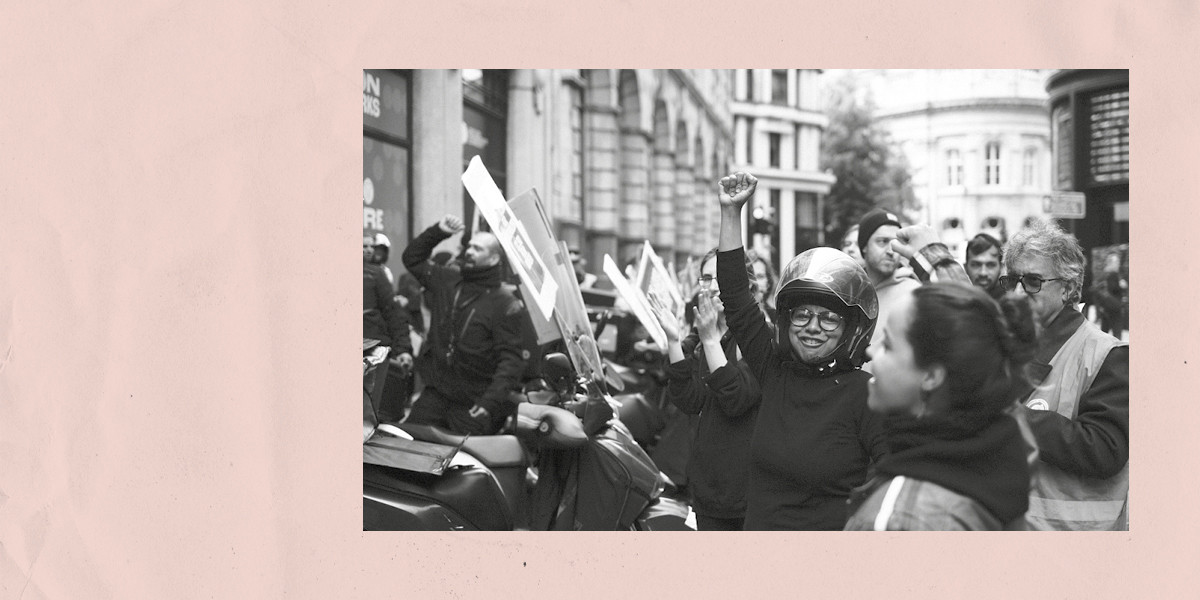
Casualised workers have sprung a series of unofficial strikes over the past decade, in many cases acting as a vanguard of the working-class movement in their intensity. Take the 2022 wildcat strikes in Amazon, the 2024 delivery strikes, which spread from London across the country, or the recent unofficial strikes by DPD drivers against company pay cuts.
While the nature of casualised work can make organising difficult, it also offers its own opportunities. The ‘self-employed’ nature of many gig workers makes joining a strike as simple as logging off an app. This allows struggles to spread from one workplace to another with a speed that traditional trade unions cannot replicate. The lack of formal union organisation does not mean these workers are not organised in their own way. WhatsApp chats, Facebook groups, canteens, pubs, migrant community centres, gathering spots on street corners and town squares – while not always as overtly orientated towards organising – can and do act in the ‘invisible organisation’ of large sections of the working-class. Mobilising non- or under-unionised sections of the working class into any strike means engaging in their self-organised struggles wherever they emerge, encouraging them to form rank and-file structures to maintain their momentum and emboldening them as a model other workers can copy.
Taking on the state
The biggest obstacle to a general strike, however, is the capitalist state. 1926 serves as a harbinger of what any such action would face. Then, the government spent years secretly preparing plans for an organisation of right-wing ‘volunteer’ workers to replace striking workers. They recruited ‘special constables’ to attack picket lines and protect scabs, many of them open members of fascist organisations. Platoons of soldiers, armed with rifles and bayonets, occupied working class areas, with navy destroyers moored in striking docks. The Communist Party HQ was raided by police, with 1,200 out of a total 5,000 members arrested over the course of the strike.
The ‘self-employed’ nature of many gig workers makes joining a strike as simple as logging off an app
Today, we would also face a state machinery intent on crushing strike action by any means necessary, informed by our own increasingly authoritarian context. Legal cases against the strike would be aggressively pursued, in the face of which the trade unions would likely fold. This reality highlights again the importance of rank and-file organisation. We would also expect to see the widespread deployment of police, military and immigration enforcement against working-class communities engaging in such a strike.
Contemporary disputes give a taste of what to expect, such as the injunction against the Birmingham bin strikers, the immigration raids in immediate response to the food courier strikes and the union reps arrested on picket lines. These would all be multiplied in the event of a more general strike. The movement would need to be prepared for such repression, knowing when to retreat and when to advance upon the state’s machinery of violence.
Beyond strike action
Even a general strike, however, would not be enough for the working class to come to power. When workers go on strike, it shows the power they hold within society: without us, nothing moves. This power has almost invariably been used to leverage concessions from employers and the state, not supplant them entirely. This is why trade unions became the dominant organisational form of the labour movement: they are able to contain the conflict between capital and labour and re-channel revolts against capital back into it. They use strikes as a bargaining tool to win better terms and conditions rather than any fundamental change to the economic system.
For any more fundamental change, a strike can only ever be a launching pad. The exertion of power that it presents can encourage workers to take action and transform how they view the world. But from there, workplaces would need to be taken over, using workers’ technical expertise to repurpose their resources towards social need rather than profit. New, mass democratic forms of economic planning and management would have to be coordinated across the workplaces taking these actions. Defence groups would need to be raised to protect those workplaces from attack by the state.
Any such movement could not start and end with the ‘workers’. It would have to integrate the demands and self-organisation of those excluded from work: the unemployed, the disabled and sick, the elderly and the young.
The challenges that would be faced by any mass strike action are huge. They may even seem impossible. But the general strike in 1926 didn’t appear from thin air. It was the product of decades of struggle by rank-and-file militants on the ground with a long-term political vision, which they took seriously in informing their actions – and demanded others did too. In the process, they were able to build a mass movement capable of launching one of the greatest offensives against capital in Britain, despite the ire of the state, bosses and trade union bureaucracy.
If we dare to take our dreams seriously, we can too.

