



From Back to the Future, Far and Away, Ned Kelly, and beyond, the Irish diaspora on the Anglo-colonial frontier has long benefitted from the plucky underdog treatment in Hollywood. And, until Sinners came along, they had managed to avoid any significant scrutiny – in cinema and elsewhere – of their participation in settler colonisation across the US, Canada or Australia.
In Back to the Future III, released in 1990, Marty McFly (Michael J. Fox) lands in the 1885 Hill Valley settlement in the midst of a cavalry pursuit of an unnamed Native group. Native people themselves, however, are otherwise absent on screen as Marty connects with his Irish ancestors in their homestead and helps to save Doc Brown’s life.
In Far and Away, released in 1992, the third act hinges on the 1893 Oklahoma Land Run, which allowed for the mass theft and settlement of ancestral Cherokee territories. Across the Pacific in 2003 thriller Ned Kelly, Heath Ledger gives a sympathetic performance as the anti-hero of the Irish squatter class rebelling against the same colonial authorities who oppressed his Irish ancestors.
Though we might bemoan the woeful ‘Oirish’ accents on display throughout these blockbusters, we Irish have rarely stopped to question our role in the various forms of violent settlement and Indigenous annihilation evident in these movies. Set between the 1880s and 1890s, roughly 35 years after the Irish famine and at the height of Irish migration to North America and Australia, these narratives centre on the importance of land, homesteading and economic stability for an impoverished and displaced Irish underclass.
Indigenous peoples either do not exist or remain as a violent spectre which threatens the settlers’ right to claim ownership of and profit from these territories. The histories of disease, forced displacement, dispossession, massacres, stolen children, and residential schools – a pattern of violence which constitutes multiple and ongoing genocides – are ignored.
The sins of our forefathers
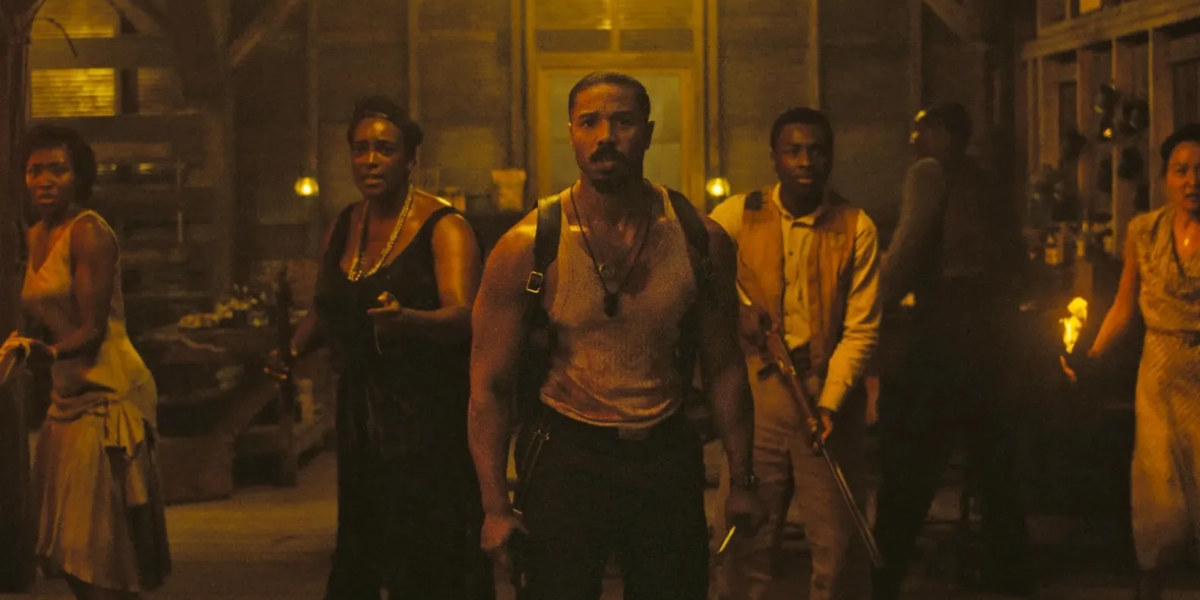
Sinners jumps forward in time about 50 years to a Jim Crow South caught in the grip of depression. Despite the promises of abolition and restoration, conditions for Black sharecroppers in 1930s Mississippi are disturbingly similar to slavery, where the Ku Klux Klan retains a stranglehold on land ownership, commerce and law. Prodigal twins, Smoke and Stack (Michael B. Jordan), return to their community from Chicago to set up a Juke Joint where weary sharecroppers can cut loose on a Saturday night.
Though prepared for all manner of contingencies, not least the omnipresent spectre of Klan violence, their most immediate threat appears in the form of an Irish vampire: Remmick (Jack O’Connell) is drawn to the Juke Joint by the musical gifts of blues player Sammie and intends to make Sammie one of his own so he can absorb the power of invoking ancestors through music.
Despite the Irish origins of vampires in folklore and literature, from the bloodsucking Abhartach of Celtic mythology to Sheridan Le Fanu’s Carmilla (1872) and Bram Stoker’s Dracula (1897), Remmick is the first Irish vampire to feature in a Hollywood blockbuster. Coogler’s choice feels more deliberate than a simple nod to the Irish origins of the source material or his stated fascination with traditional Irish music. In painting Remmick as both victim and aggressor – a migrant fleeing British oppression in Ireland who has nonetheless benefitted from white supremacist power structures – Coogler disrupts the cosy narratives of ‘victimhood and sufferance’ associated with the Irish diaspora.
Yet most critics have side-stepped such discomforting histories, focusing instead on the spellbinding use of Irish folk music or emphasising common histories of colonial oppression between the Irish, First Nations and African diasporas.
White man’s nostalgia
Despite the freedom offered by his vampirism, Remmick is weighed down by nostalgia for old Ireland and his ancestors, and tries to use this to manipulate his way into the Juke Joint. When this fails, and his vampiric nature becomes apparent, he invites them to join his vampiric family, who he promises are unconcerned with human regimes of racial violence and segregation. When this also fails, Remmick resorts to an all-out assault on the Juke Joint, fuelled by his desperation to absorb Sammie’s musical gifts.
Remmick’s presence in Sinners feels like a nod to the growing awareness and debate around Irish participation in the enslavement and trade of Africans across the Atlantic, Irish participation in the wars of extermination against first Nations Peoples and Irish-American participation in anti-Black mob violence. Less discussed, however, are the estimated 7.5 million Irish migrants who actively participated in the mass theft and settlement of Native peoples’ territories in the US alone.
In painting Remmick as both victim and aggressor, Coogler disrupts the cosy narratives of ‘victimhood and sufferance’ associated with the Irish diaspora
It feels like no coincidence that the antagonist is pursued by riders from the Choctaw Nation determined to slay him. The story of Famine-era solidarity between the Choctaw Nation and the Irish, where the Choctaw raised money to send to the Irish masses dying of starvation, is celebrated on both sides of the Atlantic as an act of solidarity between two subjugated peoples. Rarely, however, do these accounts mention the history of Irish participation in the expulsion of the Choctaw Nation from their ancestral territory of Mississippi and the subsequent settlement of those lands by significant numbers of Irish migrants.
These realities remain obscured by the thick veil of nostalgia that still clings to depictions of the Irish diaspora as poor and downtrodden migrants trying to ‘make good’ in the ‘New World’. Historian Dr. Ciarán O’Neill highlights deep alignment with white supremacist power structures and our [Irish people’s] ability ‘to dissociate from any responsibility for the exploitation and erasure of Indigenous people in the European settler empire’ over centuries.
From Carmilla to Dracula, vampire narratives were informed by Anglo-Irish anxieties about the invasive other – the colonial racialised subject – intent on the conquest of land and contamination of bloodlines. Coogler turns this trope on its head, with Remmick becoming the carrier of, yet another, European disease from the ‘Old World’ which preys on people of colour. The genius and catharsis of Sinners is that Sammie and his music survive and thrive while Remmick is reduced to a pile of dust in the sunrise.