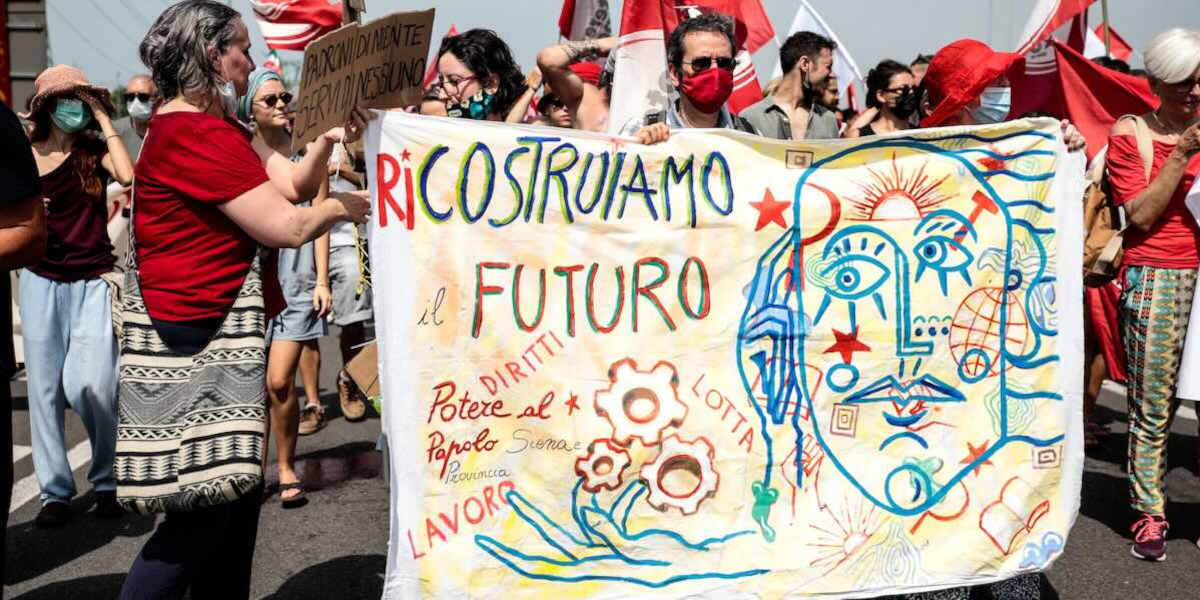
Making cargo bikes and recycling solar panels: this is the GKN Factory Collective plan for a worker-led ecological conversion. The Collective’s journey began on 9 July 2021, when over 400 workers at Florence’s GKN Driveline car axle factory were dismissed by email with no notice or negotiation. Within hours, the Collective staged an occupation of the premises, then-owned by British investment fund Melrose Industries.
Aware that previous defensive struggles against job losses in other factories had been ineffective, the workers decided to try a different approach. With the support of an interdisciplinary group of activist researchers, they developed a plan to repurpose the plant to make components for sustainable public transport. They then called for the plan to be implemented through nationalisation under workers’ control.

A monthly dose of our best articles direct to your inbox
From these foundations, GKN Florence workers forged alliances across the international climate justice movement, mobilising demonstrations tens of thousands strong and building a far-reaching solidarity network. The struggle grew massively because it was no longer merely about saving these jobs (which turned out to be not so many after all, as the ensuing quasi-collapse of Stellantis in Italy would demonstrate). It was also about an alternative vision of the ecological transition.
Echoes of Chile
The Collective has held for five years, making it the longest workplace occupation in Italy’s history. Occupying a factory to demand its nationalisation under workers’ control brings to mind the wave of workplace takeovers in early 1970s Chile under the Popular Unity government, so vividly recounted by Peter Winn as ‘a revolution from below’.
An obvious difference, relative to that context, is that Italy today is not under the threat of CIA-backed military dictatorship and terror. Italy today is, however, emblematic of the global shift towards the right. Needless to say, Giorgia Meloni is no Salvador Allende. She would much rather lose ‘Made in Italy’ jobs (as per her own nationalist rhetoric) than actually nationalise.
The call for nationalisation was thus strategically substituted with a demand for ‘regionalisation’; for ownership of the factory to be transferred to the centre-left Tuscany administration. This move became legally and technically possible in December 2024 when, after sustained pressure from below, the Tuscany regional law on industrial consortia (drafted by the Collective itself) was approved.
The Collective’s re-industrialisation effort treats the factory as a stronghold of working-class counterpower to transform relations of production
re, capital first letter, no full stop!
A publicly-owned consortium, theoretically geared towards re-industrialising the site was established in July 2025. However, the consortium never began functioning due to endless bureaucratic delays. The centre-left does not want to look the same as Meloni’s far-right. Nonetheless, within the Democratic Party’s mainstream, there is no genuine will to allow the project to develop. The success of an autonomous workers’ initiative, supported by social movements, is inconvenient for those who fear this dispute could become an example for others.
At a time when Western governments have effectively abandoned their ambitions for an ecological transition in order to prioritise re-armament, the Collective’s project has become an even bigger threat to power. As the Collective has written: ‘If you need to convince millions of people that rearmament is necessary to reindustrialisation, you have to undermine the most advanced and concrete vision of ecological reindustrialisation to have emerged so far.’
Importantly, the Collective’s re-industrialisation effort has never reflected a MAGA-style attempt to defend Western industry for its own sake – a nationalist and nostalgic vision that has proven self-defeating on its own terms, with the US shedding manufacturing jobs at an extraordinary pace under Trump’s second term). It has always been about using the factory as a stronghold of working-class counterpower to transform relations of production.
Internationalist core
The Collective’s internationalist perspective was demonstrated by its central role in Italy’s mobilisations against the genocide in Gaza and the participation of former GKN shop steward Dario Salvetti in 2026 Global Sumud Flotilla.
The Collective has also created a cooperative, GKN for Future (GFF), which could be understood as a second-best alternative to nationalisation. There is however a strong collectivist core to the idea and organisation of a co-op producing cargo bikes and the recycling of solar panels. A popular shareholding and crowdfunding campaign has collected over one million euros, with additional funds committed by Banca Etica and parts of Italy’s co-operative ecosystem.
Collective members are aware of the limits of co-ops, but recognise that the model is what the current balance of power allows for. Hundreds of supporters – individuals and organisations, from Italy and abroad – have become shareholders, and international political and financial support for the initiative remains crucial. The strategy also aims at creating a lasting network of social and political forces engaged in the project, intended to ease market constraints on the forthcoming co-op while also contributing towards a different ecological transition – once again looking far beyond GFF itself.
