
‘Here we are in twenty-first-century Britain, in a world not of our making but one that has been molded over thousands of years of exploitation and injustice.’
So begins the Aims and Principles document of Radical Routes (RR), a mutual aid network of housing co‑operatives, workers’ co‑ops and social centres, which was conceived 40 years ago at the height of Thatcherism. As house prices and rents continue to increase to a point that people find it increasingly difficult to live independently, and as we work longer for diminishing rewards, the co-operative model offers a viable alternative to the status quo. Crucially, it is also a good starting point to build the collectivism and solidarity necessary to repair the damage done by decades of neoliberal capitalism.
Co-operatives against Neoliberalism
2026 marks the 40th anniversary of a foundational meeting between the New Education Housing Co‑op (NEHC) and Giroscope. The NEHC was born from the New University Project — an ambitious plan to build a radical university in the countryside. Failing to secure enough funds for the full project the group founded NEHC in inner city Birmingham. The NEHC are still going and are now situated in a semi-rural location north of Swansea. The origins of Hull’s Giroscope project — a radical worker’s co-op — began with its original members pooling their ‘giros’ (the dole cheques which used to be issued to people on benefits by the National Girobank) to buy and renovate dilapidated houses to create affordable homes for people in need. Giroscope now has a portfolio of genuinely affordable homes in Hull, as well as community buildings like the newly launched St Mathew’s Community Enterprise Centre.
Originally, both organisations wanted to establish workers’ co‑ops in response to a desire for democratic workplaces. A natural companion to this ambition was the establishment of housing co-ops, structures that allow members to collectively purchase and manage property, kept in co-operative ownership to guarantee secure housing for future generations. As Gemma from Redcurrant Housing Co-op, a member of the RR network, explains:

A monthly dose of our best articles direct to your inbox
‘I think housing and work are interlinked under capitalism and having secure housing allows people in work to organise more effectively. I feel that one of the most important things for me living in Redcurrant is knowing that if I get fired from work for organising I still have a home. I feel that every worker should have this safety net as a given, however the lack of social housing deliberately prevents workers from being able to organise effectively and more bravely.’
We saw the power of secure housing during the 1984-85 Miners’ Strike, when councils suspended rent payments for council housing to take some financial pressure off the strikers. Breaking such security was one of the main motivations behind Thatcher’s Right To Buy scheme. Take away secure, affordable housing and you take away options. Indeed, in Leeds in the 1980s, when the grass-roots co-operative movement was at its height, you could live in a housing co-op and work in a worker’s co-op and if it didn’t go well in either you could leave your job or home and join a different co-op the next day.
Between 1988 and 1992 the number of co-operatives involved with Giroscope and NEHC’s fledgling organisation increased, and in 1988 the network agreed its common aims and adopted the name Radical Routes, going on to incorporate in 1992. During this era, Roger Hallam (yes, of Extinction Rebellion fame) wrote How to Set up a Housing Co-operative (an updated version is still available from RR today) which offers an invaluable guide for people who want to build co-operative housing. RR also offers guides on setting up workers’ co-ops and social centres.
Building a mutual aid network
Radical Routes is a secondary co‑op, acting as a mutual aid network for dozens of housing co-ops as well as some worker co-ops, alongside a few social centres. In addition to co-op members there are over 300 Investor Members, and 38 Associate Members. Every co‑op is expected to contribute voluntary labour to the wider network, supporting governance, administration, promotion, conflict resolution and peer‑to‑peer training in things like consensus decision making, which is how the network makes decisions. Member payments create a pot with which to run the network, and money from investors enables RR to offer loans to member co-operatives. This could be money to new, un-housed co-ops to help them purchase a property, or to existing co-ops who need to pay for renovations or to provide some financial stability through hard times.
In 1998, having trialled different ways of breaking dependence on capitalist banking structures, RR established an investment platform specifically designed to allow us to lend to our member co-ops. As one member put it at the time, ‘We wanted to remove at least some small chunk of our daily lives from the hands of people who profit from our vulnerability.’
You don’t have to have anything, really, as long as you can contribute what you can
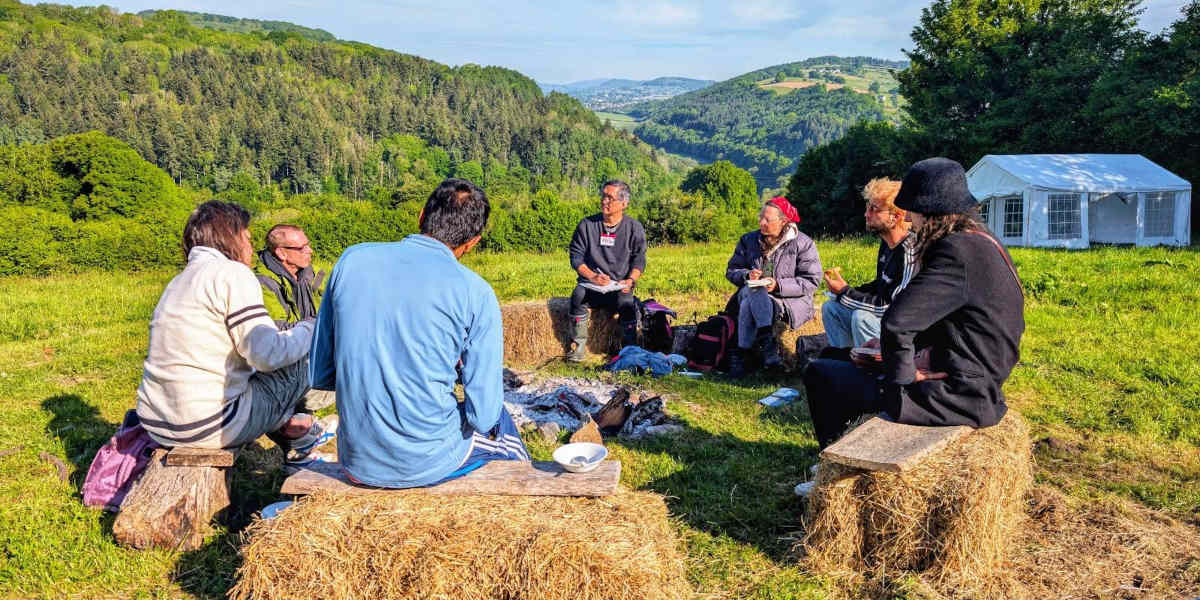
Radical Routes has a remarkable track record in lending: from 1991 to 2012, more than 60 loans were issued, totalling over £1 million — without a single default. Decisions about loans are made collectively by member co‑ops in a process known as peer‑group loan appraisal. These and other business matters are dealt with four times a year at weekend gatherings, where members from the network come together for decision‑making, learning, and socialising. Anyone can attend one of these gatherings whether you belong to a member co-op or not, though only a delegate from a member co-op can vote on business decisions.
At every gathering there is a programme of talks and workshops specifically for people who are new to living in a co-op or trying to start one. Children are welcome at these events and there is a commitment to providing childcare during gatherings so parents can participate fully.
The Changing Face of Cooperation
Cath, who was an early member of Cornerstone Housing Co-op, — which has been a member of RR since the 1990s — was introduced to co-ops through her involvement with Earth First! (EF!), the radical ecological direct action group. Alex, who had introduced her to EF!, was a Green Party student who was starting a housing co-op so that activists could live together to organise more effectively. At the time the Green Party also focused heavily on localism, aiming to build local support networks. This included an economic policy promoting clusters of economically inter-linked co-ops.
Although Cath was initially hesitant about joining a housing co-op, she came around to the idea when she realised that: ‘Trying to battle capitalism on your own is impossible… It is too much to ask of an individual that you raise a kid and work and be civically engaged and look after your house and grow an amount of your own food and not buy too much shit from the shops. But in a group you can do it.’
Members of RR co-ops were expected to undertake twenty hours of ‘socially useful work’ per week, which might mean teaching or social work, working in a workers’ co-op, home educating, campaigning, or any project aligned with the network’s principles. ‘It felt vital to the founders,’ Cath explained, ‘to put off the stoners, people who sat around talking about politics – this was for people who were working hard to create a different society.’
This expectation of members still exists, though over time the requirement was dropped to 15 hours a week and the language became ‘radical social change activity’, a clause that sparked debates between later generations of members over how feasible long hours of activism are in a different economic landscape.
Interestingly, Cath says that the solution to this problem lies in deepening co-operation so that more aspects of our daily lives are collectivised: ‘Housing co‑ops are vulnerable.’ Rising mortgage rates hit them hard, most are small and rely on members finding income in the capitalist economy. This is what we want to change with the model we are building at A Commune in the North.’ ACitN is Cath’s latest project, an egalitarian, income-sharing, anti-oppressive, eco-commune which seeks to build a network of interlinked co-operatives which seek to make a more resilient local economy. ‘You don’t have to have anything, really, as long as you can contribute what you can, so that the collective businesses generate enough income and enough food gets grown.’

