
Title: Stella Dadzie: A Whole Heap of Mix Up
Author: Stella Dadzie
Publisher: Lawrence Wishart
Year: 2025
As someone who has never visited their motherland and can only visualise it through photographs or imaginings, I am always drawn to second and third-generation immigrants’ experiences of travelling back home. Some of my favourite parts of the British educationist, activist and writer Stella Dadzie’s new book, A Whole Heap of Mix Up, are her diary entries from her time spent in Ghana. In these sections, Dadzie’s rich and attentive language ignites within the reader her reality as if it were our own. We are offered a glimpse into her life, not as a silent, static image, but as an animated story. She unpacks her feelings of comfort, of kinship, her love for the beauty and abundance of her surroundings. But also the complex feelings of detachment, the historical trauma that lingers and the inescapable identity of oburoni (Akan for ‘foreigner’, literally ‘those from over the horizon’). Here, the archive gives sound and motion to stillness, providing a depth that is missing from traditional retellings.
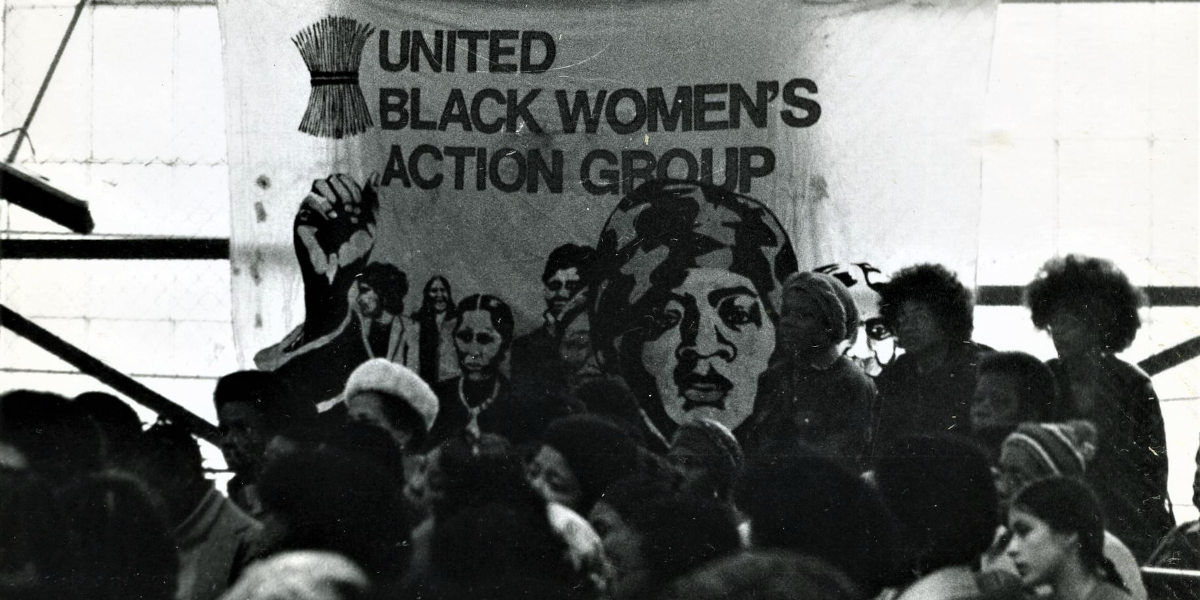
Dadzie’s book offers 40 neatly woven fragments of her life, spanning continents, decades and forms. Alongside the Ghana diaries, speeches, poems, articles, travel notes, reflections, photos and artworks – some public, many unseen – all offer a peek into the life of a woman who played a pivotal role during an era-defining period of Black British history. Often described as one of the ‘grandmothers’ of UK Black feminism, Dadzie co-founded the Organisation of Women of African and Asian Descent (OWAAD), going on to co-author the seminal Black feminist text, The Heart of the Race: Black Women’s Lives in Britain. Her newest book shows us that, among all this, she is also an artist, a poet, a historian, an educator, a friend and sister, a lover and a mother. This ability to self-define and have control within a narrative shown throughout Dadzie’s writings is offered through grassroots archiving – more pertinently, Black feminist archiving. This framework stresses the importance of Black women’s experiences, giving meaning to our lives, thoughts and stories.
When one thinks of an archive, you may imagine dust-laden boxes or rows and rows of meticulously filed folders. While this is not entirely wrong, grassroots methods have enabled us to reinvent the way we think about and interact with the archive, allowing it to unfold into a more expansive form. Black feminist archival practice is an embodied, ongoing and collaborative process, founded upon care and sensitivity toward materials, and an emphasis on valuing and respecting Black women’s expressions. In their many manifestations, these archives are constructed of information the archivist defines as significant. For Dadzie, this takes its life in many forms, legitimising alternative knowledge production. A poem, for example, unlocks nuances that allow us to gather meaning in a way a traditional archival document would not. It speaks into, not over, the silences. Black feminist archives allow us to document and preserve our histories, not only a fuller, deeper version, but one that is accurate to our reality – which is imperative in a world that repeatedly tries to minimise Black women’s expressions.
Archival abscences
This has not always been the case in the broader discipline of archiving. In Venus in Two Acts, Saidiya Hartman looks at the violence of the archive as a colonial instrument through its ability to render Black women invisible. The transatlantic slave trade transformed the archive into a holder of colonial terror, as if it were possible to contain such bloodshed and horrors within mere documentation. In these records, enslaved people were stripped of humanity, reduced instead to a number or descriptor. These archival absences leave one grasping at traces in a futile attempt to conjure some semblance of life. Hartman proposes the idea of critical fabulation, a critical reading of the archive and its gaps, to try to address what she calls ‘impossible stories’. With care, Black feminist archival practice works at broadening and reconstructing silenced narratives, highlighting the validity of knowledge that comes from lived experience, with Black women at its centre.
The Black feminist archive creates a witness to radical acts of defiance and resistance, cementing the legacies of those who came before us
This makes personal archives such as Dadzie’s integral to countering dominant narrative production, moving away from a colonial framework that was never fit to capture and preserve our stories. The offerings from Black feminist archives give us insight into ongoing political discourses and community organisations in the wider orbit. Dadzie’s critically grounded speeches and articles show how she wrestled with a world that repeatedly tried to flatten and erase her – from her challenges teaching slavery in schools in the 1980s, to the significance of lovers rock and reggae in the fight for Black women’s liberation.

A monthly dose of our best articles direct to your inbox
Preserving this type of knowledge is crucial for community building and mobilising the next generation of activists by connecting them to their predecessors. As Nydia A Swaby remarks in her important work, Amy Ashwood Garvey and the Future of Black Feminist Archives, ‘Seeing the documented struggles and successes of past Black feminists serves as a powerful reminder of Black women’s resilience and agency, fostering a sense of pride and motivation to continue the fight for justice and equality.’ The Black feminist archive creates a witness to radical acts of defiance and resistance, cementing the legacies of those who came before us.
Rethinking knowledge preservation
For Black feminist and grassroots archives to remain as tools that inform and reimagine, we must continue to reflect critically on the world around us and search for meaning within the ephemeral. While the future is uncertain, collecting, documenting and questioning that which we find meaningful allows us to capture multifarious narratives. Those interacting with the archive must continue to fashion alternative ways of rethinking knowledge preservation, much like the diverse and fruitful methods provided by Black feminist approaches. This can already be seen in Gen Z’s return to scrapbooking, with social media platforms like TikTok and Pinterest seeing an influx of young people carving out offline time to curate and make physical their memories. It is this type of return to tactile engagement that leads me to believe that grassroots archiving will persevere, despite increasing digitalisation.
Transforming the way one thinks about the archive, grassroots projects like Tottenham’s Seed Archives reach beyond conventional archival practices, creating an environment for diaspora communities to reconnect with our histories, engage differently with cultural objects and foster an open and blossoming dialogue. A community library and research space, Seed Archives is dedicated to celebrating traditional African and Caribbean art, culture and design. Visitors are encouraged to touch and handle the objects and books, with an emphasis on the necessity of haptic engagement in learning and expansion. This is antithetical to the untouchable status of materials in conventional archival institutions, challenging normative beliefs and working to create a more intimate experience. Though their physical space is in north London, Seed Archives stretches across the diaspora, also utilising the digital as a way to catalogue, commemorate and share materials, opening up knowledge to wider audiences.
There will always be a desire to preserve and make tangible radical acts and counter-histories – a desire that cannot be quelled. As Dadzie notes, ‘Too much of our lived experience gets lost or forgotten. The fragments that survive are like pieces in an unfinished jigsaw.’ It is the practice of Black feminist archiving that will help us put it back together.
