



Red Pepper
I am curious about, and potentially frustrated by, some perceived distinctions between politics and art: that politics is somehow a more material event while art sits outside of that frame, in the realm of ideas or intellect.
Your work (including your article for The New Yorker, ‘The War on Trans Art’) tends to collapse these two subjects. Why is this approach an important feature of your criticism?
Grace Byron
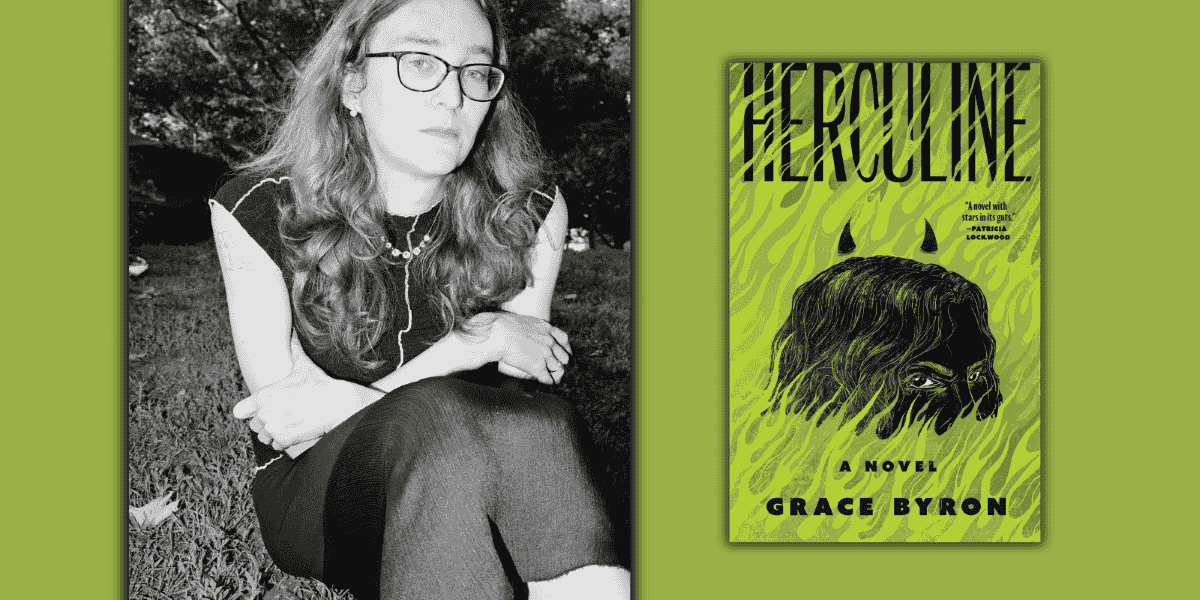
During the book campaign of my novel, Herculine [a horror fiction about an all-trans commune, published in October last year] I was asked a lot about politics. I was also asked to speak on – and speak for – the alleged trans community, which I found both interesting and complicated. If there is a signature approach or style in my writing, it’s that most of my work is concerned with the political context that produces art. And, I think sometimes that gets me branded as some sort of woke queen, but I don’t really care. Somebody has to play the woke scold, and I think that if you don’t have that force talking about those things, that’s dangerous.
I’m also not immune to good art by edgelords. I love Ivy Wolk, for instance. I think she’s one of our best provocateurs. But, I do think that, inevitably, when you’re writing about trans art, for instance, you’re forced to think about the position that trans people are allowed to inhabit – why they choose different artistic strategies. Yet all artists, I believe, are enacting their ideologies at all times, whether or not they’re part of a so-called marginalised identity. I think cis white women writers are writing just as politically as any other, and I really like Andrea Long Chu’s essay on Rachel Cusk for that reason. All art is enacting some sort of politics, right? How seamless that is, how magnetic or convincing – this is up to the artist. But, I think it’s important to sort of dissect that.
Red Pepper
I’m interested in the conflict that seems innate to trans representation, and representation in general, how trans people seek representation through art while also counteracting becoming over-labelled or homogenised.
How do you think the censorship of trans artists, either by gender-critical groups or the Trump administration, further complicates that problem
Grace Byron
Trans art has sort of always been forced to exist on the margins; I think the so-called ‘trans tipping point’ was really only for a certain kind of trans art and a certain kind of trans artist. That visibility also came with a pretty high cost, both in terms of scrutiny and as well as expectation. The idea that you have to be a role model in particular was forced on trans women actresses.
A lot of trans writers are forced to account for their artistic choices in a way that other kinds of identities are not; a lot of authors haven’t had to defend their choices in the same way. That often comes with a binaristic labelling: the trans genre is interpreted as a little too twee or buying into the slightly cynical promise of representation. Or, it’s doing something which is purposefully transgressive.
I think it’s important to reflect on the aesthetics and quality of art. Political art can be good and bad, aesthetically. Perhaps trans art, for instance, is always political, like everything else, but it’s not always radical. It’s not always political in the way audiences often assume it is. There can be good left-wing art, and there can be bad left-wing art.
If you look at the sort of books about trans issues that are reviewed by the New York Times, particularly throughout the past few years, they have all been a very particular kind of book; they are often quite explicitly about trans issues. Were those reviews written by trans critics? I don’t believe so. And, that’s fine. But, to me, it speaks to a kind of labour issue: more specifically, the way that trans people are not hired to discuss their own work. And, if you’re not getting hired to do that, then you’re less likely to get hired to speak about other issues, too.
I think the lack of opportunities for trans artists has, of course, been accelerated by Trump 2.0, by the intense censorship of trans perspectives. In an almost roundabout way, it’s forced a lot of people to care about bad art. There’s a lot of bad trans memoirs that are getting banned, and that compels us to care about them in a different way.
‘There can be good left-wing art, and there can be bad left-wing art’
Red Pepper
I’ve been reading a lot recently about the so-called ‘death of criticism’, which argues that certain developments – particularly AI and social media – are undermining the role that criticism once played. Political attacks on diversity in the American education system, combined with structural changes to the journalism industry, make critical thinking itself seem endangered. At the same time, there seems to be an uptick in young writers – particularly trans writers – who are making their mark.
How hopeful do you feel about the future of criticism?
Grace Byron
We should all be thinking about how we can organise against AI. A lot of the time, though, I can’t help but find how this is often framed to be a distraction. There is a lot of writing about the death of the arts: the death of publishing, the death of criticism, the death of books in general. It can be a bit tiresome. I remember reading about these subjects a long time ago. And, you know, there are still people reviewing books. There are definitely fewer places to deliver this work, but at the same time, that’s always fluctuated. There’s a lot of panic, and I think that there’s almost more writing about panic than writing about writing itself.
I really like a lot of the organising that Becca Rothfield has done against AI; I think she’s written very smartly about why AI is stupid and a labour issue. I think it’s helpful to build a robust world of criticism that people can dive into as an alternative to using ChatGPT. It is definitely terrifying on some level, but I also think nuclear war is terrifying on some level. There is an Ursula K. Le Guin quote at the end of A Wizard of Earthsea in which she writes something along the lines of – and I am paraphrasing – ‘go and do your work. Do it well.’ What else can you do?
I feel similarly about the threat of AI to the arts. There are a lot of critics who are doing really wonderful work right now. That should be inspiring to potential readers and critics. There’s also some great, small magazines out there. If you’re worried about AI, then subscribe to magazines so that they can pay more human writers. There really is no shortage of new and wonderful writers for people to follow. And I think tuning into that is the antidote to what’s going on. So is, perhaps, reading a book instead of posting about the panic. I think that’s a hopeful reorientation.
Red Pepper
If there is an erosion of our critical thinking, I can’t help but feel that it is tied in some way to the emotional politics of transphobia. In the United States and the UK, that reactionary response has manifested through legislation. How do you view the role of criticism during a period defined by hysteria and moral panic?
Grace Byron
I think criticism can help name and define that hysteria. A lot of psychoanalytic writers have done really interesting work by thinking through attachment theory: the good object, the bad object. Lily Scherlis has done a lot to talk about this in relation to group dynamics, for instance. I think this framework offers a very helpful reorientation; it feels important to consider the psychoanalytic attachments and ideas that are animating, not just on a personal level, but on a national level, too; how they are inflamed, and so on.
I think good criticism, in particular good political writing, can reorient us: it cuts through the bone and hopefully reveals something deeper. I’ve often felt that it’s my role to point out how it is not just the far right that is doing this, right? Similar issues also potentially arise within leftist spaces. It is important to consider in criticism how the left can perpetuate harmful ideology, even if on a different scale. As critics, this is very much our medium – that kind of thinking.
To go back to your earlier point, AI can only ever get to the gist of things. It cannot do what writers do, or should do, which is actually dig into the subject matter. Criticism is about naming things, and there are different ways to do this. I think poetry can be a form of criticism: it can open us up to consider new associations and ideas, broadening our curiosity. It demonstrates a different way of perceiving the world and its objects. All forms of criticism hopefully cut through the noise