



On 22 May 2014, David Coburn was elected to the European Parliament. With 10.4 per cent of the vote, the leader of the United Kingdom Independence Party (UKIP) in Scotland only just made it to Strasbourg, securing the country’s sixth and final seat. His election might have been narrow, but Coburn’s success marked the first time this century that the populist right had achieved parliamentary representation north of the English border. For the next five years, the UKIP – and later Brexit Party – MEP led a career distinguished only by bigotry and sleaze before stepping back from frontline politics.
Today, the name David Coburn means little, if anything, to most Scots. His breakthrough has been forgotten by a nation whose political identity rests, in no small part, on being the place where men like Coburn lose their deposits. In May 2026, however, it is likely that UKIP’s ideological descendants will breach the Scottish Parliament’s Canongate Wall for the first time. Yet, for all the headlines and media clamour, Scotland’s political class are as ill-prepared for Reform UK’s success as they were caught off-guard by Coburn’s election.
Race to the right
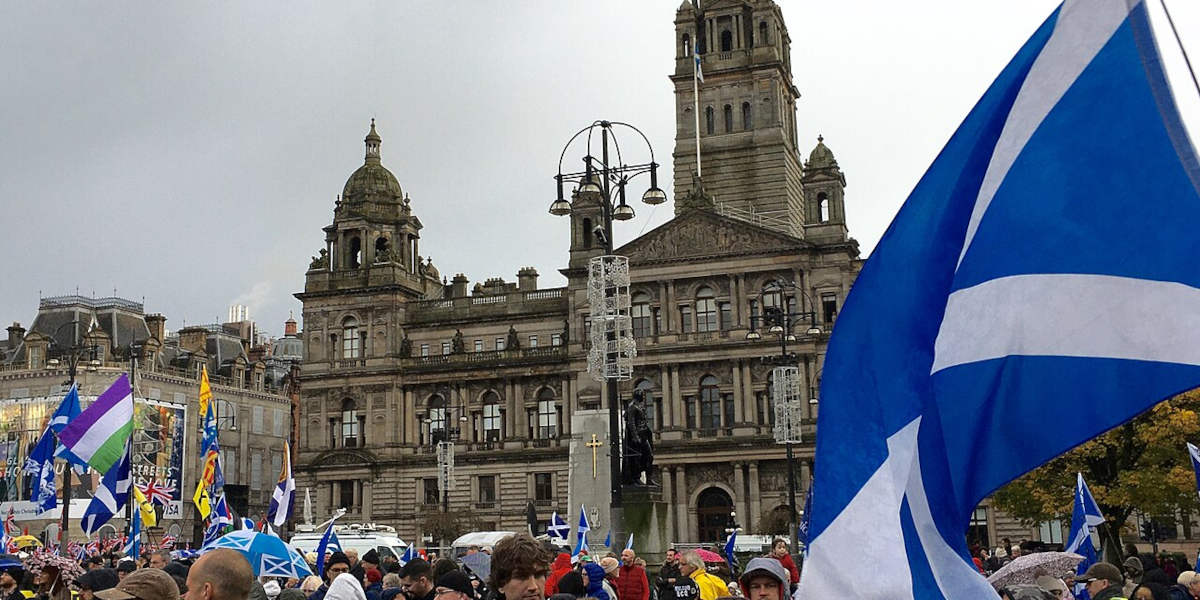
Scotland, argued First Minister John Swinney to the SNP Conference in October 2025, would never join Westminster’s ‘race to the right’. The country he led was different. It was an ‘outward-looking’ nation where refugees were welcome, and hate was not. His rhetoric embodied a common telling of Scotland’s story, perpetuated by each of Swinney’s predecessors, which buried society’s contradictions beneath an appeal to national exceptionalism.
Yet, as the First Minister spoke, support for Reform was surging across his ‘inclusive’ and ‘compassionate’ land. At the time of writing, Nigel Farage’s party is set to emerge from May’s election as Holyrood’s formal opposition.
Scotland’s governing class wrote UKIP’s 2014 victory out of history. Two years later, they dismissed the 1,018,322 voters who supported Brexit by insisting Scotland would ‘always be’ European. Ignoring Reform is not an option. Acknowledging their impending advance, however, risks dispelling civic nationalism’s convenient myth to reveal an uncomfortable truth which makes Scottish politicians squirm.
A ‘mongrel nation’?
Scotland, for William McIlvanney, was a ‘mongrel nation’. While his words, spoken under the banner of the Campaign for Scottish Democracy in 1992, have often been quoted approvingly in the parliament the novelist helped to deliver, they have long lost their meaning. Not because Scots have come to value the ‘pure lineage’ McIlvanney knew did not exist, but rather because our governing class expounds the linear, uncomplicated idea of nationhood, which he railed against. This vision disregards the messy patchwork that composes modern Scotland so as to instead present a progressive national ideal, which may preach the virtues of inclusivity but is, by its very nature, exclusionary.
Civic nationalism has become the very means by which Scotland’s elites have acclimatised to the ‘intolerable’ state of the nation
That is, after all, why McIlvanney’s preceding sentence from 1992 is so rarely spoken aloud: ‘Scotland is in an intolerable state, and we must never acclimatise to it — never’. After almost two decades of civic nationalist governance, women in the most deprived parts of Scotland can expect to spend 26.7 fewer years in good health than women in the most affluent areas. Amidst this Victorian reality, the Scottish political class has worked to maintain the nation’s ‘progressive’ sense of self by cultivating the belief that, in Scotland, things are going comparatively well.
‘Our politics – our Parliament – have demonstrated that they work,’ said John Swinney after Holyrood passed his Party’s budget for 2025/26. For whom, however, was unclear. After all, the SNP’s settlement had left local authorities with a combined projected budget gap of £392 million, necessitating a string of council closures, cuts and job losses. These consequences mattered not compared to the prospect of national political unity in the face of Nigel Farage’s ‘gathering storm’.
Shielded from accountability
Civic nationalism’s unblemished view of Scotland’s political identity has, consequently, served to shield devolution’s elites from democratic accountability. If the SNP are returned to government in May, they could cut up to 20,000 public sector jobs. These ‘efficiency savings’ will be made by a Party which has secured its electoral mandate by promising to always stand ‘on Scotland’s side’. Austerity shall thus be implemented in the name of the nation, only for its devastating social consequences to again be omitted from the lily-white view of Scottish political identity held in Bute House, Holyrood and across civil society.
McIlvanney’s hopes reversed, civic nationalism has become the very means by which Scotland’s elites have acclimatised to the ‘intolerable’ state of the nation. In this sense, national exceptionalism is a ruling-class project which claims to distribute political responsibility among the people of Scotland but denies them the agency to use it critically. Rather than empowering Scots to articulate their own vision of their country, the devolved settlement offers only a set of constraints within which ‘Scotland’ must sit. It is this top-down identity which has been placed under unprecedented strain by the rise of Reform.
Telling honest stories
Today, there exists one state-sanctioned vision of Scotland, the imagined ‘progressive’ nation increasingly unrecognisable to swathes of its citizenry. Civic nationalism, however, has proved incapable of responding to alienation from its own ideal, preferring to ignore those it leaves behind and detach itself from the lived experience of so many Scots. Nigel Farage now preys on those parts of the ‘mongrel nation’, and Holyrood’s traditional parties have given up on winning voters back from his clutches.
Instead, they promise only to ‘stop Reform’. In April 2025, they came together to do just that as John Swinney united ‘mainstream Scotland’ with the leaders of major political parties to commit to upholding the values of ‘accountability’, ‘equal opportunity’, ‘participation and openness’. These establishment efforts to erect a firewall against Farage failed comprehensively, and the First Minister’s unpopular front was never reconvened.
At May’s election, sizeable elements of the Scottish population threaten to defy the conventional telling of their own national story
This brief display of cross-constitutional unity only serves to underline the impotence of Scotland’s political class in the face of Reform’s ascendence. Their sole solution is to wallow in the hollow narrative of national exception, to breathe new life into the well-rehearsed myth that Scots really are all inherently welcoming. The bleak fact of the matter is that 25 years of such devolved politics have ensured that it is far too late to ‘lock’ Farage’s candidates out of Holyrood.
After May 2026, the least we can do is tell more honest stories about Scotland, warts and all. Who shall narrate these accounts is a different question. Almost two decades have passed since a genuinely socialist party had representation at Holyrood. New formations have come and (promptly) gone in the meantime, yet that fact is unlikely to change.
The election results, however, will undoubtedly precipitate fresh conversations regarding what is to be done to improve this sorry picture. Participants should be mindful of the civic indulgence which abetted Reform’s ascendance.