
On 8 December 2024, after enduring more than a decade of protracted struggle and civil war, the dictatorship of Bashar Al-Assad finally collapsed following an offensive by Hayat Tahrir al-Sham (HTS). The emerging transitional government has pledged to uphold the human and civil rights of cultural minorities. However, the threat of single-party, theocratic rule is already beginning to unfold. Meanwhile, the Kurdish led Democratic Autonomous Administration of North and East Syria, (DAANES), often called ‘Rojava’, is under attack by Turkish armed proxies, the so-called Syrian National Army (SNA).
The DAANES provides a beacon of hope for Syria’s future. Galvanised around principles of ecology, cultural pluralism, grassroots democracy and economic cooperativism, women led radical self-government has been practised there for over a decade. A popular coalition of autonomously organised Kurds, Arabs and other minorities called the SDF (Syrian Democratic Forces) defends the region. Through their remarkable collaboration, we can see that Syria’s fate is not yet sealed. The Syrian people themselves hold the power and agency to shape their future along secular, democratic and ecological lines.
Rojava rising
After the Syrian uprisings of 2011, Kurdish people expelled the Assad regime from several Kurdish areas, declaring an autonomous territory. Since 2012, this autonomous administration has implemented a social revolution inspired by the ideas of democratic confederalism proposed by Abdullah Öcalan, the imprisoned leader of the Kurdistan Workers Party (PKK). The main principles that guide this project are women’s liberation, social ecology and stateless democracy. This vision is similar to [US-based social theorist] Murray Bookchin’s proposal of libertarian municipalism, and indeed Öcalan was inspired by Bookchin’s ideas.
With the rise of ISIS in 2014, Kurds fought back to defend their lives and land. After the historic resistance of Kobane, Kurdish fighters became the leading partner of the US-led international coalition against the caliphate.
Once liberated from ISIS’s fascist theocracy, many Arab majority regions integrated into the DAANES’s confederal system. New communes and regional councils were organised, as well as local, autonomous military councils. Ethnic and religious minorities such as Assyrians, Armenians, Syriacs and Yazidis were also called to build their own self-defence forces.
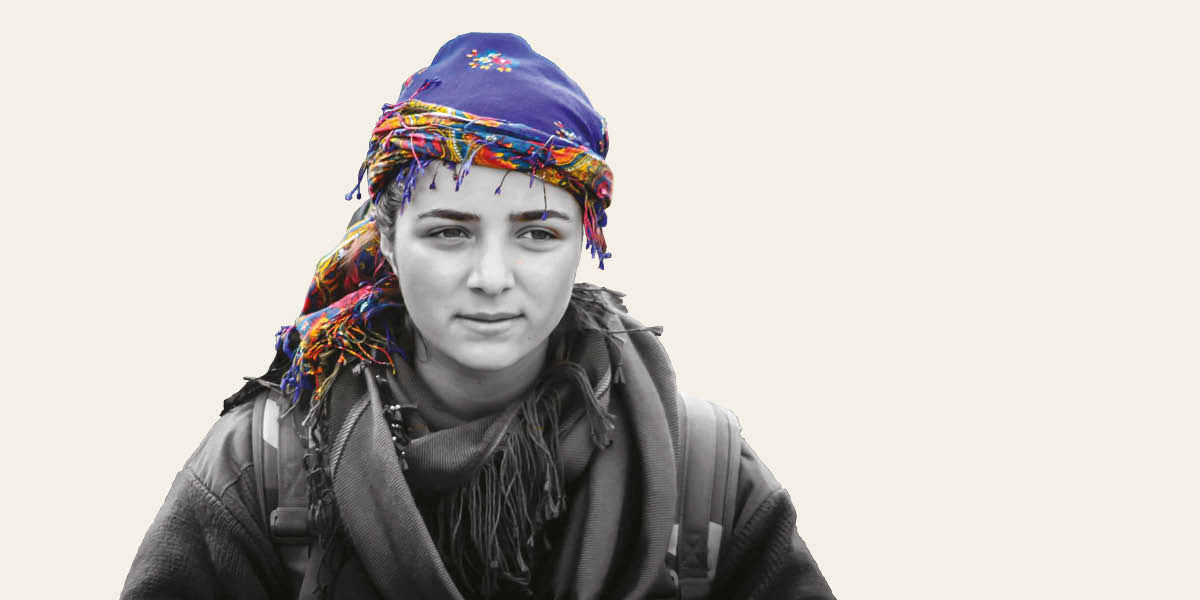
The most significant development within the DAANES is the women’s revolution. Women have their own military forces, with the women’s units leading the war against ISIS. Women’s organisations such as Kongra Star and the Zenobia Congress spearhead women’s rights and reclaim their centrality in history, politics and society. Politically, there is a system of ‘co-presidency’, with one man and one woman sharing leadership in all social and political structures. Women-led economic cooperatives ensure economic autonomy. These projects challenge the patriarchal order not only of Kurdish and Arab societies but of the entire world.
Revolution under threat
As the war against ISIS successfully defeated the caliphate in 2018, people wished for peaceful solutions to the question of a democratic Syria. However, at this time, Turkey entered the conflict, supporting various Islamist forces. Nursing ambitions of a neo-Ottoman empire, Turkish president Erdoğan has invaded northern Syria to expand Turkish borders and destroy Kurds as an oppositional force.
HTS’s 2024 offensive was carried out in coordination with Turkish proxy forces rebranded as the Syrian National Army (SNA). These proxies are a collection of Islamist groups trained, armed and supplied by Turkey, including documented ex-ISIS fighters. While HTS took Assad regime-held territory, the SNA targeted the DAANES. The Turkish army aids them with artillery fire, drone strikes and bombs dropped using Nato F-16 jets.
Turkish proxies took control of regions where refugee camps sheltered more than 150,000 people, sparking a new humanitarian crisis. In the cold nights of December, long convoys of people were driven to the roads, but SNA raids, kidnappings and summary executions blocked their escape. Those who managed to get away went to the DAANES, where local committees and humanitarian organisations such as Heyva Sor do everything they can to receive them. People are sharing already scarce resources to meet primary needs like shelter, food, blankets and medical attention.
In the east, Turkish proxies attack Manbij, an Arab-majority city that is part of the autonomous administration. The attacks come with armoured vehicles, drones, and warplanes, making it difficult for the SDF to stop their advance. After several attacks, a ceasefire was negotiated between the US and Turkey involving SDF withdrawal from some areas. Turkish proxy groups have robbed and looted whatever they can, sparking local protests and strikes demanding the return of the SDF.
ISIS is also becoming a severe problem. The regime’s collapse created a window of opportunity for the caliphate to reemerge. ISIS cells have raided abandoned weapon depots of the Syrian army and are again expanding their influence. They now threaten to release thousands of their fighters from prison, which would be catastrophic, not just for Syria and the Middle East but for the whole world.
The people of Rojava are facing Syria’s new situation with loyalty to their democratic principles. Their main priority has been to assist refugees from the Shehba and Aleppo countryside, relocating families and improvising refugee camps. On a diplomatic level, there are ongoing talks with HTS and many other Syrian and international forces to negotiate the DAANES’ role in the new Syria. Official buildings of the DAANES are already waving the Syrian independence flag, calling for a democratic and federal republic in Syria. Many Arab tribal leaders within the DAANES also make statements supporting the SDF. Delegations of ethnic minorities, including Assyrians, Armenians and Druze, have recently been in discussion with the DAANES and have issued statements calling for a federal Syria.
Women’s liberation remains a burning issue for the democratic forces. The Syrian Women’s Council held a major press conference to highlight the role of women in the Syrian revolution and warn of the risks that fundamentalist forces create for women’s freedom. International groups and Rojava solidarity committees are organising protest actions, denouncing Turkish aggression and calling for defence of the revolution.
The Assad regime has fallen, and we should celebrate that. But if we really wish for a true revolution in Syria, much work still needs to be done.

