Book bans, immigration raids, and efforts to erase Black, migrant, disabled, trans and queer students and their histories are spreading across the US. Public schools have once again been cast into the political spotlight as the Trump administration tries to dismantle the Department of Education altogether.
Teachers are beset on all sides, preparing themselves for union backlash, layoffs as a result of teaching Black and queer history, and even immigration sweeps.
In this context, headline after headline casts teachers as natural allies with communities under threat. In her acclaimed 2025 book, Why Fascists Fear Teachers, the former president of the second-largest teachers’ union in the US even declares that teachers are the last resistance against fascism. For author Randi Weingarten, ‘Fascists fear teachers because they teach young people how to think for themselves.’
The problem is, her claim is very often not true – and asserting otherwise dangerously obscures how longstanding state logics of carcerality, whiteness, obedience, nationalism are not only embedded in our public education system, but often reproduced by it. Recognising this fact is not an attack on teachers. It is a necessary action within the battle we face.
History 101
I have spent nearly two decades studying education in the US. For my latest research, I shadowed a cohort of students, and their teachers, for three years inside one of the largest public-school districts in the nation. Following insights developed through Black Radical and Third-World intellectual traditions, I have analysed how US public schools continue to function – as they long have – as a key institution through which state power and structural violence are enacted and maintained.
This dynamic is well documented, from Native boarding schools, to the curriculums and policies used to incorporate Asian and Mexican immigrants and Puerto Rican children as colonial subjects. We have documented the forced pathologizing of Black, disabled, and immigrant children in ‘juvenille justice systems’ and their criminalisation through punishment cultures like the ‘school to prison pipeline.’ While teachers, individually and collectively, have a long tradition of opposing injustices, we must not be afraid to ask where and how they have functioned within those oppressive institutions.
As agents of the institution, educators have often mobilised a system that has positioned them as caretakers of the state. White women teachers were tasked with ‘civilizing’ Indigenous children in Native boarding schools. Today, teachers over-refer students of colour and low-income students to the US child welfare system – a trend defended by some educators – despite agencies’ well-documented and long history of punishing and breaking Black families. Nationwide, Black, brown and immigrant girls frequently outperform their peers at school, yet face disproportionally frequent and harsh ‘disciplinary measures.’ Academic excellence offers no insulation from racialised and gendered harm, not that it should. Discipline is often enacted in the name of fostering academic success.
While teachers have a long tradition of opposing injustice, we must not be afraid to ask how they have also functioned within oppressive institutions
Though teaching is often framed as a vocation grounded in the values of community and togetherness, not all who enter the profession do so from a commitment to justice. Pathways into teaching are shaped by labor markets, credentialing regimes and personal ambition as much as by political conviction – and those differences matter.
A 2024 pre-US presidential election poll found that 37 per cent of all public school teachers, and 50 per cent of teachers below the age of 40, planned to vote for Donald Trump. Eighty per cent of public school teachers are white and, despite the proliferation of ‘diversity’ training, racial equity frameworks, and liberal anti-bias initiatives, anti-Blackness remains a daily feature of life inside US classrooms. Educators I spoke with have argued, without irony, the case for a ‘White History Month’, deploying the language of equity and fairness to rationalise their racial grievances – and reflecting their own inability to think critically about why Black History Month is necessary.
Classroom realities
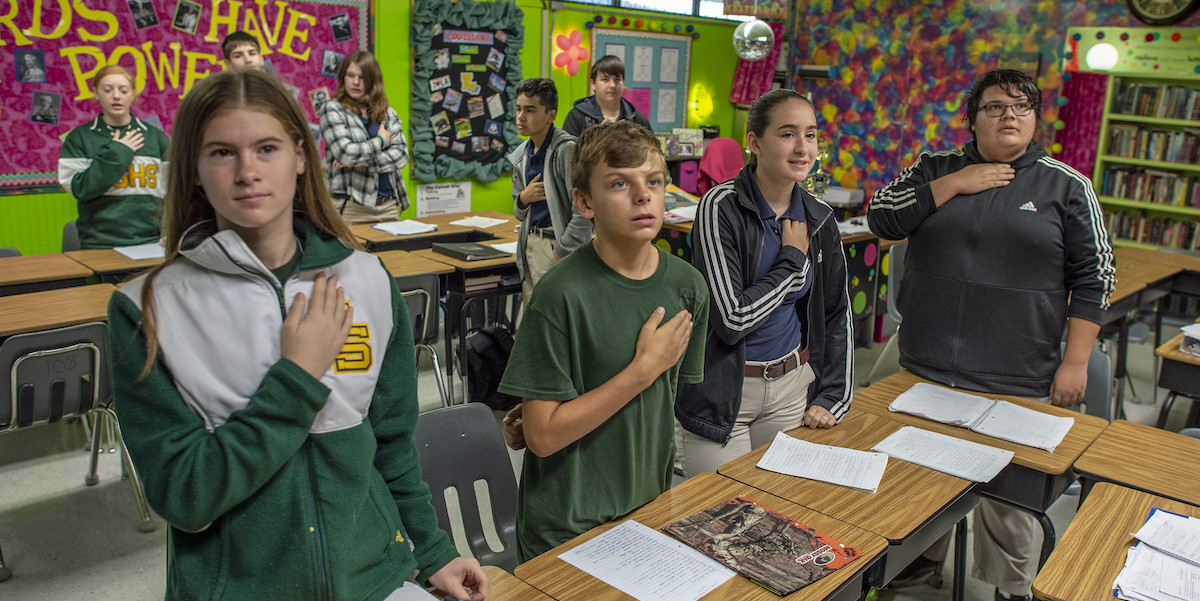
I was inside classrooms conducting observations during Trump’s first presidency when I was forced to confront my own naive assumptions around how institutional violence manifests within schools. I heard teachers openly mock immigrants, express disgust toward children of colour, harass disabled students and ridicule fat and queer children. Such acts of everyday cruelty and harm are in no way unique to the schools I was embedded in. They reflect attitudes widespread in the United States.
Consider Jada*, a Black fourth grader I came to know well. One afternoon, she and a few friends took candy from the teacher’s reward box. It was a minor infraction – ordinary ten-year-old mischief. But the incident metastasized into what school staff dubbed ‘the candy ring’.
For months after, Jada and her friends were marked as ‘thieves’, ‘cunning’ and future dangers to society. An act that might have been resolved with a brief conversation instead became a durable stigma. Teachers described Jada’s mother as incompetent and a ‘bad influence’, resurrecting the figure of the negligent Black mother that remains central to US racial mythology inside an elementary school classroom and by educators charged with the care of our children.
In this inversion, care became control, and concern became a rationale for usurping parental authority, as her teachers positioned themselves as the rightful guardians of her moral development. Jada is one example of such. Such self-reverence only becomes possible through strident narratives that frame all teachers as able to ‘foster an educated and empowered population that can see past propaganda and scare tactics’ – as Weingarten’s book claims.
Structures and ruptures
Stories of educators humiliating or mistreating students of color surface regularly, yet the institution itself remains insulated by the presumption of good intentions. We must ask: why do so many people believe – or want to believe – that all teachers are against book bans, invested in truth-telling about empire, recognise and oppose anti-Blackness and support trans, and migrants’ rights?
We are rightly cautioned against assuming benevolence in policing and other state institutions structured by white supremacy. Schools are similarly embedded in these histories and logics, as the historical examples above demonstrate. They warrant not reverence, but rigorous scrutiny, because refusing to grapple with the political contradictions of teaching has serious consequences.
These consequences show up in how we prepare teachers and how we organise as educators inside schools. We must not mis-recognise teachers’ performance of emotions of pity or sympathy for Black, migrant, trans and queer children, as their unwavering alliance in a fight for freedom from oppression. Doing so only keeps us locked in a loop – reacting to each new wave of state repression and attacks on public education, but failing to organise systematically with the clarity these times demand.
The fight we’re in is not ‘teachers vs. fascists’ but against the logics of carcerality, whiteness, obedience and nationalism embedded in public education
If we are serious about liberation – Black, Third-World, Trans, Queer, Collective – then we must stop investing in the idea that all teachers are inherently aligned with us. Many are not. Some are. Most are somewhere in between, complicit in ways they do not (or will not) name.
The point here is not to demonise teachers. It is to understand the institution they work for and often defend. ‘Teachers vs. fascists’ is not the fight we are in. The actual fight is against the logics of carcerality, whiteness, obedience, nationalism embedded in public education and recognising white heteropatriarchial agency in reproducing these logics and harm.
We don’t need better stories about ‘well-meaning white teachers’. We need ruptures. We need organising that refuses nostalgia for public schooling and teachers, and instead imagines what it would mean to build spaces of learning rooted in Black, brown, Indigenous, migrant and queer lives and logic, not state legitimacy.
* Jada is a psudonym

