



Venezuela is going through one of the most difficult moments in its history. I have been following the country’s Bolivarian Revolution from its beginning, with critical attention and solidarity. There are some media myths that need to be corrected at this vital moment.
Venezuela’s social progress over the past two decades cannot be disputed. You just have to consult, for example, the UN’s 2016 report on the Human Development Index, which notes that between 1990 and 2015, life expectancy and average years in school both rose by more than 4 years.
Such progress was achieved, it should be stressed, by Venezuela’s democratically elected government – the only interruption being the attempted coup in 2002, which had the active support of the US.
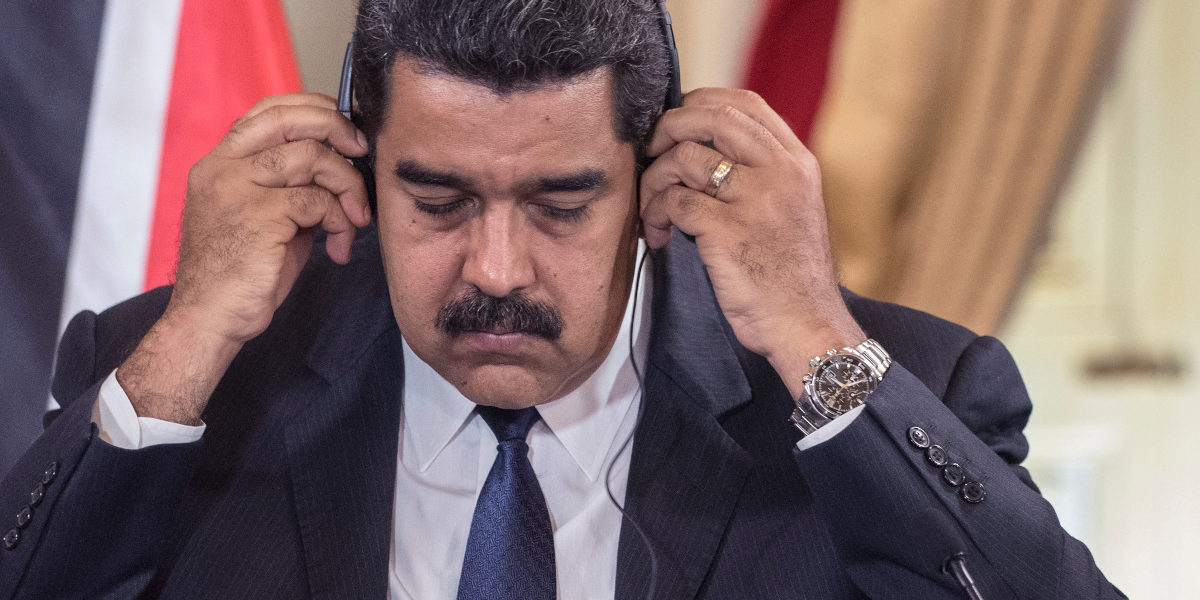
However, Hugo Chavez’s premature death in 2013 and the decrease in oil prices from 2014 had a tremendous impact on the ongoing processes of social change. Chavez’s charismatic leadership had no successor. The new president Nicholas Maduro, running as the candidate of Chavez’s party, won election by a small margin and was not prepared for the complex tasks of government. The opposition (which was actually much divided) seized the moment, again backed by the US, with Obama declaring Venezuela a ‘national security threat‘.
The situation gradually deteriorated until December 2015, when the opposition won a majority in the National Assembly. The Supreme Court suspended four assembly members for alleged electoral fraud, but the Assembly refused to recognise their verdict and comply. After this, the institutional confrontation spilled over onto the streets, fuelled by the serious scarcity crisis that had meanwhile exploded.
This chaotic situation has left more than a hundred people dead. President Maduro’s attempt to end the constitutional crisis by calling an election for a new Constituent Assembly (where elected representatives would rewrite the constitution) has been punished by US sanctions.
Constitutional legitimacy
Last May, I signed a manifesto prepared by Venezuelan intellectuals and politicians of various political tendencies, and addressed to the parties and social groups engaged in confrontation, asking them to stop street violence and start a discussion with a view to finding a non-violent, democratic outcome, without US interference.
After that, I decided I would not speak again about the Venezuelan crisis. So why am I writing today? It’s because I am shocked at the bias of European media. The media is demonising a democratically elected government, and inviting foreign intervention with all its consequences.
Recent history teaches us that economic sanctions affect innocent citizens more than they affect governments. Suffice it to remember the more than 500,000 children who, according to the 1995 UN report, died in Iraq as a result of the sanctions imposed after the Gulf War.
Nothing justifies the insurrectional climate stirred up by the opposition… Their purpose is not to correct the errors of the Bolivarian Revolution, but to put an end to it
History also shows that no democracy is ever strengthened by foreign interference. The failures of a democratic government must be sorted out by democratic means, and the result will be all the more solid the less intervention it involves.
The government of the Bolivarian Revolution has democratic legitimacy. It has lost several elections, and may lose the next one, but it is to be condemned only if it does not respect the results of the election. It has never shown any sign of attempting to overturn democracy in this way.
Despite the overheated rhetoric about illegality and even ‘dictatorship’, President Maduro has the constitutional legitimacy to convene a Constituent Assembly. To be sure, Venezuelans (including many critical Chavistas) may well question it, particularly bearing in mind that the 1999 Constitution promoted by President Chavez is still in place – and they have the democratic means to express their questioning in the election.
But nothing justifies the insurrectional climate stirred up by the opposition during the last weeks. Their purpose is not to correct the errors of the Bolivarian Revolution, but rather to put an end to it and impose the neoliberal recipe (as is happening in Brazil and Argentina).
It is not hard to imagine the consequences of such a course of events for the poor majority of Venezuela. What should concern democrats – but does not concern the global media, which has already put itself on the side of the opposition – is how candidates for the Constituent Assembly were selected. If, as one suspects, the bureaucratic apparatuses of the party in government curtail the participatory drive of the popular classes, the objective of the Assembly to democratically enlarge the political power of the social base supporting the revolution will be frustrated.
Oil at stake
In order to understand why a peaceful solution to the crisis in Venezuela is unlikely, we have to be aware of what is at stake on the global geostrategic scene. On the table are the largest oil reserves in the world.
For the US, it is crucial to have control of the world’s oil. Any country, no matter how democratic, holding such a strategic resource and not making it accessible to oil multinationals (mainly American) exposes itself to imperial intervention.
The ‘threat to national security’ mentioned by the presidents of the US has not so much to do with access to oil directly, but rather the fact that world oil trade is denominated in dollars, the true core of power of the US, since no other country has the privilege of minting notes at its pleasure without affecting their monetary value. This is the reason why Iraq was invaded and Libya devastated (in the latter case, with the active complicity of Sarkozy’s France).
For the same reason, there was interference, well documented today, in the Brazilian crisis, since the exploitation of offshore oil was in Brazilian hands. For the same reason, Iran is once again endangered. And for the same reason, the Bolivarian Revolution is being pushed to fall without the opportunity of democratically correcting the serious mistakes its leaders made during the last few years.
Without foreign interference, I am convinced that Venezuela would know how to reach a democratic and non-violent solution. Unfortunately, what is actually happening is turning the poor against Chavismo, the poor being the social basis of the Bolivarian Revolution and those who most benefited from it. At the same time, the armed forces are being disrupted with a view to a military coup to oust Maduro. Europe’s foreign policy could have been a moderating force, if meanwhile it had not lost its soul.