




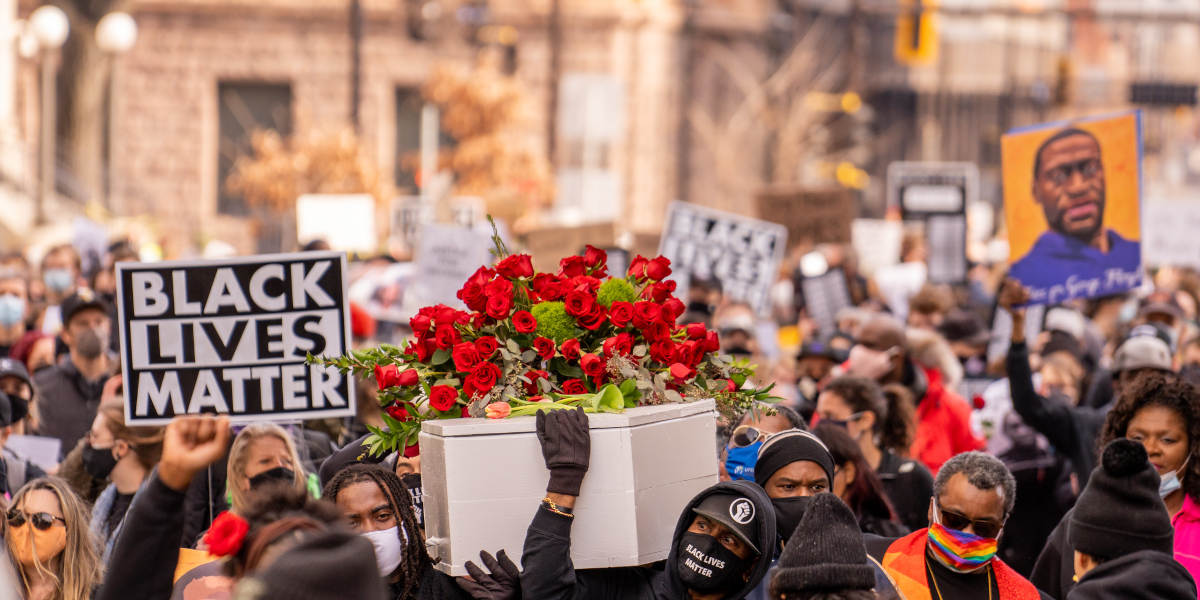
On 20 April, the verdict that so many had hoped and wished for was delivered: Derek Chauvin was found guilty of killing George Floyd. Some commentators have declared this as a ‘milestone’, a step to ‘justice’, even a ‘victory’. It’s understandable, especially for so many Black people, that Chauvin’s conviction is viewed this way. The past year has been filled with pain, grief and exhaustion. More than anything, I hope that the verdict brings George Floyd’s family some relief and peace.
Yet, as gal-dem’s Moya Lothian McLean points out, many people are realising that more action is needed. The justice we need cannot be achieved in a carceral state. Striving for murderous cops to be found guilty is not enough. We need a world in which murderous cops, and the systems which allow them to commit such heinous acts, do not exist at all.
The burden of proof
Chauvin’s conviction is an exception, not the rule. It is not an example that shows the system works or can be fixed; it’s the opposite. It is extremely rare for police officers to be convicted for their frequent acts of violence. The systems which are supposedly delivering justice now have failed countless others, including Tamir Rice, Breonna Taylor and Freddie Gray.
The guilty verdict delivered in the Chauvin case was only made likely because 17-year-old Darnella Fraizer filmed the murder on her mobile phone. There probably wouldn’t have been a conviction, or even an arrest, if that recording was not posted all over social media, prompting worldwide protests in response, with Black people taking to the streets for weeks on end.
For every Black person I know, last summer impacted them deeply. For many, it was traumatising. And yet, despite the video and the global backlash, many people were still on the edge of their seats during Chauvin’s trial, unsure whether a guilty verdict would really be delivered. It shouldn’t take a child’s recording, and millions of people watching and sharing the last moments of a man’s life to achieve this result. Why should we have to live in a world where police murder people in the first place?
Just minutes before Chauvin’s guilty verdict was announced, in nearby Columbus, Ohio, police officer Nicholas Reardon shot dead 16-year-old Ma’Khia Bryant. The chief of police defended his officer’s actions. Neither the few convictions that occur or the reforms that are implemented – like the use of body cameras – cease the killing. The incessant loss of Black lives, which spans centuries, shows that nothing that resembles ‘justice’, ‘progress’ or the real, fundamental change we need can be achieved within existing systems.
In the UK, as in the US, the ‘protectors’ and ‘protections’ that we have in society do not keep us safe. Just as imprisoning more people does not lead to less crime, putting some police officers in jail does not stop the police from committing harm. Prison is neither a cure nor a prevention. Our justice systems fail us past the point of being fixable through reforms. More funding, more powers and more training do not prevent police violence here either. Only through focusing on community-led rehabilitative responses, while reducing police powers, can long-term justice be achieved.
Transformative justice
Justice is Black people being able to live, breathe and thrive without constantly worrying about being harmed by the police. The milestone we should be working towards is transformative justice rather than viewing violent systems – which we already know fail us – as promising solutions. ‘Victory’ is not one guilty verdict. Victory is resources invested in funding harm-reduction, mental health and community services and education, and victim support.
The necessity for better systems and society is an international issue, and the injustices that exist in the UK cannot be forgotten or overlooked now. The same government ministers tweeting approval of the Chauvin verdict are legislating to allow undercover officers to break the law while trying to take away our right to protest. British Police are five times more likely to use force against Black people, and Black people account for just three percent of the population, but eight per cent of deaths in custody.
The systems which are supposedly delivering justice now have failed countless others
We need to move away from believing that there is a ‘need’ for police. Education, for example through Abolitionist Future resources, and community organising, such as the Kill The Bill mobilisations, are required for the social transformations we need to see: Black people no longer feeling unsafe, no longer threatened by police presence, because the force is obsolete. Vulnerable groups – such as homeless people, migrants, people experiencing abuse at home or mental health issues – being offered help and support rather than criminalisation. No police in schools. Funding for community resources, not for bigger jails. Racial, gender and economic justice.
I empathise with and understand why many people have felt content with the Chauvin verdict. But this conviction does not move us away from systems and structures that cause more harm than good. There will be no real justice until Black people are free from the cycle of harm committed against them by the carceral state, and this cycle of harm will not be dismantled until the carceral state is no more. Justice is not served with more police in prison; it’s no police or prisons.