




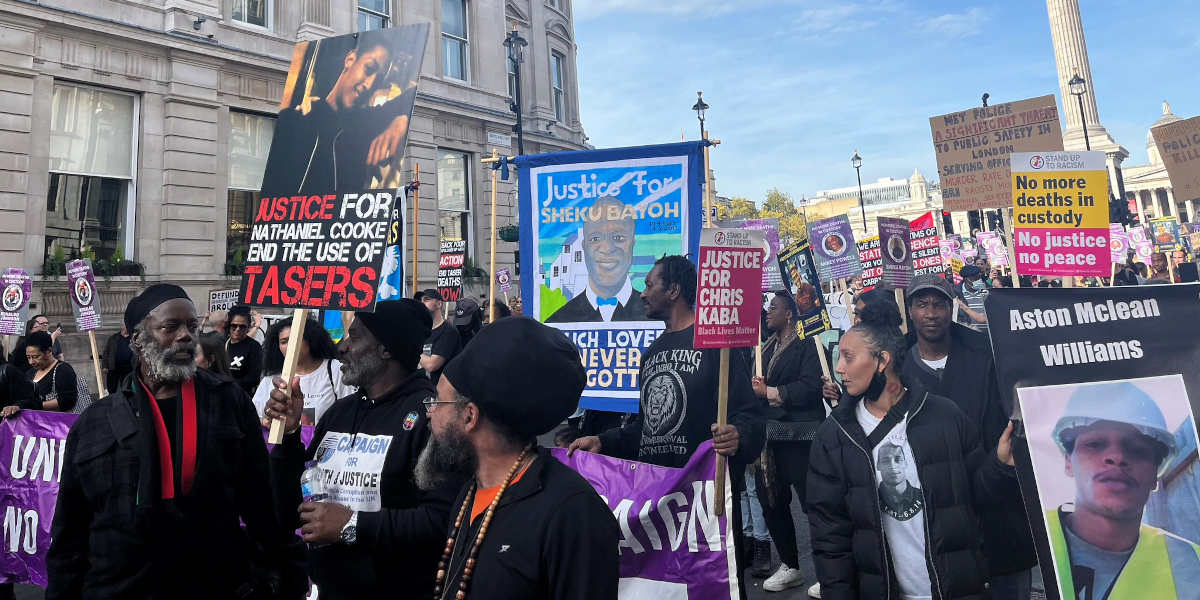
The friends and families of those who ‘died in custody’ in the UK, frustrated with the inability of reform to deliver justice, have established the People’s Tribunal on Police Killings. Bringing together over twenty families for a class action lawsuit against the police, it will be the first time families have initiated a group prosecution.
The tribunal renames these deaths ‘killings’, due to the systematic nature of the cases. They told me: ‘we need no more legislation, no more excuses, no more police training. The criminal law needs to be applied to police officers… we are abolitionist in our approach but in the meantime cops that kill should go to jail’.
It is an anti-reformist position combined with a practical demand for justice. In line with this, the group is critical of various efforts to change the police through government reviews, inquests and improvements to police watchdogs, such as the Independent Office for Police Conduct (IOPC). Reforms to these institutions got them no closer to prosecutions, and often diverted them from justice.
The problem with reform
This problem came into focus after an internal report was released by the Metropolitan Police – ‘30 Patterns of Harm’. It argued racism was ‘built in’ the Metropolitan Police, which the police responded by promising to establish a government review followed by a process of reform.
The changes proposed by reviews like these are treated with extreme scepticism by the tribunal. One of the key members of the tribunal is Samantha Patterson, whose brother Jason McPherson ‘died’ on 18 January 2007.
Samantha was exhausted by these reports, arguing: ‘Killings have increased, and they’re increasing in a more violent way. It’s not getting better in anyway whatsoever… [even if] you have a Lord, Lady or Baroness, write 10,000 words to say what they think needs to be done and what needs to be changed’. Last year was the highest number of deaths in and following police custody in 17 years.
There have already been numerous ineffective reports on making policing less discriminatory. One of these, the Angiolini Review, has since been kicked into the long grass, according to its own author. The problem was never recommending improvements; it was always a lack of political will to prosecute officers.
New Labour and Centring Reform
To understand how the government came to invest in this ineffectual strategy of reform, we must look at the start of this process under New Labour. Blair’s government came to power ready to embrace reform and expand the criminal justice system. NGOs and charities who had been excluded from the prior Thatcher government were finally included in the new government’s policy on prisons.
The minor concessions given to these charities involved ‘access to prisons, consultative meetings, friendly relationships with administrators, and openness to discussing alternatives to incarceration’. However, the government increased the number of incarcerated people. To the frustration of reformers, New Labour’s new approach was a dual process of expanding incarceration and encouraging reform.
The government also used reform to ‘address’ institutional racism revealed by the Stephen Lawrence campaign. New Labour replaced the old police watchdog, the Police Complaints Authority, with the Independent Police Complaints Commission (IPCC), to make it separate from the police with fewer former officers in the organisation.
The role of the body was to investigate thoroughly and make recommendations for prosecutions. However, it was flawed from the start. The so-called ‘independent’ police investigation into Jean Charles De Menezes killing failed to reveal key information about his killing, such as him not vaulting over a ticket barrier before being shot. The only reason we know the truth of what happened is because a whistle-blower from the IPCC revealed it.
Despite these problems, successive governments continued with this strategy of incremental changes to the police watchdog. After being plagued by scandals for years, the IPCC became the Independent Office of Police Conduct in 2018. Members of the tribunal, like Samantha, did not believe this reflected a meaningful shift in the institution: ‘You can change the name of the IPCC to the IOPC, to whatever you want to. It is the same institution, it’s the same body, and nothing has changed.’
Despite the IOPC’s claim to be an independent body, they still employ a combination of those who worked in the police, seconded police, and non-police to investigate complaints. Since these ‘changes’, only one officer has ever been successfully prosecuted for murder or manslaughter post-1986.
Inquests
Another way which New Labour enacted its policy of prison reform was through the inquest court system, where the coroner tries to establish the circumstances in which someone has died. Both sides might have lawyers to argue their case, and verdicts, like ‘unlawful killing’, ‘neglect’ or ‘natural causes’ are determined by a jury. In this system, no one can establish any form of civil or criminal liability.
Under New Labour, the Human Rights Act 1999 enabled a range of new laws to be applied which expanded the scope of these courts. However, the inability of this court to deliver prosecutions remained unchanged.
‘I don’t want my children to look at me and say, “Jason died all those years ago and the police are still doing what they’re doing…” that’s why this tribunal is important.’
This problem continues to this day, as noted by another member of the tribunal, Ken Fero – founding member of Migrant Media – who has been part of these campaigns for over two decades. When it came to the inquest system, he argued: ‘It’s almost like there’s a huge war going on and there’s been a kind of diversionary tactic to make people focus on inquests… the inquest system has never led to a successful prosecution for a police officer for manslaughter or murder’.
This lack of action persists despite inquests often issuing the critical verdict of ‘unlawful killing’. It seems a powerless institution which drains time, with people continually trying to fix it. For the one officer who was prosecuted since 1986, there was no inquest, only a direct criminal trial.
Moving towards justice
Incremental reform prioritises marginal fixes in the future over the necessity of immediate justice whilst diverting time and energy towards institutions that have repeatedly failed to hold the police accountable. Consequently, the tribunal is initiating a direct prosecution – a class action lawsuit.
Lawsuits like these can be successful; in 2015 seven women received an apology by the metropolitan police and undisclosed financial settlements after being deceived into relationships with undercover police. It led to other prosecutions of the police and widespread acknowledgment they violated these women’s rights. Yet despite the success of class action lawsuits, they have never been done in relation to ‘deaths in police custody’.
Samantha added another reason why this is an important route for the tribunal: ‘I don’t want in many years time for my children to look at me and say, “hang on a minute Jason died all those years ago and the police are still doing what they’re doing [killing people]…” that’s why this tribunal is important.’
The tribunal’s class action provides hope policing will change for future generations and the possibility that the state will be forced to acknowledge family’s rights have been violated.