
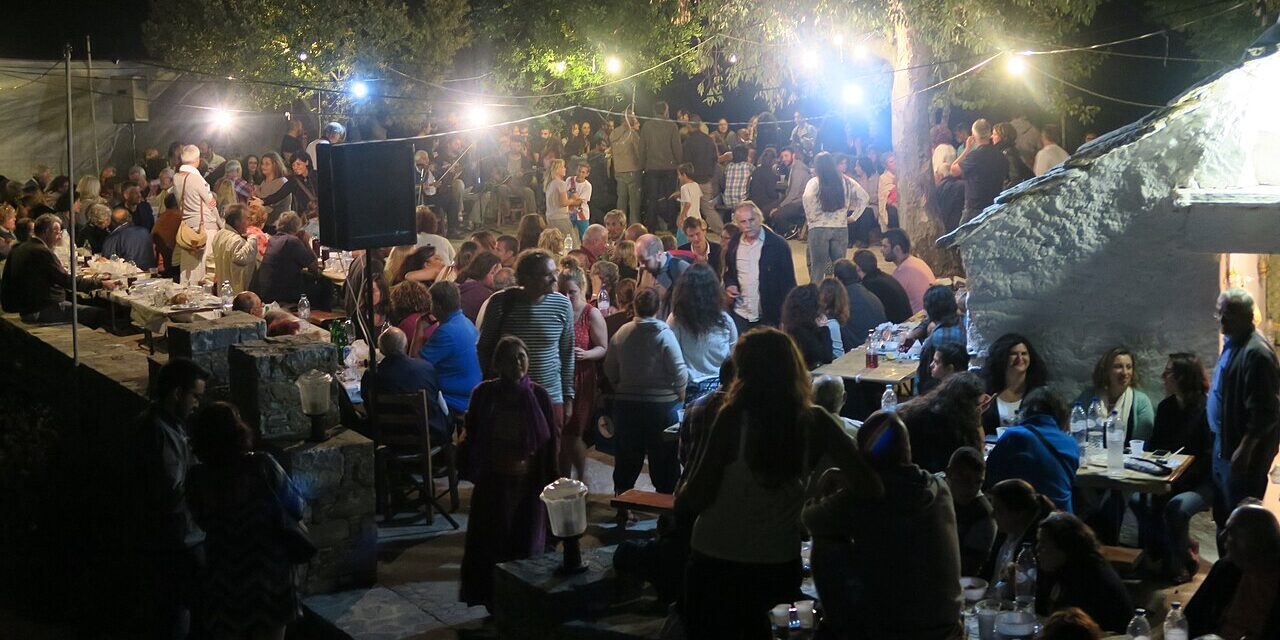
Real Existing Degrowth (RED) is an emerging scholarly idea. In many ways, it’s the 2020’s climate politics version of previous efforts to locate radical alternative economies in daily life, such as actually existing socialism and everyday communism. Rather than asking whether degrowth is possible in the future, RED asks to what extent elements of it already exist today.
Its proponents stress that REDs are messy and incomplete – but that does not negate their existence as alternatives to capitalism. This article gives some concrete examples of where they manifest, from a self-sufficient community in rural Somerset, to a volunteer women-run community kitchen in Veracruz, Mexico, to convivial folk dances on a ‘left behind’ Greek island.
What is RED?
RED builds on the ideas of the degrowth movement, which considers how it is possible to live well with less, within planetary boundaries. Degrowth has challenged the idea that economic growth is necessary for a thriving society. Instead, it points to the planetary and neocolonial harm which is perpetuated when growth is prioritised at all costs. In contrast, degrowthers support a planned reduction in economies’ GDP, arguing this will lead to more justice and a better quality of life for people and planet.
A common criticism of degrowth has been that it is unfeasible – an approach echoing Mark Fisher’s argument, in his book Capitalist Realism, that it is easier to imagine the end of the world than the end of capitalism. It is in response to these critiques that RED has emerged. Real Existing Degrowth refers to the empirical study of actually existing, albeit imperfect, practices and territories where people achieve forms of wellbeing while resisting or living without economic growth.
Rather than imagining degrowth as a future transition, RED focuses on the messy and sometimes contradictory ways that post-growth dynamics are currently unfolding in specific places. The concept is analytical and comparative, and RED’s work includes developing a methodology to quantify degrowth, and a typology for different kinds of REDs, where high wellbeing is achieved with low resource use.
Living well with less
Whether in invisibilised violent conditions of industrial farming, or in the way surging avocado demand has accelerated drought and cartel violence in Michoacán, Mexico, most people under capitalism are largely disconnected from what happens before food reaches them. This disconnection is structural and inherently tied to a growth imperative: trade, economic specialisation, and farming-for-profit all depend on our alienation.
Real Existing Degrowth, then, exists in food systems when production and consumption are reorganised around community need rather than market logic. In Tinkers Bubble, Somerset, established in 1994, a community lives off the land and has done so for over three decades. In their own words, they prioritise ‘low-impact living’. This includes local over global supply chains, restraint around consumerism, and regenerative care of the land. Energy comes from timber harvested on site, decisions are made collectively, and the land is worked without fossil-fuelled machinery.
Tinkers Bubble is RED because its residents live well with less. It is not without flaws, but it doesn’t need to be to demonstrate that non-capitalist ways of living are not a theoretical utopia. Critically, examples like Tinkers Bubble are not isolated. They exist within a broader network in the UK, including the likes of seed savers, mutual aid networks, pay-what-you-can restaurants, heritage grain protectors, and urban housing cooperatives.
Rather than degrowth as a future transition, RED focuses on the messy and contradictory ways it’s unfolding right now
Crisis and conviviality
RED can manifest in moments of crisis and in diverse geographical contexts. Since 1995, Las Patronas, a volunteer women-run community kitchen in Veracruz, Mexico, has provided food and water to migrants making the dangerous journey north on ‘La Bestia’, the freight train that crosses Mexico toward the US border.
Latin America’s severe migration crisis is itself a product of economic structures that lock countries into subordinate positions, while policies that criminalise migration reinforce these inequalities. Las Patronas challenges this through their insurgent, feminist social reproductive labour. To feed and water undocumented migrants who are rendered disposable by global capital is to directly refuse the logic of a system that relies on their exploitation. Volunteer women run alongside the moving train, throwing bags of food and bottles of water up to migrants, doing deeply political and physical work.
This is not an isolated example in Mexico. Beyond Las Patronas and the renowned Zapatistas, Mexico is also home to examples of urban self-sufficiency. These include the autonomous community Los Panchos in Mexico City, acting in the legacy of revolutionary Pancho Villa; feminist forms of alternative water governance which challenge water-for-profit; and more institutional forms of non-capitalist organising in mayor Clara Brugada’s Utopías programme.
A less overtly political, and decidedly convivial, example of RED is found on the island of Ikaria. Here, as in the rest of Greece, frequent panigiris (also spelt panigyri, paniyiri) take place, particularly in the summer months. These are traditional folk celebrations that citizens of all ages participate in, which continue late into the night. Panigiris are collective liminal moments, where social norms are thrown out in exchange for dances, drinks and general conviviality.
In a world increasingly defined by homogenous globalisation and desires for exponential consumption, the maintenance of these free communal festivities feels defiant. These all-night dances – or raves, as they have been described – reinforce strong and important social bonds in the face of what would be defined by many as a material ‘lack’.
The good, the bad and the ugly
These prefigurative examples highlight the possibilities of life outside capitalism in very different contexts. Sometimes, RED’s focus on local alternatives is criticised for being ‘unscalable’. However, in taking this RED perspective and seeing networks of non-capitalist production and reproduction across countries and borders, scalability starts to become evident. From an off-grid living project in Somerset to municipal care infrastructure in one of the world’s largest cities, RED is already taking place at the local, urban and international scale.
By developing frameworks and methodologies to systematically study existing examples of wellbeing with low resource use, RED shows how and why alternatives thrive, and scalability becomes more realistic. We see that anti-capitalist living is a viable possibility. This is an important reminder to those who feel there is no way out of the current system. Real Existing Degrowth analytically examines these seeds of possibility, teaching us more about thriving in the absence of the growth-obsessed matrix we continue to be embedded in.

