



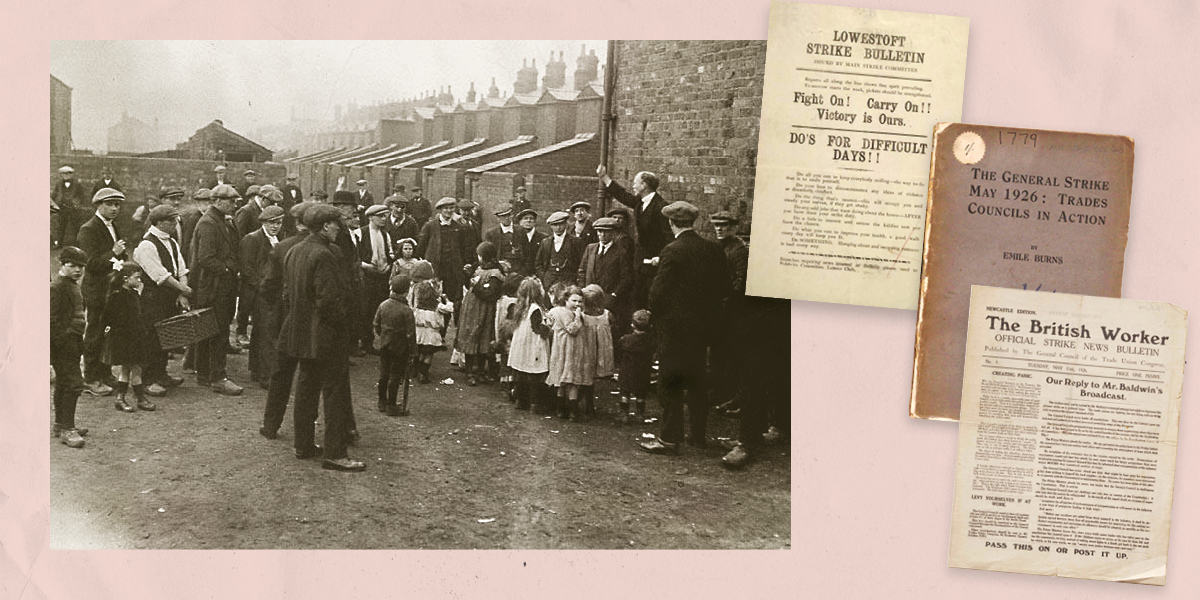
As shown in histories of the British labour movement, trades councils played a prominent role in the early foundation of the Trades Union Congress (TUC) in 1868, which owed much to the efforts of the London Trades Council. They are known today as ‘trade union councils’, of which there are about 150 active in England and Wales. They are local federations of different trade union branches that campaign on a wide range of social and economic problems facing those they represent, as well as confronting political issues on local, national and international scales. Their history offers an interesting angle to rediscover tensions that affected the labour movement, especially during periods of heightened industrial militancy. As the historian and political theorist GDH Cole reflected in his 1939 History of British Trade Unionism, ‘The hour of glory for the trades councils came in the general strike of 1926.’
Councils of action, 1919-20
In the decade from 1916 to 1926, the trade union movement expanded, reorganised itself and engaged in conflicts with employers. The industrial and political disputes prompted trades councils into adopting methods of collective action that went beyond the bounds of what they had tried before. During the Belfast general strike for a 44-hour working week in 1919, the city’s trades council had formed itself into a ‘council of action’ to control the movement of goods in the city. Not only is this perhaps the first instance of this new structure for mobilising trades councils during mass stoppages, but it is also the first occasion that the hopes of militants invested in trades councils bore fruit.
The sympathy shown by the trades councils to the Russian revolutionaries in 1917 and the civil war during 1918-20 plays a significant part in the history of councils of action. During 1919-20, the labour movement organised demonstrations against British military intervention, known as the ‘Hands Off’ campaign. On 9 August 1920, the Labour Party and TUC formed a ‘National Council of Action’ to potentially use industrial action to force the coalition government to retreat from intervening in foreign affairs. During the campaign, the South Shields trades council recommended a ‘down tools policy’ to provide leverage against British interventionism. It decided to join the national campaign and establish a Council of Action branch in South Shields. On 7 September 1920, it moved a resolution stating that ‘universal peace has been established in Europe’ and that all British troops ought to be ‘withdrawn from the lands of Ireland, Egypt, Mesopotamia and India’. There is a continuous thread running from these developments in 1919-20 to the general strike in May 1926.
Nine days of strike: 4-12 May
On 30 April 1926, King George V proclaimed a ‘state of emergency’ and the special constabulary were subsequently mobilised. Emergency powers turned London’s Hyde Park into a military camp, troops in full war kit paraded the streets, and tanks and armoured cars rolled into all the industrial cities. The Admiralty sent warships and submarines to the Thames, the Tyne, the Humber and the Clyde. The Northern Division (Northumberland, Durham, and North Yorkshire) proved to be one of the most disturbed areas outside London, with one-third of the cases of violence in English counties taking place in Durham (183 out of 583) and 103 proceedings being brought under the emergency regulations in Northumberland.
Within a day or two after the general strike started, in nearly every town there existed an organisation to oversee the dispute. Workers around Britain adopted the titles ‘council of action’ or ‘joint strike committee’ for a substantial number of special organisations to organise strike activities.
The councils of action blocked non essential trade via picket lines and only issued permits for goods to be delivered to hospitals and other services deemed necessary
During the stoppage, these councils of action provided general coordination among a network of strike committees for organising tasks of picketing, publicity, issuing permits, selling of foodstuffs, boot-repair services, sports activities, dispatch riding and the upkeep of soup kitchens. In monitoring distribution, the councils of action blocked non essential trade via picket lines and only issued permits for goods to be delivered to hospitals and other services deemed necessary; they released foodstuffs only to union labour, and improvised special transport services.
Women also played a role in councils of action through fundraising and managing child welfare, as well as attending pickets and anti-strikebreaking demonstrations. At the start of the strike, Jessie Platt, of the Newcastle trades council and representative of the National Union of General Workers, urged women to ‘stand four square behind their menfolk, remembering that their fight is our fight and that of our children’. Bella Jolly, a miner’s wife and Labour councillor, reflected on her involvement: ‘If the Labour movement has to go down in history, one of its finest achievements is how the women stood by their men in 1926.’
Northumberland and Durham joint strike committee
Trade unionists in the region of Northumberland and Durham formed at least 28 councils of action and 52 strike committees during the general strike. Similar to Merseyside and Dartford, the region was unusual in that it federated councils and committees under a ‘Northumberland and Durham joint strike committee general council’. On Monday 3 May 1926, at the offices of the National Union of Distributive and Allied Workers on Leazes Terrace, an informal meeting took place that consisted of 14 organisations, including both the Newcastle and Gateshead trades councils. The joint strike committee met daily at 3pm in Burt Hall during the nine days of the stoppage with the first meeting taking place at 7pm on the evening of 4 May. The newly established committee sought to control both the Northumberland and Durham coalfields and the ports and shipyards of the Tyne, Tees and Wear, with their great engineering and chemical works, as well as the north-south traffic routes.
The Newcastle trades council held meetings at the Newcastle William Morris Club on Newgate Street. On the evening of 4 May, its president GH Laraman (Foundry Workers) convened a special meeting with delegates from union branches and political organisations in the city. The purpose was ‘setting up a council of action, which would be responsible for the leadership of Newcastle during the crisis’ and ‘work in conjunction with the Durham and Northumberland council of action’. Laraman oversaw the publication of The Workers’ Chronicle, a strike bulletin, in efforts to counter anti-strike narratives produced in The British Gazette. The latter was under the editorial control of the chancellor of the exchequer, Winston Churchill. He accused strikers and the TUC of mounting a direct challenge to the British constitution and parliamentary authority, alleging that the strike was illegal.
The Workers’ Chronicle first appeared on Wednesday 5 May 1926 and declared its aim to ‘provide our class with correct news of the great struggle into which we have entered in defence of our wages and hours’. The bulletin also highlighted the recent police imprisonment of Communist Battersea MP, Shapurji Saklatvala, for a seditious speech on the eve of the general strike at a May Day rally in Hyde Park. It warned strikers that ‘the government will not stop here but will soon turn their attention to our trade union leaders’.
The Newcastle trades council urged trade unions to open their offices and register their members for mass picketing, where responsibility was then handed over to the council of action and joint strike committee, who would direct the picketing.
Contested spaces and repression
Confrontations between the joint strike committee and the government’s emergency services soon emerged when strikebreaking volunteers unloaded food ships at the Tyne. On 5 May, James Tarbit (National Union of General and Municipal Workers) informed the committee that trade union labour abandoned their work because of the volunteers and the presence of two destroyers and a submarine moored alongside the food ship. The committee decided to withdraw all trade permits.
Britain today is a hugely different place compared to the 1920s, yet current political and international crises have familiar parallels
Between 8 and 9 May, the situation in Newcastle escalated with police baton charges to break pickets by force. Two separate police baton charges occurred against crowds in Grainger Street and on the High Level Bridge, resulting in 22 arrests with 13 men charged with offences under emergency regulations and nine with actions likely to lead to disaffection among the civilians. The joint strike committee argued that authorities were attempting to undermine the effectiveness of the pickets by the use of brute force. Similar cases of police repression occurred in the mining districts of Durham and Northumberland, where large scale pickets of miners severely restricted the movement of traffic without permits.
Aftermath
Although the strike officially ended on Wednesday 12 May 1926, trades councils initially misinterpreted the settlement and published in their bulletins the belief that their trade union leaders had secured the workers’ demands. By 14 May, the true nature of the situation had become more evident. On the same date, Newcastle’s Workers’ Chronicle stated that: ‘Whilst the general strike has compelled the government to grant a subsidy, yet the manner of ending the general strike resulting in the collapse at London headquarters has left us exposed to the most bitter persecution by the local employers… Keep all the local councils of action, trades councils, strike committees etc in being and communicate with us regularly. Hold together!’
Many workers remained out on strike for a few days after 12 May. Newspapers and reports from the Darlington transport joint strike committee show that workers stood firmly in support of miners in York, Goole, Hull, Nottingham, West Hartlepool, Stockton, Middlesborough, Durham, Kirkby Stephen, Thirsk, Sunderland, Gateshead and Newcastle. Transport workers bore the brunt of the employers’ offensive, especially with the continued stoppage in the coal industry. Some strikers experienced victimisation: many returned to work under worse conditions of employment compared to pre-strike terms; for others, there were either reduced hours of work available or a period of unemployment.
Past and present
Trade union morale received a great blow with the failure of the general strike and union membership declined. In 1927, the government consolidated its victory with the passage of the Trades Disputes and Trade Unions Act, which made general sympathy strikes illegal and required union members to ‘contract in’ to the political levy. The Labour Party pledged itself to repeal the act when it came to power. That opportunity came after the 1929 election, but Labour abandoned efforts to repeal the bill in the face of the combined opposition of the Conservative and Liberal Parties.
Britain today is a hugely different place compared to the 1920s, yet current political and international crises have familiar parallels. Under successive Tory governments between 2010 to 2024, trade unions have faced an onslaught of anti-union legislation, tipping the balance of power in the workplace further towards employers and away from workers. Yet in 2023, the UK saw more strikes than in any other years since the 1980s. The Tory government responded to this wave of action with the Strikes (Minimum Service Levels) Act, further disempowering workers and imposing new obligations. Labour’s Employment Rights Act 2025 became law in December 2025, introducing major reforms to reverse some anti-trade union laws.
Although some might say the strength of popular political action in the North East has declined alongside deindustrialisation, legacies of radicalism have endured. Traditions of solidarity are rooted in working class and migrant communities in post-industrial towns and embedded within urban identity. The Newcastle trades council has supported various trade union picket lines and strike funds, as well as publicised solidarity for Palestine and kept a presence at counter protests to challenge far-right demonstrations in the city. Trades councils remain crucial organisation for building local grassroot power and promoting solidarity in local communities to defend rights, challenge exploitation, and support social justice.