
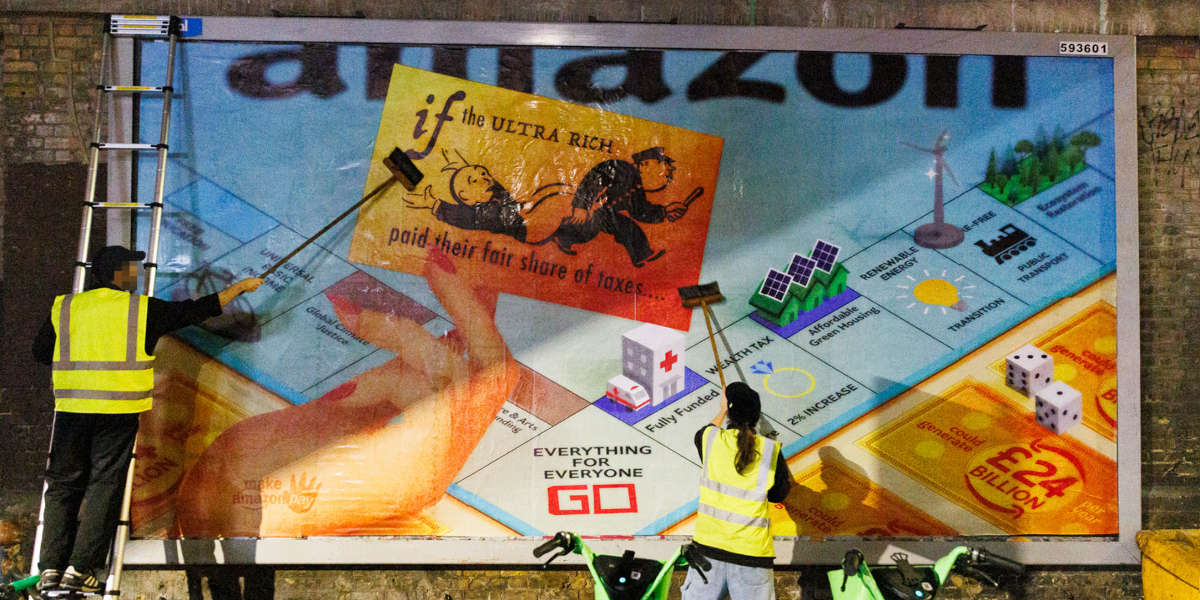
We are growing accustomed to the annual timetable of Autumnal shopping inducements. Halloween spending starts weeks before 31 October. When it’s done, the orange and black plastic bunting is swiftly replaced with Christmas decorations. In 2025, festive advertising began earlier than ever before.
Since the 2010s, the shopping run into Christmas has been turbo-charged by the Black Friday sales blitz – an ‘event’ tied to and imported from the US-specific Thanksgiving holiday period. Black Friday Week now runs until Cyber Monday, merging with the highly-saturated festive season through to the January sales.
The success of Amazon – the company responsible for importing these shopping ‘moments’ – is testament to its corporate, lobbying and marketing might. Behind the wall-to-wall Amazon adverts calling on us to ‘unwrap the smiles’, the costs of its cut-throat business model are severe. From eroding worker’s rights, to facilitating war and ecological crises, the corporation’s monopoly power is re-defining our notions of exploitation and extractivism.
Streets paved with ads
Amazon is the world’s biggest advertiser, spending $21 billion globally in 2024. In Britain, this amounts to £30 million on Out of Home marketing and £68 million in TV advertising, flooding our streets and houses with surround sound of calls to buy.
Environmental campaigners can have a difficult time attempting to shift Christmas from corrosive overconsumption towards less commercially-oriented acts of social connection or mid-winter celebration. Even for the ecologically-concerned, deeply-embedded societal norms of family relationships, tradition and peer pressure compel demonstrations of love and affection through material gifting.
The relatively new phenomenon of Black Friday, however, is easily distinguishable as naked runaway consumerism for the sake of big business profits. The Black Friday window produces around 1.5 million tonnes of waste in the UK, of which 80 per cent ends up in landfill, incinerated or poorly recycled – adding to the 3 million tonnes produced over the Christmas period.
Black Friday produces 1.5 million tonnes of waste in the UK, of which 80 per cent ends up in landfill, incinerated or poorly recycled
It doesn’t matter that most Black Friday ‘deals’ are actually cheaper or the same price at other times of year; Amazon has perfected the art of tech-calibrated addictive shopping. The government, bowing to advertising industry pressure, is for its part reluctant to take measures that could be seen as ‘anti-growth’. When challenged to restrict advertising that harmed the government’s own Circular Economy goals, for example, Energy Minister Michael Shanks bullishly replied that Labour were ‘not in the business of banning things’.
A sprawling, deadly empire
Amazon has built its empire by ruthlessly prioritising one-click consumer convenience and suppressing the pay and conditions of its workforce – now numbered at 1.5 million direct employees worldwide, with more in its supply chain. Injuries to its warehouse workers – already commonplace – increase further under the ‘severe pressure’ to meet Black Friday demand.
The corporation is also a notorious union buster, closing seven warehouse sites across Quebec in response to a single site successfully unionising in regional capital, Montreal. In Britain, the GMB union accused Amazon of using underhand tactics to narrowly defeat a historic vote on union recognition at its 3000 employee site in Coventry.
Beyond online retail, Amazon has expanded into delivery, entertainment, logistics, fashion and groceries. Amazon Web Services now account for around two thirds of the company’s operating profits and over 30 per cent of all global web cloud platforms. Its disturbing surveillance and AI technologies are being woven into the structures of repression, including use in ICE raids on migrants in the US and the Israeli military targeting of civilians in Gaza.
Amazon surveillance and AI technologies are being used in ICE raids on migrants in the US and by the Israeli military in Gaza
Millions of people are now tied to Amazon – whether we like it or not. Its October 2025 web server outage, for example, directly affected 2,000 companies including Signal Messenger and HMRC. The company has been steadily increasing its monopolistic power, with the US Federal Trade Commission alleging in a 2023 lawsuit that the company extracts nearly half of every dollar of revenue made by its sellers. For economist Yannis Varoufakis, this unprecedented level of power marks a new era of ‘technofeudalism’, where traditional capitalist interests are subservient to Big Tech.
While Amazon has relied upon the public services of transport, education, healthcare and technological infrastructure to grow its empire, it has also shown a world-beating ability to dodge paying the taxes that fund them. Thanks in part to the UK government’s ‘super deduction’ initiative – a tax break for corporations claimed to ‘promote growth’ – Amazon paid no corporation tax at all 2020-2023. In 2024 alone, its corporation tax avoidance cost the UK exchequer an estimated £575 million.
Levers of justice
Individual consumer choices such as boycotting Amazon, buying second hand at Christmas or gifting experiences rather than physical items are all worthwhile consciousness-raising exercises, which are often an important first step in social change.
However, the scale of devastation of the overproduction and overconsumption of the Black Friday and Christmas period, and the techno-authoritarian direction of travel from Big Tech’s alliance with the far right, requires a systemic response. We need an approach that harnesses the consciousness raised by individual choices towards meaningful collective action.
Make Amazon Pay is one such response. The global coalition of trade unionists, tax justice campaigners and environmentalists has organised strikes, protests and walkouts every Black Friday since 2020. In 2025, actions took place in 38 countries under the Make Amazon Pay banner.
In India, tens of thousands of workers rallied across 20 cities, demanding improved pay and protection from lethal heatwaves – conditions that effectively turn Amazon warehouses into furnaces. Workers’ anger is fueled by the fact that, twelve years on from the Rana Plaza factory collapse, Amazon still refuses to sign the Bangladesh Accord on Fire and Building Safety.
‘Subvertising’ activists graffitied advert sites in Leipzig, Germany in support of the Make Amazon Pay coalition
CREDIT: SUBVERTISERS INTERNATIONAL
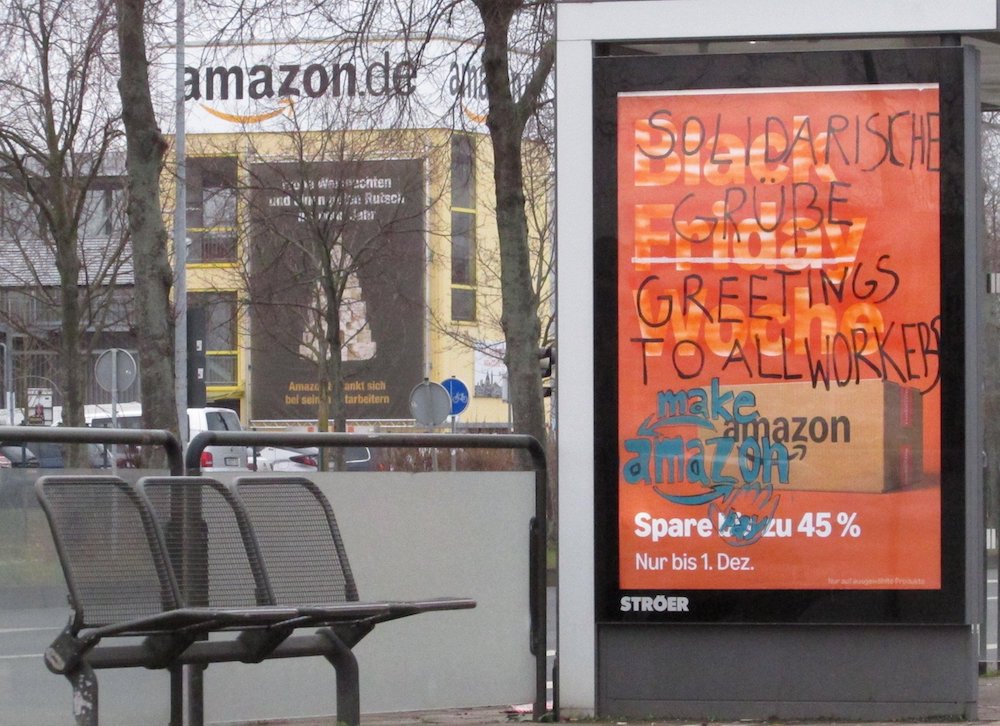
In Germany, Amazon saw its largest strike in company history on Black Friday 2025, as thousands of warehouse workers in nine locations formed picket lines. Anti-advertising groups united across Europe with their own intervention the ‘ZAP Games’ – for Zone Anti-Publicité – two weeks of creative actions against the outdoor advertising industry that has filled our streets with intrusive digital billboards. Groups staged creative interventions across 19 cities – interrupting advertising infrastructure as part of wider ‘ad-free city’ campaigns to reclaim public space altogether.
Despite the mountains of waste from fast fashion and discarded electronic goods, governments remain unquestioningly wedded to retail sector success. The potential of the Make Amazon Pay coalition is its muscular ability to halt business-as-usual at production sites around the world and to intervene in the circulation of capital and profit accumulation.
Looking to the future, the discourse around consumerism must differentiate between the legitimate need to lift people’s material conditions and the harmful consequences on our wallets, wellbeing and environment of never-ending rounds of shopping. As we prepare to enjoy Christmas despite the consumerism blitz, we can find inspiration from the coalitions of groups that are building movement power, year-on-year, in the name of human dignity and a liveable planet.

