



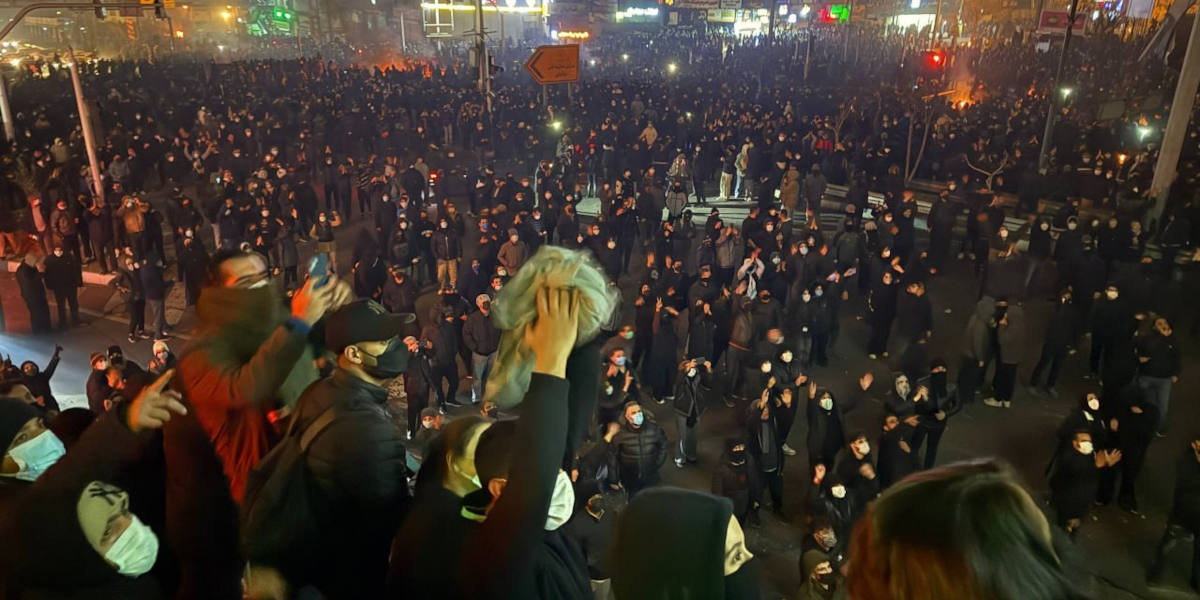
The current uprising in Iran comes on the heels of the 2022 Woman, Life, Freedom revolution, now with a greater emphasis on ‘Life’. That this slogan became the watchword of that revolution speaks volumes about its potentials and deep-seated ideals. Rooted in a paralysing economic crisis, the current uprising is continuing those aspirations on an extended scale. This movement is aiming to dismantle not only political oppression but also economic inequality. And in a capitalist society, this can only mean dismantling capitalism itself.
Woman, Life, Freedom and its current sequel are the result of the development of class struggles in contemporary Iran. In 1979, Iran’s working class was a young working class in a newly capitalist country, following the 1960s Land Reforms. Yet, its participation in the revolution had a massive impact on political and social developments.
Early post-revolutionary Iran witnessed the rise, crisis and fall of Iran’s populist left, which defined itself primarily in opposition to ‘dependent capitalism’ and imperialism, and the simultaneous rise of a ‘Revolutionary Marxist’ and then a ‘worker-communist’ left, which developed through a critique of Iran’s populist socialism and the global strands of communism and socialism existing at the time.
1979 and its legacy
Despite the hijacking of Iran’s secular 1979 Revolution by religious-nationalists with the help of the major Western powers (who, by supporting Khomeini and the Islamists, sought to build an anti-communist barrier vis-à-vis the neighbouring Soviet Union – no matter what its human cost for the people of Iran), Iranian society never acquiesced to this medievalism and barbarity.
The first manifestation of this progressive, secular resistance was the magnificent women’s march, together with supportive men, on International Women’s Day against Khomeini’s order for compulsory hijab (Islamic head scarf), only a few weeks into the installation of the Islamic regime. This resistance converged with workers’ struggles in pursuit of their demands, the revolutionary movement in the Kurdistan region of Iran, and the popular demands for political liberties, increasingly under attack by the counter-revolutionary regime.
This incompatibility between a working class and a people yearning for freedom and equality, and a reactionary, despotic religious capitalist regime, has marked the history of post-1979 Iran. One result has been the emergence of a large social left and a progressive pole in Iranian society in opposition to the Islamic regime, as well as to the bourgeois opposition on the right.
This significant and numerically large social left and progressive pole has not existed merely as an intellectual current, but has repeatedly expressed itself through concrete campaigns and struggles inside Iran. Prominent examples include the prolonged strikes of the Haft Tappeh Sugarcane Workers, which openly challenged corruption and privatisation while advancing demands for dignity and workers’ control, and the repeated nationwide mobilisations of teachers, pensioners and numerous other sectors linking economic justice to political freedom. Women have been at the forefront of significant protests for gender equality and social freedoms (culminating in the Woman, Life, Freedom revolution), while universities have been centres of socialist radicalism and political protest.
With a worsening economic situation and lack of political and civil liberties the fundamental issues behind the uprising remain
In the current revolutionary upsurge, these traditions have re-emerged clearly: in the radical slogans on the streets, the central role of women and youth, the rejection of religious authority and the refusal to rally behind monarchist or nationalist alternatives, despite this being presented in the West as the only alternative to the Islamic Republic.
The Iranian left has developed modern organisational and communication capacities capable of sustaining resistance under severe repression. A key example is New Channel TV (Kanal Jadid TV), a satellite television channel broadcasting into Iran 24 hours a day, seven days a week, for the past 21 years, sustained entirely by activists and supporters. Independent of state and corporate media, it has provided a platform for political prisoners, families of the executed and grassroots activists, maintaining visibility and solidarity in the face of systematic silencing.
Amid recent internet shutdowns, its director, Keyvan Javid, has called on people to publicly circulate the channel’s satellite frequency, ensuring continued access even when the internet has been shut down and all communication blocked. Such initiatives form part of the material infrastructure through which the struggle persists.
A Pahlavi restoration?
Alongside the left, communists and other revolutionaries and progressives fighting to push the movement forward towards its aims, we find in opposition, the nationalists and in particular the homegrown Trumpist monarchists, working to hijack the revolution for their own aims.
The right, and specifically the monarchists, appear to have gained the initiative owing to the familiarity of their figurehead, Reza Pahlavi, a sense of nostalgia for the past by some (oblivious to the former regime’s harsh repression and exploitation), and their access to economic and media resources and corridors of power in the West and globally.
However, calls for the prince to come back, rather than reflecting a widespread desire for the past, are the cries of a desperate population clutching at whatever it can so as to beat down its main adversary. Despite their attempts to hijack the revolution, the monarchists are at most a temporary instrument in the eyes of the people in their revolutionary struggle. The fundamental aims of the revolution are diametrically opposed to the oppressive police state and the austerity, poverty and exploitation which a monarchist or ultra-nationalist far right government promises.
The bourgeois right of course fears the revolution and in particular an armed insurrection of the people as in 1979. This puts the initiative in the hands of the revolutionary masses and disrupts the counter-revolutionary attempts of the right for a ‘smooth’ transition of power from the current regime into its hands, leaving intact the organs of the bourgeois state: the armed forces, police, courts, prisons and the security and administrative apparatus.
The path ahead
The facts slowly coming out of Iran, despite a continuing internet and communications outage, report tens of thousands of deaths, injuries and arrests. This massacre, and the de facto martial law in place in Iran’s cities, have of course shocked the people, but also added to their fury and hatred of the regime. With a worsening economic situation, rampant inflation, the daily struggle to survive and lack of political and civil liberties, the fundamental issues which gave rise to the uprising are still there. It is not, therefore, a question of if another revolutionary resurgence will happen, but when.
Under these circumstances, a path for a left victory is open. However, it will require the conscious efforts and diligence of revolutionaries in leading the revolution and in providing a strong and viable political alternative to ensure that such a prospect becomes a reality.