



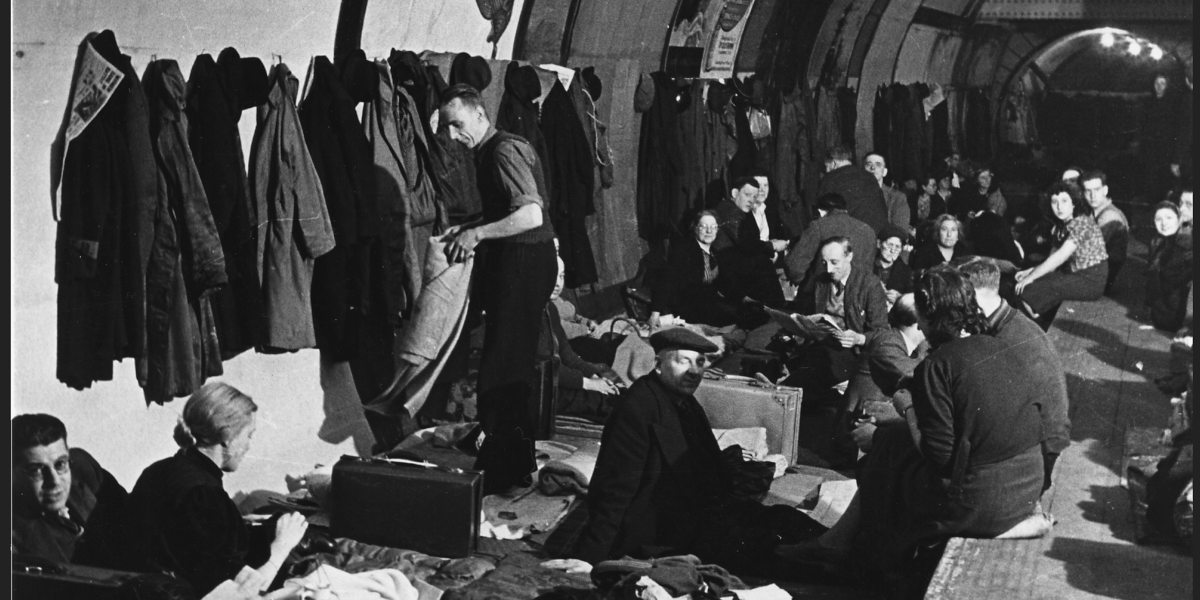
Today the Blitz is evoked as a moment of national unity, but at the time it exposed deep, class rifts in British society. Sitting underneath the ‘Blitz spirit’ mythology are nasty truths – such as the widespread neglect and abuse of working class evacuees, or the anger that attached to the conspicuous consumption of the rich while the poor experienced rationing and starvation. But nowhere was this more apparent than in the provision of air-raid shelter.
The Communist Party – drawing on their knowledge, and in some cases first-hand experiences, of fascist bombing in Spain – led the call for the government to build deep bomb-proof shelters. The call fell on deaf ears. The government, preparing to fight the last war, distributed gas masks, and prioritised digging shallow trench shelters in parks, which immediately filled with water, whilst providing corrugated ‘Anderson shelters’ for those with gardens.
The minister of civil defence, Sir John Anderson (who gave his name to the aforementioned shelters), responded to the calls, stating ‘I do not think we are prepared to adapt our whole civilisation, so as to compel a large proportion of our people to live and maintain the productive capacity in a troglodyte existence deep underground.’ On government orders, Londoners were forbidden from using underground stations for shelter.
The elite’s preparation for the war, meanwhile, exposed as a lie the notion that deep shelter was undesirable. The cabinet moved into purpose-built war rooms beneath the treasury, while London’s best hotels – the Ritz, Dorchester and Savoy – turned their basements into five-star bunkers. This latter move was part of high society’s belief in ‘lunching for England’ – continuing to enjoy their lavish lifestyles in (imagined) defiance of Hitler. When the hotels began advertising these luxurious bunkers, the communists decided that something had to be done.
Forcing open the shelters
On 14 September 1940 – a week into the bombing – an initiative was formed. Somewhere between 40 and 70 East Enders assembled, comprising dockers, pregnant women, homeless children, unemployed workers, rent strikers, veterans of Spain and of Cable Street. They were led by local organiser and future Communist MP Phil Piratin.
The group waited in Embankment Gardens for the air raid sirens to begin, at which point they produced banners and marched into the lobby of the Savoy, demanding entry into the hotel’s shelter. ‘We decided,’ Piratin said, ‘that what was good enough for the Savoy Hotel parasites was reasonably good enough for Stepney workers and their families.’ The police were called but were quickly informed that any attempt to evict the protestors would be resisted, and eventually left. The protestors settled in for the night, asking the waiters for tea and bread and butter (for which they refused to pay anymore than they would in a Stepney cafe).
‘We decided,’ Piratin said, ‘that what was good enough for the Savoy Hotel parasites was reasonably good enough for Stepney workers and their families.’
Although the press stayed largely silent, the stunt galvanised the campaign for better air raid provisions. Days later thousands stormed the underground system, breaking open the gates and sweeping aside the police. Similar activity took place at various subterranean warehouses across London. These ‘unofficial’ shelters were quickly overwhelmed by Londoners seeking safety. ‘Shelter committees’ were elected to ensure health, safety, and general order. Many published ‘shelter bulletins’, and a London-wide shelter committee conference took place. The communist-aligned Unity Theatre group even began touring the shelters, offering light-hearted political satire (whose targets included landlords, war profiteers, and the government) alongside classic music-hall fare.
In the face of this widespread disobedience the government reversed its policy, formally opening the underground as a shelter, and quietly relieving John Anderson of his ministerial brief. Despite this, the spirit of self-organisation prevailed. To take just one example, The Fruit & Wool Exchange shelter became known as ‘Mickey’s Shelter’ after Mickey Davies, a 3ft 3in optometrist and organiser. When the government replaced him with an ‘official’ marshall, the shelterers successfully demanded his reinstatement. And this spirit prevailed at the war’s end, which saw systematic squatting to provide shelter for those made homeless due to the bombing. These experiences fed into the post-war consensus that the government would have to ensure that everyone was housed, fed, and looked after.
Lessons from the Savoy
In our era of compounding crises and state abandonment, there are a lot of lessons we can take from the Blitz, not least that governments failing to provide the necessities of life opens up space for struggle. We can also learn that direct action to secure those necessities can not only succeed, but prove popular and even radicalising. Indeed, the tactics of the Communist Party in this era – staying close to the people, taking action to meet unmet needs – should be of interest to the various emerging left party formations which seek to be something more than simply electoral vehicles.
When I first read Piratin’s account of the Savoy, my mind went to the climate crisis. After all, the rich are once again building bunkers while telling us not to worry. Though on a different scale entirely, climate breakdown is something, like the Blitz, which the working class has not brought about, but is expected to endure – with little government support. Amid calls to develop a ‘socialist politics of adaptation’ we might draw upon this underground stream of history to develop responses to issues like flooding, food insecurity, heatwaves and brutal coldsnaps. In the face of the myriad Blitzes we will face, we should ask ourselves: what do we need? And how can we take it?