


In deploying the largest naval armada seen in the Caribbean Sea for decades, the Trump administration has spent recent months ramping up long-standing US aggression against Venezuela. Predicated upon the falsehood that Venezuela is a narco-state run by the non-existent Cartel de los Soles, the fleet comprises at least thirteen warships, including three guided-missile destroyers, five support vessels, a nuclear submarine and the USS Gerald Ford.
The latter, the world’s largest aircraft carrier, is capable of carrying over 75 military aircraft and a range of military assets. Overall, the US has deployed at least 16,000 military personnel to the flotilla. The Pentagon is also docking warships and moving in war materiel through Puerto Rico and Trinidad and Tobago, and likely through Guyana and other Caribbean islands.
These manoeuvres are an undisguised effort towards regime change by direct military aggression, a dream shared by all US administrations since Hugo Chavez was elected President of Venezuela in 1999. This aim has always been driven by a desire to depose a socialist state in its backyard and to control the largest oil reserves on the planet.
From sanctions to missiles
Consecutive US governments have inflicted painful sanctions on Venezuela, aimed at asphyxiating the economy and causing horrific harm to millions of people. They have blocked Venezuela oil exports, leading to a catastrophic decline in oil revenue (by 99 per cent), and imports including food, spare parts, fuel, medicines and other essentials. Sanctions have also effectively expelled Venezuela from the world financial system: the US has confiscated Venezuela’s assets in the US, while European countries have frozen access to assets held in their banks.
As a result, in 2018, inflation in Venezuela reached 1.5 million per cent. A 2019 report estimated that 40,000 people had died as a result of the sanctions over the preceeding two years. Led to despair, courted by the Venezuelan right and following traffickers’ false promises of jobs in the US and Latin America, several million Venezuelans left the country between 2015 and 2020. Around one million have since returned.
More recently, Trump has claimed that the US is engaged in an ‘armed conflict’ with drug cartels that it has labelled terrorist organizations – thereby designating people accused as traffickers by the US as ‘unlawful combatants’. US warplanes have bombed over 20 small boats in the Pacific, killing 83 civilians from Venezuela, Colombia, Ecuador, Trinidad and neighbouring islands, most likely fishermen or traders.
US government officials have neither produced evidence of drug trafficking nor made any arrests of putative traffickers. These arbitrary killings, in the absence of a declared war or due judicial process, constitute extrajudicial executions. According to UN experts, they may amount to international crimes and violate fundamental international human rights law.
Overt and covert threats
The US naval deployment follows intensifying pressure on the Venezuelan government. In August, the US Department of Justice increased an existing bounty on President Maduro’s head from $25 million to $50 million, followed by the deployment of the war fleet.
That same month, Venezuelan authorities seized massive stockpiles of explosives, ammunition, machine guns, detonators, and grenades in caches across five cities. The seizure of these arsenals foiled a key component of an alleged plot: terrorist attacks set to be depicted internationally as a ‘popular insurrection’ – which would have been supported by the conveniently-deployed US armada surrounding Venezuela. In the past, sabotage of critical infrastructure across the country has been linked to opposition leaders’ supporters.
Meanwhile, Trump announced that the maritime war on drugs would evolve to strike land targets inside Venezuela and US combat planes flew provocatively close to Venezuela’s coast. Trump also authorised the CIA to conduct covert operations inside Venezuela. The docking of the USS Gravely in Port Spain, Trinidad and Tobago, on the edge of Venezuelan territory, prompted the Venezuelan government to announce its capture of mercenaries who it alleges have been plotting a ‘false-flag’ attack from within the country. Such an attack would provide pretext for full military confrontation in the region.
As world opinion turns against a US invasion of Venezuela, all of us must campaign for the UK to join the chorus and defend Latin America as a region of peace
Venezuela has met US threats with a massive mobilization of the armed forces and the people’s militia, a civilian force with constitutional status made up of volunteers. Recruitment centres for volunteers to receive military training have boosted the militia’s numbers. Any US expectations that its intimidation tactics would lead to defections and splits within the Bolivarian civil-military alliance appear unfounded.
Now, Trump and US Secretary of State Marco Rubio are expanding threats against Venezuela to include cartel-linked targets in Colombia and Mexico. Trump has designated Colombia as ‘failing to cooperate’ and said he would bomb Mexico if doing so stopped drug trafficking. The administration has tried to further prop up their wobbling ‘war on drugs’ by accusing Maduro of trafficking fentanyl to the US. Mexican President Claudia Sheinbaum and her Colombian counterpart Gustavo Petro have both flatly rejected these laughable claims, while also denouncing the US military threat against Venezuela and all of Latin America and the Caribbean. President Lula of Brazil has also spoken out against US military action in the region.
Coordinated response
A September summit of the Community of Latin American and Caribbean States (CELAC) also denounced US military deployment in the region. There, a crucial dimension of Venezuela’s response strategy became clear: to isolate the US politically by appealing to the UN Charter principles of the sovereign quality of states and CELAC’s 2014 declaration of Latin America as Zone of Peace, and denunciation of threats of force and extrajudicial executions
The international chorus against US military aggression has since grown worldwide, with the UN, UN experts, the G77+China, the CELAC-EU Summit, the ALBA-TCP countries, parliamentarians from Latin American nations, Russia and China at UN Security Council and the Puebla Group all echoing concerns. Pope Leo XIV, in a direct reference to the tension in the Caribbean, stated ‘no one wins with violence’. Even The New York Times notes that ‘Trump is deeply focused on Venezuela’s oil reserves’ – echoing US Republican Representative Maria Salazar’s open admission that regime change ‘is a number one goal for this administration from an economic standpoint’.
Nonetheless, on 14 November, US Secretary of War Pete Hegseth named the ongoing military campaign Operation Southern Spear and stated its aim as removing ‘narco-terrorists from our Hemisphere’. Further joint military exercises between US deployed forces and Trinidad and Tobago’s armed forces just seven miles from Venezuela’s coast are underway.
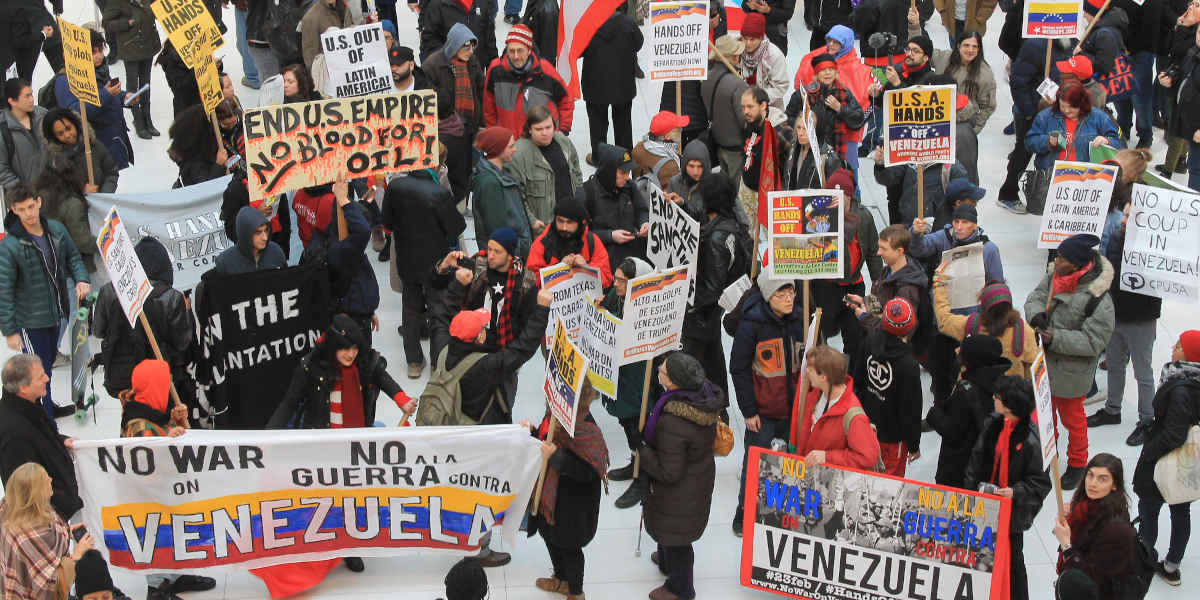
As world opinion turns against a US invasion of Venezuela, all of us must campaign for the UK to join the chorus and defend Latin America as a region of peace by calling for intensified solidarity with Venezuela in this extremely dangerous moment.