
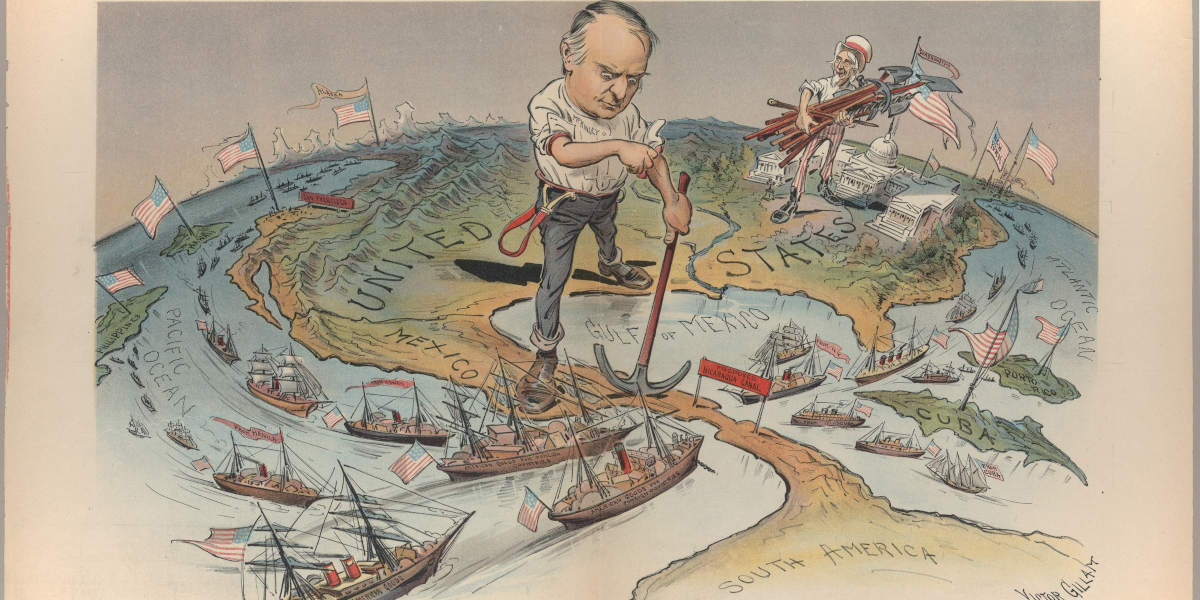
In a clear violation of international law, the Trump administration bombed Venezuela and effectively kidnapped its president on 3 January 2026. Photographs of a Latin American head of state handcuffed, blindfolded and bundled onto a plane were shocking, but not surprising. The actions follow a long history of US interventions in the region, including repeated invasions, occupations and support for coups and repressive regimes.
An expansionist doctrine
After the recent US action in Venezuela, President Trump evoked the Monroe Doctrine, the 1823 proclamation by President James Monroe warning European countries to stay out of the Western Hemisphere, effectively staking out Latin America as a United States ‘sphere of influence’.
Originally a defensive posture against European colonial powers, the doctrine was updated in 1904, by President Theodore Roosevelt’s Corollary, to explicitly justify US military intervention in the region. ‘Chronic wrongdoing’ in Latin America, he wrote, might require intervention by a ‘civilized nation’.
The change in posture reflected a growing US confidence, which followed its enormous westward expansion in the nineteenth century. In 1848, after the Mexican-American War, it increased its territory enormously by annexing more than half of Mexico. Current US states California, Nevada, Utah, Arizona, New Mexico and Texas used to be part of Mexico, as did parts of Colorado, Wyoming, Kansas, and Oklahoma.
In the early twentieth century, the United States repeatedly invaded and occupied countries in the Central America and the Caribbean, to install or support governments conducive to the interests of the US state and US companies. Since proclaiming the Monroe Doctrine, the US has intervened militarily in Latin America more than 80 times.
Murderers and acquisitions
In 1898, the USA acquired the Philippines, Guam and Puerto Rico from Spain, making it a global power. These territories were annexed without any representation from the countries concerned, two of which had been fighting for independence from Spain during the years prior. In the same year, the United States sent troops to Cuba ostensibly to support its own independence struggle against Spain. US marines, however, stayed after Cuba became independent. In 1901, US Congress inserted an amendment into the Cuba’s constitution that effectively made it a protectorate of the USA.
As the US emerged as a global trading power, it wanted to build a route linking its Atlantic and Pacific interests. Panama, the thinnest country on the Central American isthmus was the perfect location, but in 1903 it was part of Colombia. When the Colombian congress rejected The Hay-Herrán Treaty, the US plan to build a canal, Roosevelt fomented a successionist uprising, sent troops to support it and then recognised Panama as an independent country.
Fifteen days later, they signed the Panama Canal treaty, handing the US – ‘in perpetuity’ – a ten-mile strip that stretched across the whole country. US leaders later installed an army training school, the School of the Americas (SOA), in the Panama Canal Zone, teaching thousands of Latin American officers counterinsurgency and interrogation techniques. Several SOA alumni went became murderous dictators, including Panama’s Manuel Noriega.
Mid-century mercenaries
During the Cold War, the United States backed a wave of repressive regimes and undermined or ousted democratically-elected presidents who sought to redistribute wealth and land across a region with the world’s highest rates of inequality.
The 1954 overthrow of the elected president of Guatemala, Jacobo Arbenz, was a seminal moment. Arbenz was a moderate who proposed land reform in a country that was dominated by vast fruit plantations owned by US company United Fruit. Dwight Eisenhower’s government authorised the CIA to remove Arbenz, following a plan now declassified and published on the Agency’s website.
The CIA recruited and trained a mercenary force to invade the country and launched a psychological warfare campaign of misinformation while bombing of strategic sites in Guatemala. A chance at peaceful reform was destroyed, and Guatemala plunged into decades of authoritarian rule and civil war.
Since proclaiming the Monroe Doctrine in 1923, the United States has intervened militarily in Latin America more than 80 times
The United States also offered support to military coup-plotters who overthrew the left-wing elected president of Brazil, João Goulart in 1964. A year later, Lyndon B. Johnson’s administration invaded the Dominican Republic to prevent left-winger Juan Bosch from returning to power (he’d been elected president, then ousted by the military).
In Chile, Richard Nixon’s government helped oust President Salvador Allende, elected in 1970, whose promise of a ‘peaceful road to socialism’ had inspired millions across Latin America. Henry Kissinger, the US National Security Advisor at the time remarked: ‘I don’t see why we need to stand by and watch a country go communist due to the irresponsibility of its own people.’
The disappeared decades
By the late 1970s, most South American countries – including Brazil, Paraguay, Uruguay, Chile, Bolivia and Argentina – were ruled by dictatorships backed by the United States. The military regimes in Argentina and Chile were responsible for the ‘disappearance’ of thousands of citizens and the torture of tens of thousands of people.
During the 1980s, the Reagan administration trained and funded a mercenary force to undermine a left-wing government in Nicaragua, while funding and training repressive militaries in Honduras, El Salvador and Guatemala.
The US invaded Grenada in 1983 (to oust a once popular but increasingly repressive government) and sent 26,000 troops to Panama in 1989, under George H W Bush, to remove the dictator, Manuel Noriega. The one-time ally of the US and the CIA’s highest-ranking asset in Latin America had outlived his usefulness to Washington.
2026: the ‘Donroe’ doctrine?
In its recently-published National Security Strategy, the Trump administration has re-asserted the Monroe Doctrine in its crudest form, brazenly asserting its right to Latin America’s natural resources. It aims to ‘to restore American pre-eminence in the Western Hemisphere’ and deny ‘non-Hemispheric competitors’ the ability to ‘to own or control strategically vital assets in our Hemisphere.’
While previous US interventions have been justified with lofty-sounding rhetoric about promoting democracy or freedom, Trump has made clear he is interested in Venezuelan oil – elections will not be held for a ‘long time’. In overtly colonialist language, he says the US will ‘run’ Venezuela, selling its oil and putting the proceeds in a US-controlled bank account.
The US strategy is now, in the words of House speaker Mike Johnson, to ‘coerce’ the incumbent government to open up the oil sector on terms favourable to the US. The coercion takes the form of threats of renewed military action and a naval blockade on Venezuelan oil – illegal under international law – which is bringing the economy close to collapse.
What next for Venezuela?
US antagonism towards Venezuela goes back to the late 1990s, when socialist Hugo Chavez was elected president, promising to use Venezuela’s oil wealth to reduce poverty. Chavez won three landslide elections and in the early years used oil revenues to fund a raft of social programmes. Tens of thousands of Venezuelans joined grassroots movements as part of his Bolivarian revolution. In 2002, the US supported a botched attempt to oust Chavez.
Chavez popularity was waning by the 2010s and under his successor Nicolas Maduro,the Venezuelan government became increasingly authoritarian. The military took on a more prominent role, opposition parties were banned and the 2024 presidential elections were widely believed to be fraudulent. In the aftermath, the government detained 2,000 protesters without charge.
Today in Venezuela there is a broad, heterogenous opposition which spans the US-backed right to left-wing and centrist groups. The latter two factions are very strongly opposed to US intervention. Some grassroots movements still support the Bolivarian project. The US operation removed Maduro but left the rest of his ministers in place. Venezuelans who hoped for fresh elections or a peaceful transition by looking to the United States have been left disappointed. Given US history, they should not be surprised.

